
The New Geography of Power

Ninety per cent of the world’s rare earths are refined in one country. By 2030, America will burn more electricity thinking than it does making steel. The map is being redrawn — in concrete, in copper, and in the dark.
At three in the morning
the Strait of Gibraltar does not sleep. It glitters.
From the control tower at Tanger Med, the water below is a moving grid of light: the running lamps of container ships queued nose to tail, each the length of four football pitches, sliding through a channel nine miles across at its narrowest. They do not stop. They are threading the eye of a needle that joins the Atlantic to the Mediterranean, Europe to Africa, the factories of Guangdong to the shelves of Hamburg.
The duty officer has done this for eleven years. On his screen each vessel is a green triangle with a name and a flag. Maersk. CMA CGM. Hapag-Lloyd. He remembers when the terminals were half empty. He remembers when the ships came, but not in these numbers, and not with this hunger.
Last year the four terminals below him handled a little over eleven million containers. The port moved 161 million tonnes of cargo. It received more than thirteen hundred vessels longer than 290 metres — a class of ship that barely existed when he started. It now connects to a hundred and eighty ports in seventy countries.
Twenty years ago there was nothing here. Scrub, a fishing village, and a view of Spain.
That is the first thing to understand about the new geography of power: it is not a metaphor.
It is poured concrete and dredged seabed. It is high-voltage cable and rare-earth oxide. It is being built right now, in places most of the world has never heard of, and the map it produces will not look like the one we grew up with.
◆ ◆ ◆
THE CHOKEPOINT NOBODY WAS WATCHING
Ask a room of executives where the world’s strategic chokepoints are and you will hear the same four answers. Hormuz. Malacca. Suez. Panama. All correct. All incomplete. All, in a certain sense, answers from the last century.
The chokepoints that decide things in 2026 are not straits. They are processing steps.
Take rare earths, which have become the clearest illustration of the new topology. The popular understanding is that China has the minerals. This is only partly true. Rare earths are not, despite the name, especially rare; deposits sit in Nevada, in Australia, in Brazil, in Greenland. What China has is the industrial capacity to separate them.
Separation is a chemistry problem of extraordinary tedium. Seventeen elements with nearly identical ionic radii, teased apart across hundreds of sequential solvent-extraction stages, in facilities that smell of acid and run on margins that would embarrass a cement plant. It is difficult, filthy, capital-hungry and profoundly unglamorous — which is precisely why the West, over four decades, was content to let it go.
The result is a structure in which China accounts for roughly seventy per cent of production but close to ninety per cent of refining. On current projections, by 2035 it will supply more than sixty per cent of the world’s refined lithium and cobalt, and around eighty per cent of its battery-grade graphite and rare earths.
And then Beijing did something that most Western analysts, still watching the mines, did not fully register.
It moved downstream.
Dysprosium- and terbium-enhanced permanent magnets are the components that make a high-performance electric motor turn and a missile find its target. They are now a second chokepoint, and Western investment has barely begun to address it. You can open a mine in Nevada. You can, at considerable expense, build a separation plant. Neither of those gets you a magnet.
The consequence stopped being theoretical in the first half of this year. Between January and June, the price of neodymium-praseodymium oxide rose sixfold. Tungsten concentrate tripled. Antimony doubled. European defence contractors began reporting, quietly and then less quietly, that they could not source the magnets their guidance systems required. More than four in five European companies depend on Chinese supply chains for the minerals that go into their defence systems, their electric vehicles and their wind turbines.
There is an arithmetic underneath all of this, and it is the most important set of numbers in this story.
A new refinery takes about two years to come online. A new mine takes several years more. Rebuilding a complete, independent supply chain — extraction, separation, refining, magnets, recycling — is estimated at twenty to thirty years.
The geopolitical window is estimated at twelve to eighteen months.
The West is trying to build a twenty-year answer inside an eighteen-month window. Everyone knows this. Almost nobody will say it out loud.
What they have done instead is spend. In February, Washington convened fifty-four countries and the European Commission for a critical minerals ministerial, launched a new forum with an acronym, and announced more than thirty billion dollars in support. Eleven bilateral frameworks were signed in a single day, with Argentina, Guinea, Peru, the Philippines, Uzbekistan — and Morocco. Two days earlier the Export-Import Bank had unveiled Project Vault: a direct loan of up to ten billion dollars to build a strategic reserve, more than double the largest financing in the bank’s history.
Brussels selected sixty strategic projects under its Critical Raw Materials Act, with a new and welcome emphasis on processing rather than digging.
This is not nothing. By the standards of Western industrial policy it is remarkable. And it does not close the gap.
Producing rare-earth oxides in the United States costs roughly seventy per cent more than in China, even after you strip out the price of the raw material. That is not a subsidy problem. It is a problem of scale, of forty years of accumulated process knowledge, and of what a society is willing to tolerate downwind of a separation plant.
Meanwhile, the architecture on the other side has not been dismantled. It has been paused. The most aggressive Chinese measures — introduced last October and modelled, pointedly, on America’s own Foreign Direct Product Rule — are suspended until November of this year, alongside a reciprocal American suspension. But the earlier controls remain in force. On the first of January, Beijing quietly widened its export licensing catalogue. At the end of March, a State Council order folded export controls, countermeasures, data security and investment screening into a single national-security framework.
China suspended the use of the weapon. It did not suspend the weapon.
◆ ◆ ◆
THE MACHINE HAS A BODY
There is a persistent fantasy about artificial intelligence, and it is that AI is made of mathematics.
It is made of buildings.
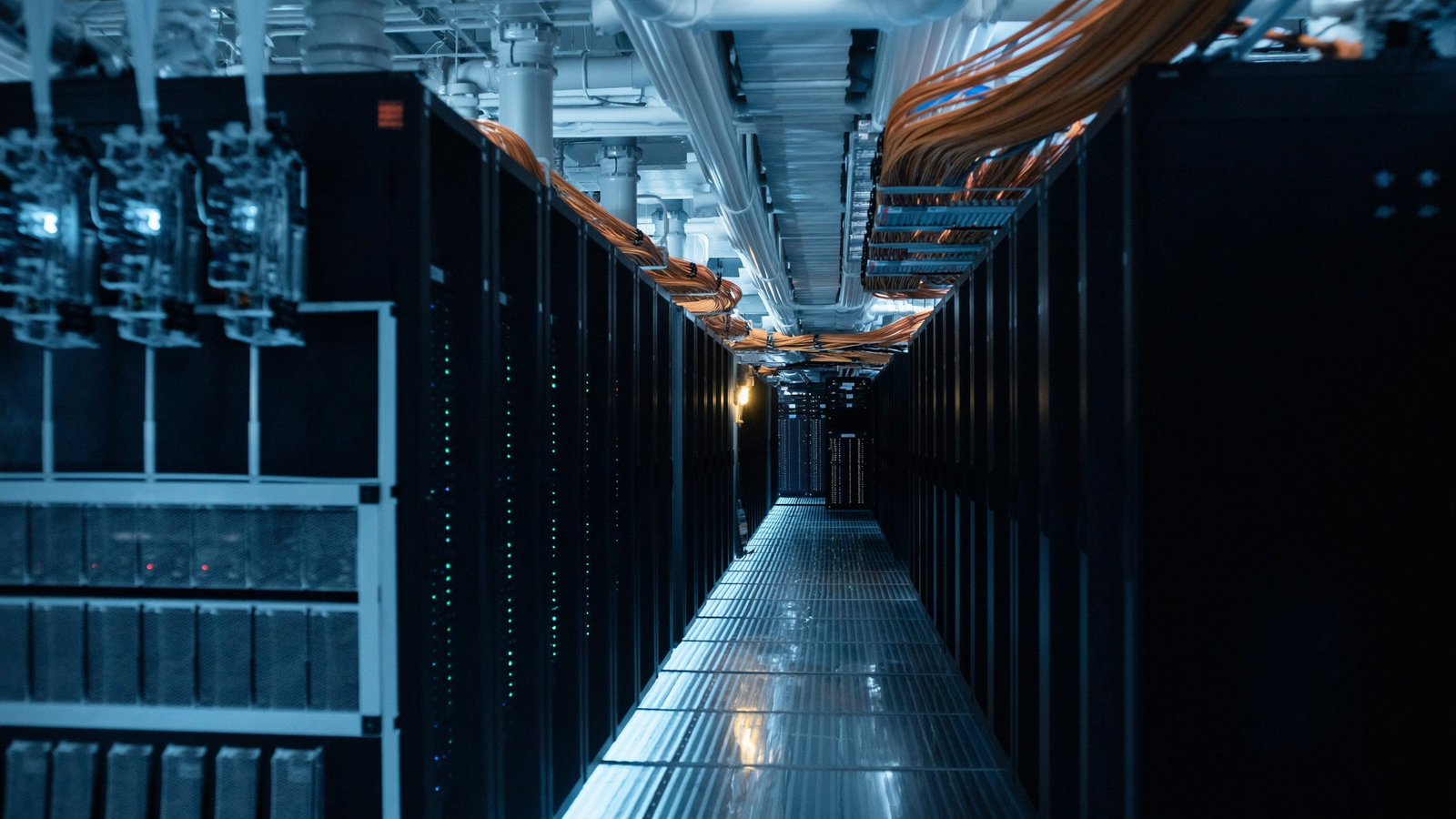
A model is trained and served inside a data centre: a windowless industrial shed containing racks of accelerated servers, a cooling plant, an electrical substation and, increasingly, its own power station. It drinks electricity on the scale of a small city. It drinks water. It eats copper, steel, gallium and rare-earth magnets. It is, by any honest engineering definition, heavy industry.
The numbers have stopped being abstract. The world’s data centres consumed around 415 terawatt-hours in 2024 — about one and a half per cent of global electricity. The International Energy Agency projects that this will more than double, to roughly 945 terawatt-hours by 2030. That is slightly more than Japan uses in a year. Consumption is climbing at fifteen per cent annually, more than four times faster than demand from every other sector combined.
The distribution is what turns an engineering fact into a geopolitical one. The United States and China together account for nearly eighty per cent of the projected growth. And within America the concentration is sharper still: data centres are on course to account for almost half of all electricity demand growth this decade. By 2030, on the IEA’s projection, the American economy will consume more electricity processing data than it does manufacturing aluminium, steel, cement and chemicals — combined.
By 2030 the United States will spend more electricity thinking than it does making things.
Read that twice. It is one of the strangest sentences in modern industrial history, and it was arrived at without a vote, a white paper, or a moment of public deliberation.
The binding constraint, therefore, is not chips. It is the grid. Up to a fifth of planned data centres could face delays simply connecting to the electricity network. A typical facility draws as much power as a hundred thousand households. The largest campuses now going up will demand twenty times that.
The strain is already visible in the places that host them. In Loudoun County, Virginia, data centres consumed twenty-one per cent of the county’s power in 2023 — more than every home in it. The following year, a minor electrical disturbance in neighbouring Fairfax caused sixty data centres to flip simultaneously onto backup generation, shedding some 1,500 megawatts of load. That is roughly the entire electricity demand of Boston, dropped from the grid in an instant. It came uncomfortably close to a cascade.
The machine has a body. The body is fragile. And nobody voted for it.
There is a further turn of the screw, and it closes the circle back to the mines. Gallium is essential to compute chips and power electronics. It is refined almost entirely in China — something on the order of ninety-nine per cent of global supply. Data-centre demand alone could swallow more than a tenth of that supply by the end of the decade.
So the AI boom requires chips. The chips require gallium. The gallium comes from the country whose leverage the AI boom was partly meant to reduce.
This is not irony. It is topology.
◆ ◆ ◆
THREE CHOKEPOINTS, ONE ISLAND
The public conversation about semiconductors has a geography problem. It stops at Taiwan.
Taiwan matters enormously. But the silicon chain has at least three chokepoints and Taiwan is merely the most visible. The second is Dutch: one company in the world builds the extreme-ultraviolet lithography machines without which leading-edge fabrication is simply not possible. The third is Japanese and chemical — photoresists, ultra-pure gases, specialty substrates. Narrow markets. Very few suppliers. Enormous consequence.
Block any one of the three and the chain stops.
This is why the CHIPS Act, for all its ambition, cannot by itself solve the problem it was written to solve. TSMC’s Phoenix campus — three leading-edge fabs, each larger than two million square feet, underwritten by billions in federal grants and loans — relocates the fabrication step. It does not relocate Veldhoven. It does not relocate the photoresist plants of Japan.
Sovereignty over one link in a chain of four is not sovereignty. It is a very expensive form of reassurance.
◆ ◆ ◆
THE SLOWEST REVOLUTION
Every energy transition in history has taken longer than its champions promised and arrived more completely than its sceptics believed. Coal did not replace wood in a decade. Oil did not replace coal in a generation. The pattern is neither triumph nor collapse. It is accretion, punctuated by long plateaus that feel, from the inside, like stagnation.
We are standing on one, and it is generating a great deal of bad analysis in both directions.
The data-centre buildout shows the tension precisely. Renewables today supply around twenty-seven per cent of the electricity that data centres consume; the IEA expects that to reach roughly half by 2030, driven by wind and solar. That is real, and it is fast. But over the same period, gas generation for data centres is projected to grow by some 175 terawatt-hours — much of it in America, where new gas plants are being built specifically to feed compute campuses behind the meter.
Both things are true at once. The grid is getting cleaner, and fossil generation is expanding to serve a new load. Anyone who tells you only one of those is selling you something.
The deeper constraint is physical, and it is the one the industry least wants to discuss. High-capacity transformers have order books stretching years out. Transmission lines run into permitting regimes designed for a world of flat demand, and can take over a decade to approve in the United States or the European Union. In the same window, China added more than four hundred gigawatts of new generating capacity in a single year.
You cannot compute your way out of a copper shortage. You cannot legislate a transformer into existence. The energy transition is, at bottom, a manufacturing and permitting problem wearing the costume of a technology problem.
◆ ◆ ◆
COURTED, NOT CONQUERED
Africa is being courted with an intensity not seen in half a century, and the instruments have changed. There are no gunboats. There are memoranda of understanding, land reservation agreements, concessional finance packages, and framework partnerships with acronyms.
This is progress, and it should be named as such. It is also, seen from a longer distance, familiar.
The continent’s leverage is real. It holds sixty-five per cent of the world’s uncultivated arable land and mineral reserves without which the energy transition simply does not happen. It is the fastest-urbanising region on earth. And, for the first time in the modern era, it has more than one suitor. Guinea, Zambia, Morocco and the Congo are not choosing between a coloniser and independence. They are choosing between Washington, Brussels and Beijing — each of which needs something they have.
That is a materially different position from the one their grandparents occupied, and it is worth saying so.
But the question that decides whether this becomes an African century or another African extraction is not who invests. It is where the value settles.
Here the data is bleak. Africa’s data-centre electricity consumption stands at under one kilowatt-hour per person, rising to a little under two by 2030. The American figure is around five hundred and forty, on its way past twelve hundred. That is a ratio of several hundred to one. On current trajectory, the continent that supplies the cobalt is not the continent that runs the compute.
The history of African commodities is a long procession of promises about local beneficiation. Some were kept — Botswana’s diamond sector remains the standing rebuttal to every fatalist in the room. Most were not. And what separates the two is not geological luck. It is institutional sequencing: whether the sovereign fund, the fiscal rule and the negotiating capacity exist before the boom arrives, rather than being promised during it.
For the states signing minerals frameworks this year, that window is open now. It will not be open indefinitely.
◆ ◆ ◆
THE LABORATORY ON THE SOUTHERN SHORE
If the new geography of power has a natural laboratory, it is the strip of land between the Atlantic, the Strait and the Sahara.
Morocco’s position is not an accident of geology alone, though the geology is startling: the kingdom sits on roughly seventy per cent of the world’s phosphate rock, a resource on which global food security materially depends. But phosphate is the old story. What is being attempted now is more ambitious, and considerably more interesting.
Renault’s plant at Melloussa can build four hundred thousand cars a year. Last year Morocco shipped two hundred and twenty thousand vehicles to Europe, an eighteen per cent jump. At Kenitra, the Chinese firm Gotion is building Africa’s first battery gigafactory, with production scheduled to begin this autumn and capacity intended to scale fivefold. LG Chem and Huayou Cobalt are developing a cathode plant and a lithium refinery. In February the energy ministry opened three hundred and sixty-one exploration blocks across thirteen thousand square kilometres of the eastern desert.
The energy bet is larger still. Morocco has approved green hydrogen projects worth some thirty-two and a half billion dollars and set aside three hundred thousand hectares of public land for them. The investor list reads like a map of the multipolar world: an American-Spanish-German consortium, an Emirati-Spanish venture, a Saudi developer, a Chinese state group, and Morocco’s own Nareva. The logic is coherent — the kingdom imports around two million tonnes of ammonia a year for its fertiliser industry, and making that ammonia at home from green hydrogen would give it self-sufficiency, price stability, and a decarbonised product precisely as Europe’s carbon border tax begins to bite. Brussels wants to import ten million tonnes of renewable hydrogen by 2030.
Morocco is fourteen kilometres away.
Now the part the brochures leave out.
In 2024, coal still generated 59.3 per cent of Morocco’s electricity. The figure is falling — it stood near seventy per cent two years earlier — and the kingdom has committed to phasing coal out by around 2040, conditional on international climate finance arriving. Renewables account for roughly forty-five per cent of installed capacity against a 2030 target of fifty-two.
But installed capacity and generated electricity are not the same measure, and the gap between them is where the honest analysis lives.
A country that generates most of its power from coal while selling itself as a green hydrogen exporter is not lying. It is sequencing. But the sequence has to actually happen.
There is a further complication, and a serious magazine does not walk around it.
At least two of the land agreements signed in February relate to Western Sahara, a territory whose status is disputed and which the United Nations lists as non-self-governing. One consortium received land at Dakhla; another obtained land at El Aaiún for a four-and-a-half-billion-dollar green ammonia project — more than two gigawatts of wind and solar, some nine hundred megawatts of electrolysers, seawater desalination, a hundred thousand tonnes of hydrogen a year. In March of last year, eight UN special rapporteurs raised concerns about home demolitions linked to green energy expansion in the territory. Rabat frames the projects as development and regional integration; the Polisario Front and its supporters call them entrenchment. The legal questions remain live, and European courts have returned to them more than once.
We do not adjudicate that dispute here, and it would be presumptuous to try. But we will not describe a thirty-five-billion-dollar energy programme without noting that part of it sits on contested ground. Readers of this kind find out. A magazine that omits the difficulty is not reporting. It is advertising.
◆ ◆ ◆
FOUR FUTURES
Forecasting is a genre with an unblemished record of failure, so what follows are not predictions. They are shapes — ways the pieces might fall — offered so that a reader can recognise which one is arriving.
The first is a managed bifurcation. Two technology stacks emerge, imperfectly separated. Minerals, chips and standards circulate within blocs and are licensed, expensively, between them. Trade does not collapse; it becomes permissioned. Costs rise, structurally and permanently, and they are borne largely by the countries doing the reshoring. Middle powers with resources and neutrality — Morocco, Indonesia, Brazil, the Gulf — do extremely well, selling to both sides. This is the shape the current data most supports.
The second is a substitution break. Some laboratory produces a magnet without heavy rare earths, or a battery without cobalt, or a lithography path that does not require extreme ultraviolet — and a chokepoint simply evaporates. This is not fantasy. Lithium-iron-phosphate chemistry already displaced cobalt-heavy alternatives across much of the market, and Morocco’s phosphate reserves are a bet on that displacement continuing. The West’s real hedge is not a mine. It is a laboratory.
The third is a grid wall. The energy constraint binds before the geopolitical one resolves. Compute growth slows — not because of policy, but because transformers and transmission lines and permitting officers cannot keep up. In this future, the countries that capture the AI industry are not the ones with the best models. They are the ones with spare generating capacity and a functioning planning system. This scenario is badly under-priced.
The fourth is a reordering. November passes without resolution. Controls resume in full. Prices, already elevated sixfold in some materials, dislocate further. Industrial democracies face a choice between accelerated mobilisation and accommodation — and history suggests that states in this position choose accommodation, and give it another name.
Nobody is planning for the fourth. Which is, as a rule, why the fourth tends to happen.
◆ ◆ ◆
THE TOWER AT THREE IN THE MORNING
Return to the control tower above the Strait.
The officer on duty is watching green triangles cross a screen. He is not thinking about China’s fifteenth Five-Year Plan, or the price of neodymium-praseodymium oxide, or whether America will spend more electricity thinking than making. He is thinking about berth seven, and whether the vessel inbound from Algeciras will hold its slot.
And yet the entire architecture of the coming century passes beneath his window, in containers, every night.
This is what the phrase means, when you strip the abstraction from it. Not a summit. Not a doctrine. A port that did not exist twenty years ago, now moving eleven million containers a year. A field in Texas where six thousand people are assembling a machine that will drink the electricity of a city. A separation plant somewhere in Inner Mongolia, performing a chemistry so tedious that the West gratefully handed it over — and in handing it over, handed over rather more than it understood.
The states that will do well in the decades ahead are not the ones with the finest rhetoric about resilience. They are the ones that noticed, early, that power had become physical again — that it now lives in refineries and transformers and berths and export licences — and that started building before it was obvious they would need to.
Some of them are small. Some of them are on the southern shore of a strait nine miles wide.
The map is being redrawn. It always is. The only question that has ever mattered is who is holding the pen.