

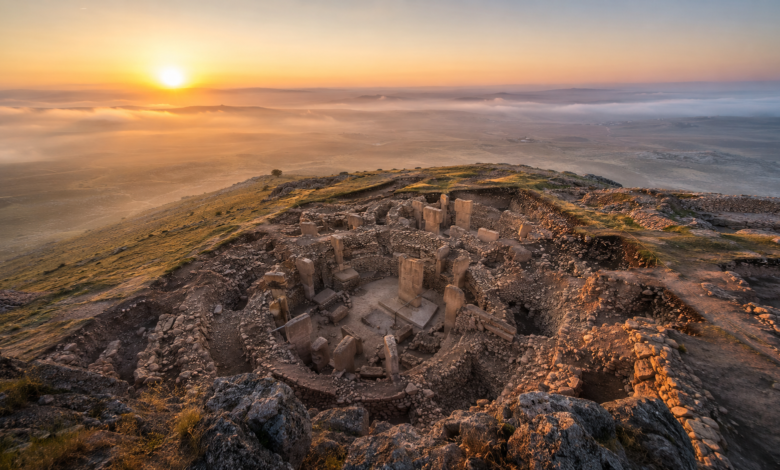
Long before the erection of Stonehenge or the Great Pyramids of Egypt, nomadic tribes of hunter-gatherers raised a forest of megaliths on a barren hill in what is now southeastern Türkiye. Their titanic work, frozen in stone for 12,000 years, forces us today to ask a staggering question: what if the human quest for the sacred preceded—and even provoked—the birth of civilization? A deep dive into the greatest archaeological upheaval of our century.
I. THE ANOMALY ON THE HIGH PLATEAU
The morning wind sweeping across the limestone plateau of the Şanlıurfa province, at the edges of the Fertile Crescent, is bitter and heavy with red dust. Here, the landscape offers a silent, almost lunar vastness, broken only by the distant call to prayer or the circling flight of a bird of prey. But beneath this arid earth, under a hill the locals call Göbekli Tepe (“Potbelly Hill”), slept a secret capable of shattering our understanding of human evolution.
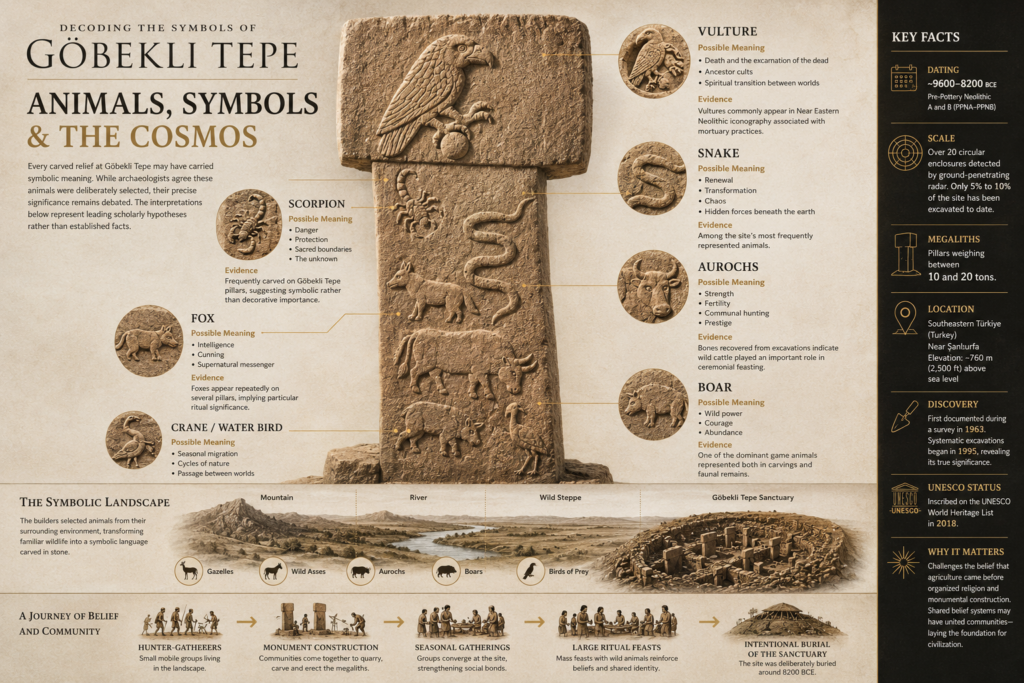
When you step beneath the massive protective canopies of the archaeological site today, the air seems to freeze. Before you stand colossal limestone pillars, carved into a distinct T-shape, some reaching over 18 feet (5.5 meters) high and weighing nearly twenty tons. They are arranged in perfect circles, forming vast megalithic enclosures. On their smooth flanks, a terrifying menagerie has been sculpted in low relief with unsettling precision: stalking foxes, scorpions, vultures with outspread wings, and menacing boars.
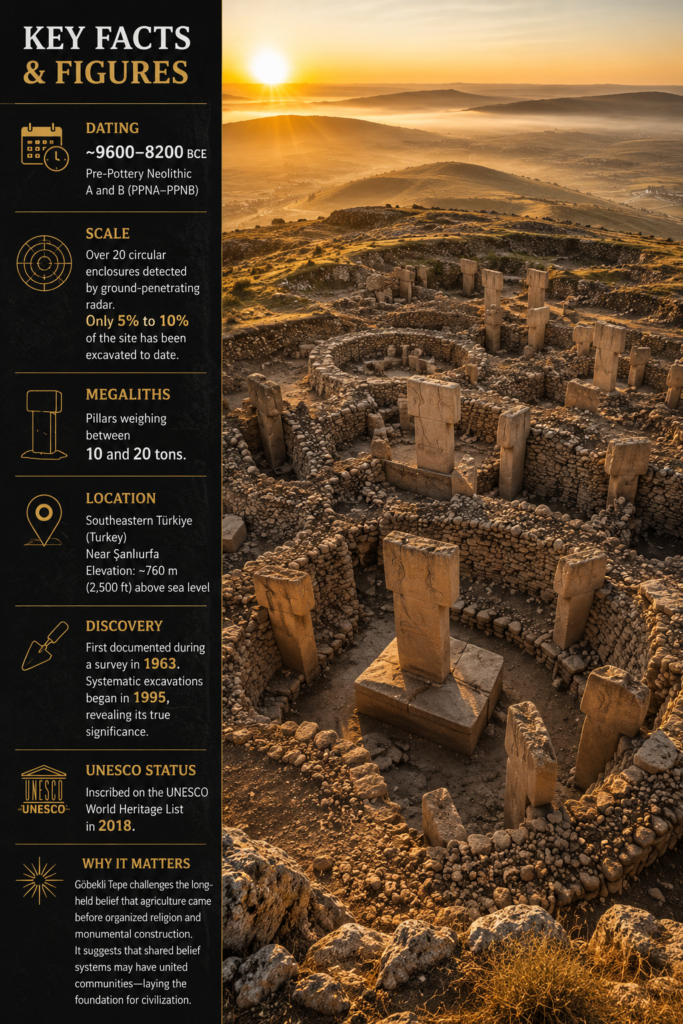
The vertigo comes not just from the raw beauty of the site, but from its timeline. Radiocarbon dating is absolute: this complex was erected more than 11,600 years ago, plunging us into the 10th millennium BCE.
This was an era when the Earth was barely emerging from the last Ice Age. The humans who quarried, transported, and raised these stone giants knew neither the wheel, nor writing, nor pottery, nor metallurgy. Most incredibly: they did not know agriculture. According to every 20th-century history textbook, this place simply should not exist. Stone Age hunter-gatherers were supposed to live in small, egalitarian nomadic bands, fighting for daily survival, incapable of the large-scale cooperation required to conceive monumental architecture. Yet, the stones are there, defying time and our certainties.
“Göbekli Tepe is not just an archaeological discovery; it is a philosophical earthquake. It is the smoking gun proving that human imagination outpaced human technology.”
II. THE COLLAPSE OF A PARADIGM
To measure the shockwave caused by Göbekli Tepe, one must understand the dogma it overturned. For decades, the narrative of our origins followed a ruthless logic, formalized in the 1930s by the illustrious Australian prehistorian V. Gordon Childe under the term “Neolithic Revolution.”
Childe’s model was mathematically elegant: at the end of the Ice Age, global warming forced humans to seek new food sources. They invented agriculture. Fields of wheat and barley generated food surpluses. These surpluses supported larger populations, forcing nomads to settle in the first permanent villages. Sedentary life bred property, then social hierarchy, then the division of labor. It was only at the very end of this process—once bellies were full and city walls were built—that humanity could afford the “luxury” of organized religion, financing priests and building monumental temples.
In this equation, the temple is the final product of the city. Material survival precedes spiritual elevation.
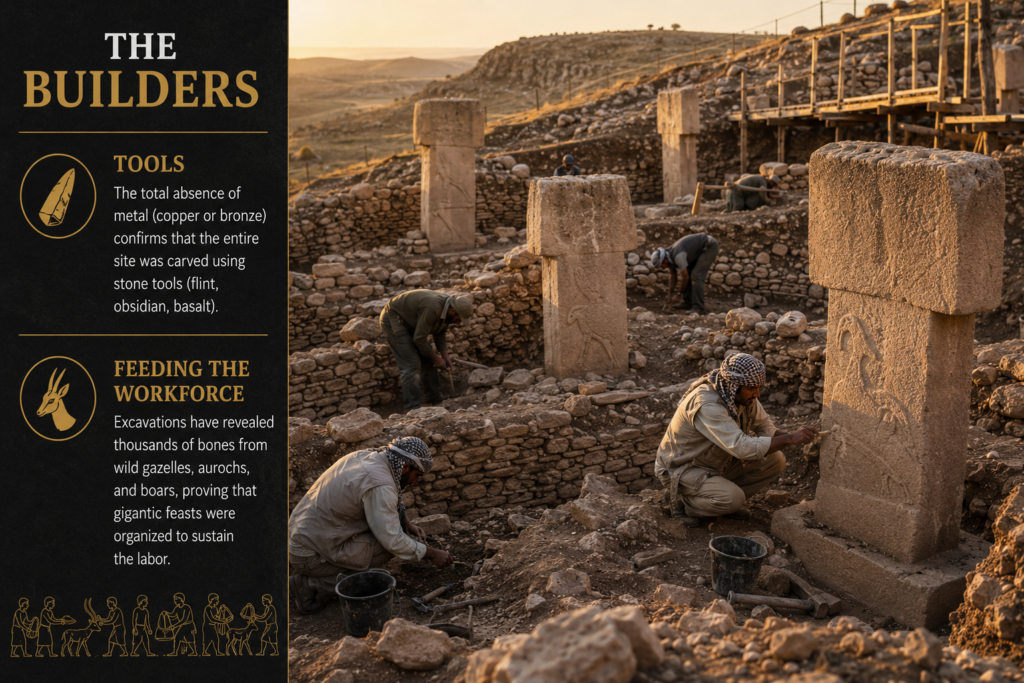
But Göbekli Tepe entirely inverts the arrow of time. The site predates the earliest traces of sedentary agriculture in the region by centuries, if not millennia. The builders of these stone circles had no granaries. They fed on wild gazelles, pistachios, and almonds harvested from the steppe. The idea that roaming populations, carrying all their possessions on their backs, could conceive such a project violated the fundamental laws of prehistoric economics.
[INFOGRAPHIC SPACE / ART DIRECTION]
Visual Concept: A full-page infographic comparing the classic model (Childe) with the inverted model (Göbekli Tepe). A horizontal axis shows the progression of time. Top: The old model (Agriculture ➔ Village ➔ Hierarchy ➔ Temple). Bottom: The new paradigm (Temple ➔ Mass Cooperation ➔ Food Scarcity ➔ Agriculture).
III. KLAUS SCHMIDT’S REVELATION
The story of this scientific revolution is inextricably linked to one man: Klaus Schmidt. In reality, the site had already been surveyed in 1963 by a joint team from the Universities of Istanbul and Chicago. The American archaeologist Peter Benedict noted anomalous mounds and a profusion of flint tools, but he wrongly concluded that the exposed limestone slabs belonged to an obscure, abandoned Byzantine cemetery.
It took until 1994 for the destiny of the hill to shift. Klaus Schmidt, a prehistorian attached to the German Archaeological Institute (DAI), was looking for a new site to excavate. While reading the old reports from the 1963 expedition, a detail caught his attention. He traveled to the site.
Under the crushing heat of the Anatolian autumn, Schmidt walked the hill. His trained eye immediately spotted what Benedict had missed. The density of flint flakes on the ground was astronomical, betraying not a late cemetery, but a prehistoric workshop of unprecedented scale. When he rested his hand on the limestone top of a pillar barely protruding from the dusty earth, the truth struck him with the violence of a revelation.
“Within a minute of first seeing it,” he would confide years later with his eternal modesty, “I knew I had two choices: go away and tell nobody, or spend the rest of my life working here.”
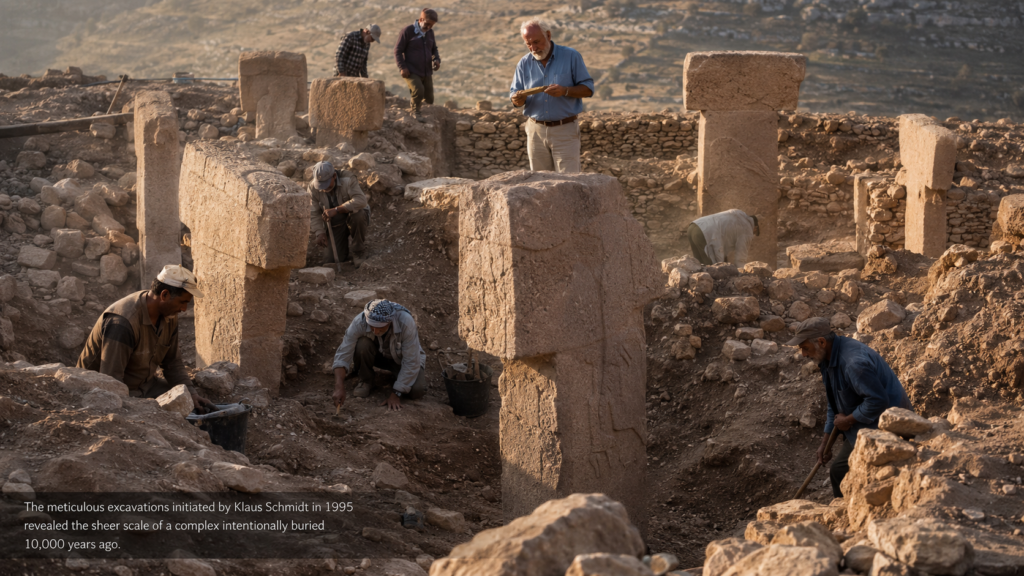
Excavations began in 1995. Very quickly, trowels and brushes revealed structures that had nothing to do with Byzantium. By clearing “Layer III,” the oldest stratum, Schmidt’s team unearthed the formidable megalithic enclosures. The global archaeological community held its breath.
IV. THE LOGISTICAL MIRACLE OF ICE AGE ARCHITECTS
To stand today at the center of Enclosure D, the best-preserved on the site, is to confront a mystery of engineering. The two central pillars rise majestically, surrounded by a circular wall integrating smaller pillars.
How did scattered groups of hunter-gatherers coordinate such a construction site? The answer lies a few hundred yards away, on the limestone plateau where the quarries are located. The local limestone is relatively soft. Armed with simple flint picks and basalt hammers, the quarrymen carved the monoliths directly out of the bedrock in situ.
Once a pillar was freed, the real logistical nightmare began. Modern archaeological experiments estimate that it takes a minimum of 50 to 75 adult men, coordinating their efforts perfectly, to move a 15-ton block using wooden levers, braided ropes, and rollers.
If we add the stonemasons, the artisans carving the bas-reliefs, the hunters tasked with bringing back meat to feed the workers, and the shamans or priests directing the rituals, the necessary workforce numbers in the hundreds, perhaps thousands of individuals. To gather such a crowd in the pre-agricultural era, they had to overcome tribal rivalries, establish a common language (or at least a complex communication system), and possess a spiritual motivation of unprecedented power.
“They had no wheels. They had no beasts of burden. They had only flint, wood, and a staggering capacity for collective intelligence.”
V. FACELESS GIANTS AND THE ENCYCLOPEDIA OF STONE
But who do these limestone colossi represent? Modern archaeology offers an answer as fascinating as it is eerie: they are deities or primordial ancestors, deliberately represented without faces.
The T-shape is not accidental. It represents a highly stylized human being. On several central monoliths, anatomical details carved in low relief confirm this thesis: one can clearly make out long, thin arms extending down the sides of the shaft, ending in hands with slender fingers that cross over the belly, just above an engraved belt. From this belt hangs a loincloth, very often depicted as a fox pelt draping down between the legs.
Yet, the upper part, which serves as the head, is systematically smooth and blank. In shamanic beliefs, to represent a face is to summon the spirit of a mortal individual. By keeping these giants anonymous, the Neolithic artists rendered them as cosmic, universal entities, dominating the collective psyche of all assembled tribes.
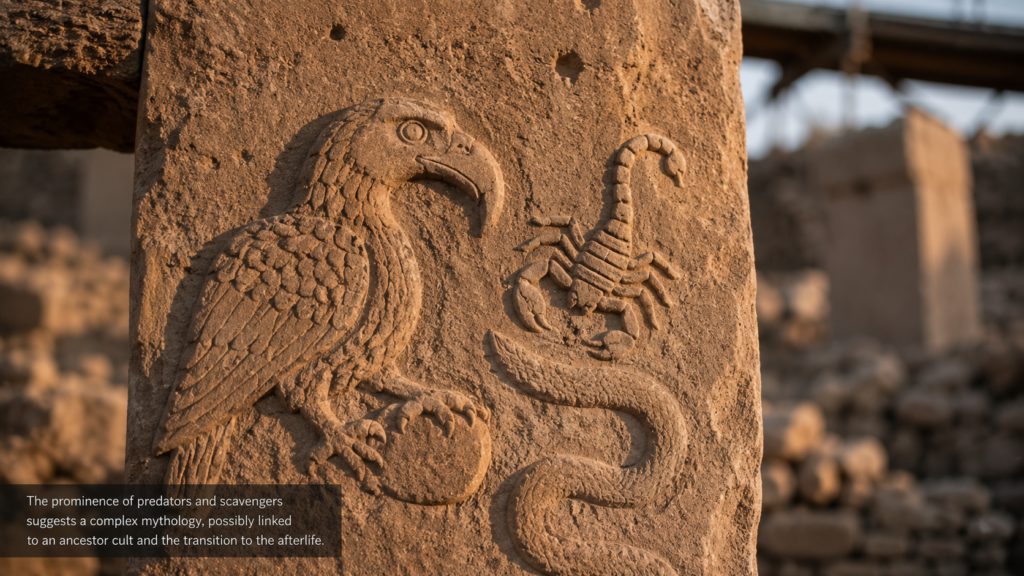
If the giants are silent, they are, however, covered in a tumultuous fauna. Göbekli Tepe is a veritable zoological library carved in stone. The bas-reliefs swarm with undulating snakes, spiders, foxes, snarling boars, and vultures. A remarkable zooarchaeological paradox: the builders did not depict the game they ate (the gazelle is almost entirely absent from the site’s art), but rather terrifying, venomous, or scavenging predators.
The vulture, in particular, occupies a central place. In later Neolithic cultures of the region (such as at Çatalhöyük), this bird was the agent of excarnation—the sacred process by which birds stripped flesh from corpses to release the soul. The stones of Göbekli Tepe do not tell tales of hunting; they scream a mythology of death, transition, and apotropaic (evil-averting) protection.
VI. DID RITUAL BIRTH AGRICULTURE?
It is here that Klaus Schmidt’s revolutionary hypothesis takes on its full magnitude. For him, the hill was a regional pilgrimage center, a “Vatican of the Stone Age.” Hunter-gatherers converged there from hundreds of miles around.
However, gathering thousands of individuals to carve stone and celebrate rituals poses a mathematical problem: they must be fed. The wild resources of the region, though abundant, were no longer sufficient to support these massive, recurring gatherings. The obligation to produce an astronomical amount of food for these ritual feasts (known as feasting theories in archaeology) would have created a sudden, fierce evolutionary pressure.
To meet this divine demand, tribes would have begun protecting patches of wild wheat (einkorn), then selecting the best seeds, thus empirically inventing agriculture. Modern genetic analysis gives an unsettling echo to this theory: the genetic ancestor of all strains of domestic wheat in the world has been located in the Karaca Dağ mountains… barely 20 miles from Göbekli Tepe.
Devotion created the need. Need forced the invention.
Admittedly, since Schmidt’s tragic death in 2014, new excavation teams have nuanced his claims. The recent discovery of rainwater cisterns and probable domestic structures suggests the site was not only ceremonial, but may have housed a flourishing sedentary population. Nevertheless, this only reinforces the central idea: it was the social and spiritual organization around megalith-building that catalyzed sedentarization, not the other way around.
VII. THE GREAT BURIAL AND THE CIVILIZATION OF THE STONE HILLS
Around 8200 BCE, the monumental story of Göbekli Tepe abruptly stopped. The immense stone circles were buried under thousands of tons of earth, animal bones, and limestone rubble.
Was this an intentional ritual burial, as Schmidt believed, marking the “death” of a temple that had fulfilled its sacred cycle? Or was it, as current geoarchaeologists suggest, the result of slow natural erosion (colluviation) that saw earth slide from settlements higher up the hill to fill the enclosures below? Regardless, this backfill acted as a miraculous time capsule, preserving the pillars from wind erosion and human vandalism for a hundred centuries.
But Göbekli Tepe is no longer alone. It is not a unique anomaly generated by isolated minds.
The Turkish government is currently orchestrating the Taş Tepeler (“The Stone Hills”) project. Archaeologists are unearthing a dozen sister sites scattered over a 120-mile radius (including Sefer Tepe, Sayburç, and most notably, Karahan Tepe).
At Karahan Tepe, the art undergoes a spectacular mutation. Animals give way to three-dimensional human faces emerging from the bedrock, staring down a procession of phallic pillars. Researchers have even discovered hydraulic engineering systems and solar alignments suggesting astronomical observations during the winter solstice. We are no longer facing a simple sanctuary, but the ruins of an authentic Stone Age civilization, unified by common engineering, iconography, and spirituality.
“Göbekli Tepe was the cultural and spiritual capital of a hunter-gatherer civilization we had never imagined.”
VIII. EPILOGUE: REDEFINING HUMANITY
The lesson bestowed upon us by the Turkish hill goes far beyond archaeology; it is anthropological. For a century, fascinated by our own technological prowess, we thought ancient humanity was cynical and purely pragmatic. We believed our ancestors could only look up at the sky, or dream of building giants, once their stomachs were filled by the technology of the plow.
The mineral echo of Göbekli Tepe tells us exactly the opposite. The capacity for wonder, the need to weave unifying myths, the fierce impulse to carve the invisible into stone are not “by-products” of our modern comfort. They are the thermal engine of our species.
It is because these tribes wanted to touch the sacred that they gathered. It is because they gathered that they had to innovate, to sow, and to structure themselves. In the shadow of these T-shaped giants, the conclusion imposes itself, vertiginous in its humanity: it is not civilization that shaped our beliefs; it is our beliefs that birthed civilization.
And as the mechanical diggers continue to gently scrape the red dust of the Anatolian plateau—remembering that 90% of the site is still buried—one cannot help but shiver at the thought of the other mysteries still sleeping in the belly of the hill.
