

How Infrastructure, Technology and Resources Are Redefining the Global Order
The Invisible Architecture of Global Power
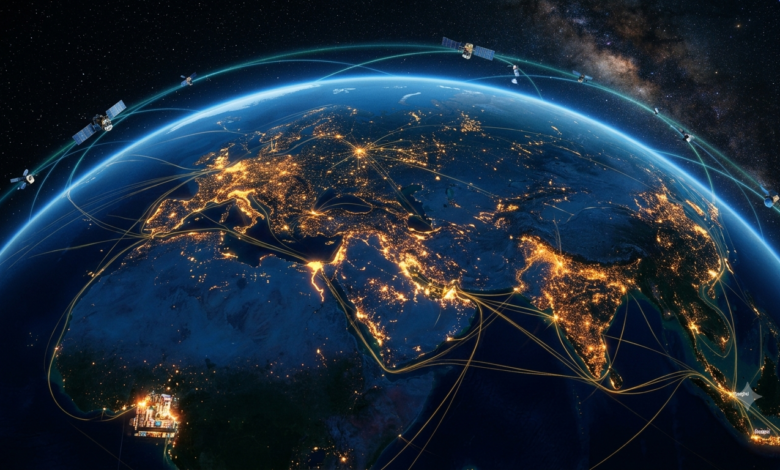
From the silence of space, the Earth reveals a remarkable reality.
The planet is connected by an invisible architecture of influence: maritime routes crossing oceans, digital networks running beneath continents, satellites orbiting above nations, energy corridors linking regions, and industrial systems transforming raw materials into the products that define modern life.
This interconnected structure represents the new geography of power.
For centuries, global influence was determined by territorial expansion, military capabilities, and control over natural resources. Empires rose by controlling strategic locations and commercial routes.
Today, the foundations of power are evolving.
The most influential nations are not only those that possess resources, but those capable of organizing, connecting, and transforming them into strategic advantages.
In the 21st century, power belongs increasingly to those who control the networks that sustain civilization.
A Global Order in Transformation
The modern world was built on an unprecedented wave of globalization.
Over the past decades, international trade expanded rapidly. Production networks became global. Companies established complex supply chains connecting factories, markets, and consumers across continents.
This model created remarkable economic progress.
However, the same interconnected system that generated efficiency also introduced new vulnerabilities.
Disruptions in one region could affect industries worldwide. Energy instability could influence global markets. Technological dependencies could become strategic risks.
The events of recent years have accelerated a fundamental transformation:
The world is moving from an era of pure globalization toward an era of strategic competition and resilience.
Governments and industries are now focused on securing critical systems, strengthening domestic capabilities, and building more adaptable networks.
The central question of the new era is no longer:
“How connected is the world?”
It is:
“Who controls the connections that define the world?”
The Evolution of Global Power
Throughout history, geography has played a decisive role in shaping civilizations.
The Nile River supported one of humanity’s earliest civilizations.
The Roman road system enabled the expansion of an empire.
The Silk Roads connected Asia, Europe, and the Middle East through trade and cultural exchange.
The principle remains constant:
Strategic connections create strategic power.
However, today’s most important connections are no longer limited to physical territories.
They exist through:
- global logistics networks,
- advanced technological ecosystems,
- energy infrastructure,
- digital communication systems,
- scientific research capabilities.
A modern port is not simply a transportation facility.
It is a gateway to economic influence.
A semiconductor plant is not simply a factory.
It is a symbol of technological sovereignty.
A data center is not simply infrastructure.
It is a foundation of digital power.
