




The Parthenon Marbles, the Benin Bronzes, and the emptying museum
The argument used to be theoretical. It is not any more. In 2025 the Netherlands handed 119 Benin Bronzes back to Nigeria; the Museum of Fine Arts in Boston gave two directly to a king. Germany has signed away more than a thousand. The Smithsonian has transferred ownership of its own. Every month, another vitrine in another Western capital is quietly emptied. This is no longer a debate about whether restitution will happen — it is happening — but about what it means, who it is for, and what, if anything, the universal museum was ever good for. Here is the strongest version of every side. The verdict is yours.
The Empty Case
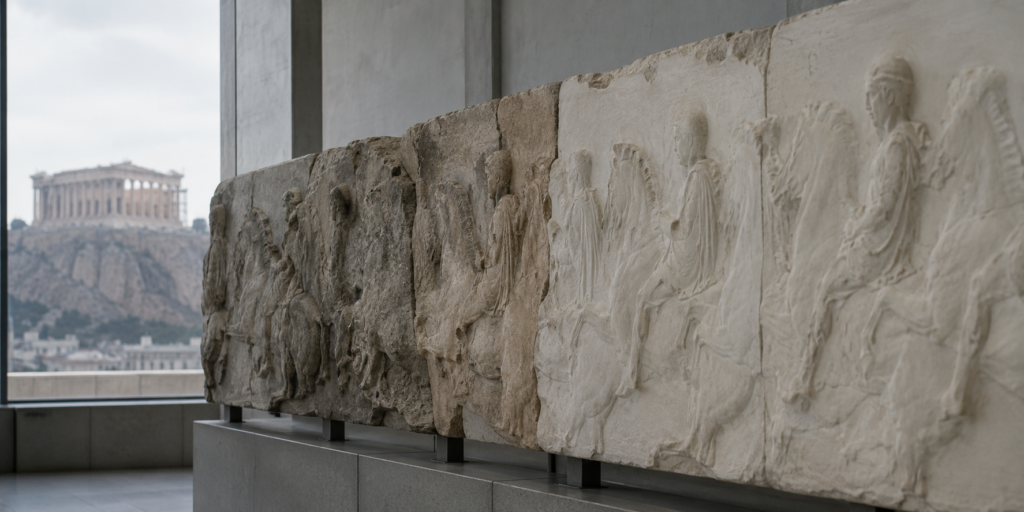
Walk into the Acropolis Museum in Athens, climb to the top floor, and you will find a gallery built around an absence. The Parthenon Gallery is oriented to the exact compass bearing of the temple itself, which stands framed in the windows a few hundred metres up the hill. The surviving sculptures are mounted at the height and in the sequence they occupied on the building. And in the gaps between them — roughly half the frieze, many of the finest figures — are plaster casts, deliberately paler than the marble, so that the eye cannot mistake a copy for the thing itself. The absence is the exhibit. It has been curated.
The Case for the Universal Museum
Begin with the argument that is now losing, because it is stronger than its opponents usually allow, and because a debate in which only one side is stated fairly is not worth having.
The universal museum — the Enlightenment museum, the “encyclopaedic” museum — rests on a genuine idea, not merely a convenient one. Its claim is that there is unique and irreplaceable value in a place where the visitor can stand between a Benin plaque, an Athenian frieze, an Assyrian relief and a Chinese bronze, and see them as chapters of a single human story. No single national museum, however well funded, can assemble that panorama. Break up the encyclopaedic collections and you do not redistribute that value; you destroy it. The whole was worth more than the sum, and the sum is what you are left with.
There is a custodial claim beneath the philosophical one. The great museums argue that they have kept these objects safe, studied them, conserved them and shown them to hundreds of millions of people, free, for two centuries. The British Museum receives around six million visitors a year, most paying nothing. An object in Bloomsbury or on the Mall is an object placed at the disposal of the entire world, not sequestered in the country that happens to claim it.

And there is a slippery-slope argument that is easy to caricature and hard to answer. If origin is destiny — if every object belongs where it was made — then almost every museum on earth must be dismantled. The Louvre, the Met, the Getty, the Hermitage, the Pergamon, and indeed the great museums of Cairo, Istanbul, Mexico City and Beijing, all hold objects made somewhere else. Where does the unwinding stop? Does Egypt return every Nubian artefact to Sudan; does Turkey empty its collections of Greek and Armenian work? The principle, pressed to its conclusion, ends museums as a form.
The universal museum’s defenders also raise a question that the restitution movement has not always answered cleanly, and it is the practical one that follows.
If everything returns to where it was made, there are no museums — only national treasuries. The question is whether that is a price worth paying, not whether it is a price.
The universalist’s strongest card, stated at its strongest.
The Case for Restitution
Now the argument that is winning, and winning because on the specific objects in dispute it is, quite simply, better.
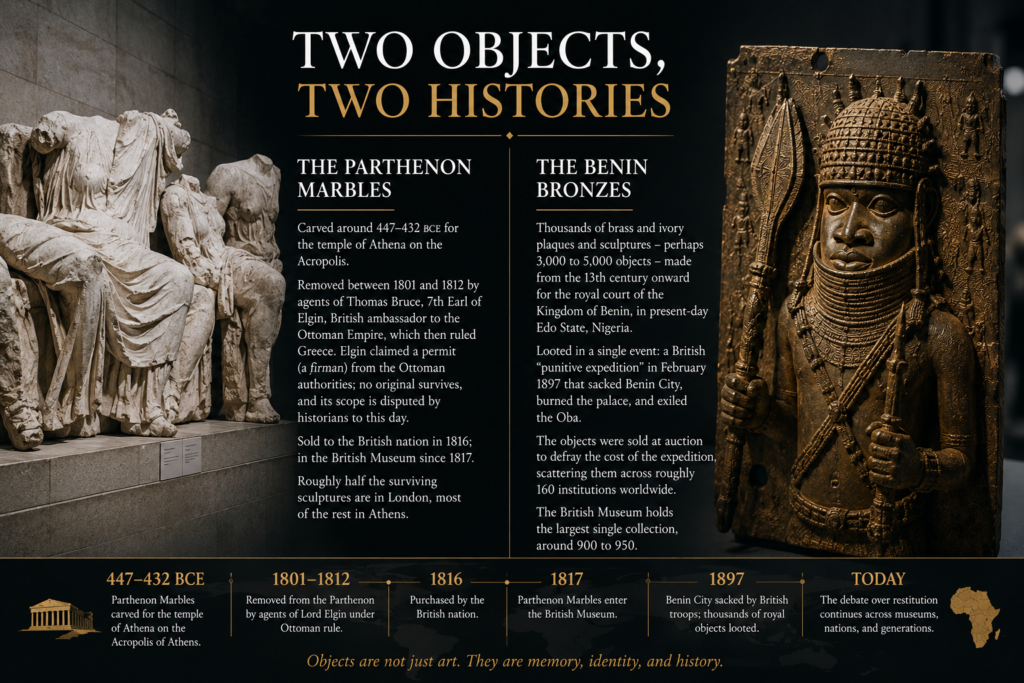
Start by narrowing the claim, because the restitution case is strongest when it refuses the universalist’s invitation to defend an absurdity. Serious restitution advocates are not arguing that every object belongs where it was made. They are arguing about a much smaller category: objects taken by force, by theft, or under the radical coercion of colonial rule, from people who never consented and who have asked for them back. The Benin Bronzes were not bought, traded or found. They were seized in a documented act of war, from a burning palace, and sold to pay for the soldiers who burned it. The provenance is not murky. It is an atrocity with a receipt.
Once the category is narrowed like that, the universalist’s slippery slope loses most of its grip. There is a clean moral line between an object acquired by agreement and an object acquired by sacking a city. Almost nobody is demanding that France return objects lawfully purchased; a great many people are asking that museums return objects whose acquisition their own curators now describe, in published provenance research, as looting.
Then the argument from meaning. For the society of origin, these are not merely artefacts; they are, in many cases, the physical infrastructure of memory, religion and identity — the visual record of a civilisation, or the sacred objects of a living one. The Benin plaques were the dynastic archive of a kingdom, a history written in metal. To hold them abroad is not neutral custodianship; it is the continued possession of another people’s past, on terms they did not set, as a direct consequence of the violence that took them. The loss, restitution advocates argue, is not only historical but intimate and ongoing — a wound that is re-opened every day the object stays.
The custodial argument, meanwhile, has taken damage that is partly self-inflicted. The British Museum spent 2023 explaining how one of its own curators had allegedly stolen some 2,000 objects over years and sold them online — a scandal that made the claim to be the world’s uniquely responsible custodian difficult to deliver with a straight face. And the “we show them to everyone” argument runs into a demographic fact: the people with the strongest claim to see the Benin Bronzes daily, the people of Benin City, are precisely those least able to afford a trip to Bloomsbury. Accessibility to “the world” has, in practice, meant accessibility to whoever can reach a handful of Western capitals.
The restitution case, at its strongest, is therefore not a sentimental one. It is a claim about consent, about the moral status of objects taken by force, and about who should decide the terms on which a people’s heritage is displayed. On the specific objects most in dispute, it has largely won the argument. Which is why the objects are moving.
What Is Actually Happening
Strip away the philosophy and look at the ledger, because the ledger is now the most eloquent participant in the debate.
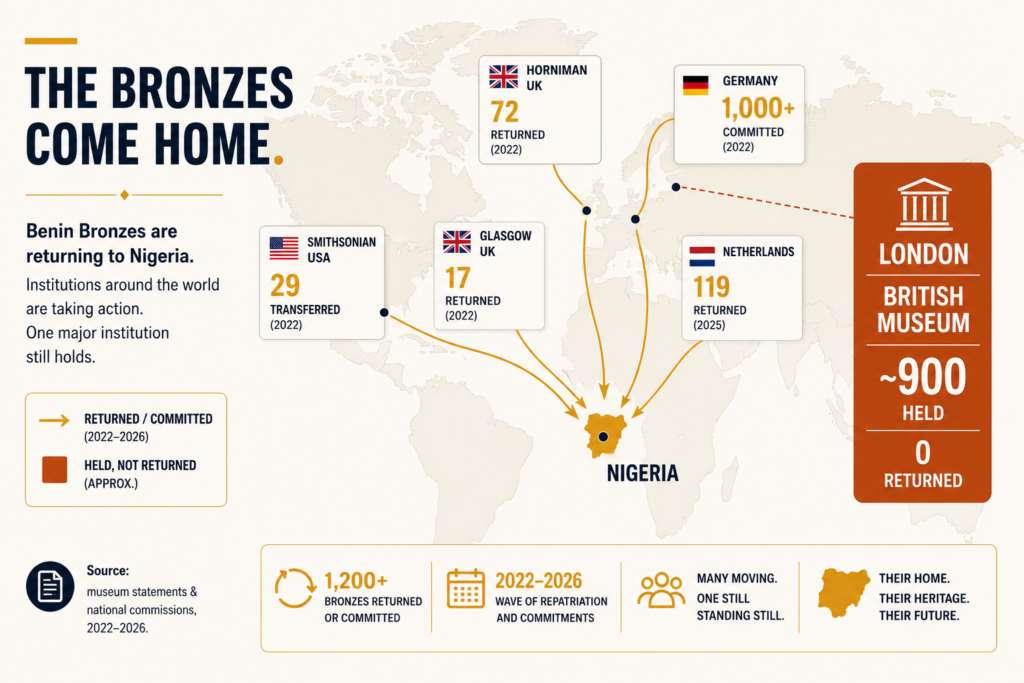
Germany moved first and moved biggest. In 2022 it agreed to transfer ownership of more than a thousand Benin Bronzes held across its museums, beginning returns immediately and handing legal title to Nigeria regardless of where the objects physically stay. The Netherlands followed the logic to its conclusion: after returning hundreds of objects to Indonesia and Sri Lanka in 2023, it handed 119 Benin Bronzes to Nigeria in 2025 — the single largest restitution of these objects to date — and declared the transfer unconditional, its culture minister stating that the works “should never have ended up in the Netherlands.” In the United States, the Smithsonian transferred ownership of 29 bronzes in 2022; the Museum of Fine Arts, Boston, gave two more in 2025 — not to the Nigerian state, but directly to the Oba of Benin. Britain’s own Horniman Museum returned 72; Glasgow’s council voted to return 17; Oxford and Cambridge colleges have moved to follow.
The Parthenon Marbles are a different mechanism heading, perhaps, toward a different destination. Because the British Museum is forbidden by the British Museum Act of 1963 from permanently giving away its collection, the negotiation reported through 2025 and into 2026 — led on the museum’s side by its chairman, the former chancellor George Osborne — is not a return but a “Partnership”: a long-term, renewable loan of the Marbles to Athens, in exchange for a rotating supply of Greek antiquities never before seen in London, with legal ownership formally unchanged. Greece has spent decades refusing to concede ownership by accepting a loan; Britain cannot concede ownership without an Act of Parliament. The proposed deal is an exercise in letting both governments tell their publics they did not blink.
Notice what separates the two cases, because it is the practical hinge of the entire debate. The Benin returns are transfers of ownership, made possible partly because many of the holding institutions — in Germany, the Netherlands and the United States — had the legal freedom to deaccession. The Parthenon deal is a loan, structured precisely to avoid a transfer of ownership that British law forbids. The difference between them is not principally about the strength of the moral claim. It is about a 1963 statute.
The Questions Nobody in the Photo-Op Wants
Here the article has to do the thing that most coverage of restitution avoids: state, at full strength, the hard practical objections — not as a way of opposing return, but because a return that ignores them can go wrong, and some have.
Who receives? “Return it to Nigeria” conceals a live dispute. To the federal government? The Edo state government? Or the Oba of Benin, the hereditary monarch whose great-great-grandfather ruled at the time of the looting? In 2023 the then-president of Nigeria issued a decree naming the Oba the owner and custodian of all returned bronzes — moving them, in effect, from a British public institution to a private royal collection. Some returned objects have reportedly dropped out of public view. If the case for restitution rests partly on public access, then the destination matters, and “home” is not a single address.
Who speaks for the taken? The most uncomfortable objection comes not from European museums but from the African diaspora. The New York–based Restitution Study Group, led by Deadria Farmer-Paellmann — herself a descendant of people enslaved from the Benin region — sued to stop the Smithsonian’s return, on a startling ground: many of the bronzes were cast from manillas, the brass bracelets used as currency to buy human beings, and the Kingdom of Benin was itself a major slave-trading power. Returning the objects solely to the heirs of the sellers, the group argued, erases the descendants of the sold. The US courts rejected the suit and the Supreme Court declined to hear it. But the moral question does not resolve on a standing technicality: the bronzes are, in the most literal sense, made of the metal of the slave trade, and more than one group of descendants can lay a claim to them.
Capacity, and the insult of doubting it. Museums have long argued that objects should not return until the receiving country can conserve and secure them. This argument is sometimes a genuine conservation concern and sometimes a colonial reflex in a lab coat — and telling the two apart is the whole difficulty. Nigeria’s answer is concrete: the Edo Museum of West African Art, designed by David Adjaye, intended precisely as a home for the returning bronzes. Delays and controversies have dogged it. But the deeper reply is a matter of principle: a stolen object is not owed back only on condition that the victim first build a house the thief approves of.
None of these questions is a reason not to return. Each is a reason to return carefully, with the terms of access, ownership and display settled in the open rather than assumed. The objects are moving regardless. The choice is whether they move thoughtlessly or well.
The Emptying Museum
Stand back from the individual disputes and a larger question comes into view — the one in the subtitle, the one that will outlast the Benin Bronzes and the Parthenon Marbles both. If the objects taken by force go home, what is a universal museum for?
One answer, offered in a certain kind of London and New York op-ed, is elegiac: that we are witnessing the slow dismantling of the Enlightenment’s great gift, the one place where humanity could see itself whole, sacrificed to a narrow politics of origin. There is something in it. A world in which every object sits only in its country of manufacture is a poorer, more parochial world, in which the Athenian and the Beninese and the visitor from neither place lose the room where all three met.
But there is a more interesting answer, and it is the one the more thoughtful museums are quietly moving toward. The encyclopaedic collection was built on an assumption that no longer holds: that objects can only be in one place, and that possession and access are the same thing. High-resolution scanning, 3D reproduction, digital circulation and — crucially — the transfer of ownership decoupled from physical location have begun to prise those things apart. Germany handed Nigeria legal title to bronzes that, in some cases, remain on display in Germany, on loan from their new owners. The Parthenon deal, if it happens, will do the reverse: keep London’s title, move Athens’s stones. In both, the old binary — we own it and hold it, or you do — is dissolving into something stranger and more supple.
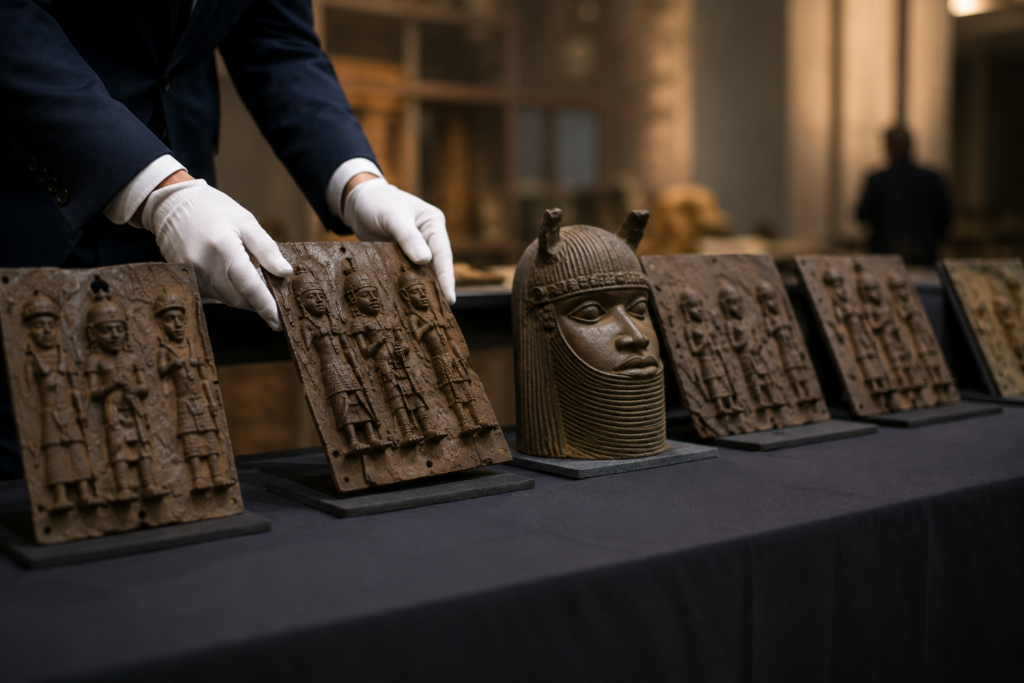
It is possible, in other words, that restitution does not empty the universal museum so much as change what it is: from a place that owns the world’s objects to a place that borrows them, on terms negotiated with the people whose objects they are. That is a humbler institution than the one Elgin’s contemporaries imagined. It may also be a more honest one. A loan requires a relationship. A conquest does not.
What is ending is not the museum. What is ending is the idea that a museum in a powerful country has an automatic right to the heritage of a weaker one, acquired on the terms the powerful country set, defended in the language of universal humanity while the universe in question was rarely consulted. That idea was always doing two jobs at once — preserving genuine treasures for genuine study, and laundering the spoils of empire into the neutral vocabulary of culture. The task of the next generation of curators is to keep the first job and abandon the second, and to discover, object by contested object, whether the two can actually be separated.
They cannot always. Some objects are both. That is precisely why it is hard.
A loan requires a relationship. A conquest does not. The museum of the future will own less and negotiate more — and may, for the first time, have to ask.
The shift beneath all the individual disputes.
Who Owns the Past?
Return, at the end, to the two empty spaces with which this began: the pale casts in Athens, waiting for their marbles; the vitrines in Europe, emptied of their bronzes.
The honest answer to the question in the title is that nobody owns the past, and everybody does. The Parthenon frieze belongs to Greece, whose ancestors carved it and in whose light it was meant to be seen — and it belongs, too, to a Turkish visitor whose Ottoman forebears ruled Athens when Elgin came, and to a British schoolchild for whom Room 18 was the first encounter with the ancient world, and to the idea, not yet obsolete, that some things are the inheritance of the species rather than the property of a state. The Benin Bronzes belong to the Oba’s court, whose dynastic record they are — and to the people of Edo State, and to the descendants of those the kingdom sold, and to the metallurgists still learning from their casting. More than one true claim can rest on a single object. That is not a loophole. That is the nature of heritage, which is always held in common and always fought over.
What the past two years have settled is narrower, and it is real. The objects taken by force, from people who have asked for them back, are going home — not because the universal museum lost an argument about the nature of civilisation, but because it lost a more specific and more damning one about consent. The galleries will empty, partially, and fill again with things lent rather than seized. The museum will survive, diminished in ownership and, perhaps, enlarged in legitimacy.
The pale casts in Athens are a bet that the marbles will come home. The empty cases in Europe are the proof that, for other objects, the bet has already paid. Whether that is a loss or a reckoning is the one question this article will not answer for you.
It is, after all, your past too.
The Record, and How Far to Trust It
Netherlands: 119 Benin Bronzes returned to Nigeria, 2025. Agreement signed February 2025; handover ceremony in Lagos, 21 June 2025. 113 objects from the Dutch state collection plus 6 from Rotterdam. Declared unconditional. Confidence: high — multiple contemporaneous reports (NPR, Al Jazeera, The Art Newspaper, Artnet).
Germany: 1,000+ Benin Bronzes, ownership transferred from 2022. Title handed to Nigeria; some objects remain in German museums on loan from their new Nigerian owners. Confidence: high.
Smithsonian: 29 bronzes transferred, October 2022; MFA Boston: 2 objects to the Oba, 2025. The MFA objects went to the monarch, not the state — a distinction that matters. Confidence: high.
British Museum: ~900–950 Benin Bronzes, none returned. Constrained by the British Museum Act 1963, which bars permanent deaccession except in narrow circumstances. Horniman (72) and Glasgow (17) are separate UK institutions not bound the same way. Confidence: high on the law and the holdout; the exact count varies by source (“around 900”).
Parthenon “Partnership”: a long-term loan under negotiation, not a return. Led by British Museum chairman George Osborne; reported through 2025 into 2026 as advanced but not concluded. Ownership formally unchanged; Greece has not conceded ownership. Confidence: medium-high on the shape of the deal; low on timing — both governments have repeatedly denied an imminent agreement, and it may not complete. Treat any specific date as speculative.
Elgin’s firman. Elgin claimed Ottoman permission; no original document survives, and historians dispute whether what was granted authorised removal at all. Confidence: high that the dispute is genuine and unresolved; the legality is not a settled fact in either direction.
Restitution Study Group lawsuit. RSG, led by Deadria Farmer-Paellmann, sued to halt the Smithsonian’s return, arguing the bronzes were cast from slave-trade manillas and that diaspora descendants have a claim. Restraining order denied October 2022; Supreme Court declined to hear the case, 2024. Confidence: high on the facts of the case; the underlying moral claim is contested and is presented here as a claim, not a finding.
“Some returned objects have dropped from public view.” Reported by several outlets following the 2023 Nigerian decree naming the Oba custodian. Confidence: medium — credibly reported but hard to verify comprehensively; stated here as reporting, not established fact.
British Museum thefts. c. 2,000 objects reported stolen from the collection over years, disclosed 2023; a curator dismissed. Confidence: high.
To Go Deeper
Hicks, D. (2020). The Brutish Museums: The Benin Bronzes, Colonial Violence and Cultural Restitution. Pluto Press. The most forceful scholarly statement of the restitution case, by a serving Oxford curator.
Sarr, F., & Savoy, B. (2018). The Restitution of African Cultural Heritage: Toward a New Relational Ethics. Report commissioned by the French presidency — the document that reopened the European debate.
Cuno, J. (2008). Who Owns Antiquity? Museums and the Battle over Our Ancient Heritage. Princeton University Press. The strongest book-length defence of the universal museum; read it against Hicks.
Dutch Advisory Committee on the Return of Cultural Objects (2020–2025). The reports underpinning the Netherlands’ returns — the clearest working model of provenance-led restitution.
