
Galaxies too big, too early — and what that actually means
For three years, the James Webb Space Telescope has been accused of demolishing the Big Bang. It has done nothing of the kind. What it has done is stranger, and more interesting: it has caught us weighing the universe wrong — and then, in public, in real time, it has watched a field of science correct itself. The galaxies that were too heavy turned out not to be. The anomaly that survived is not about mass at all. And the objects at the centre of the whole affair may not be galaxies.
A Million and a Half Kilometres from Anywhere
It is very cold where the telescope is, and it has to be.
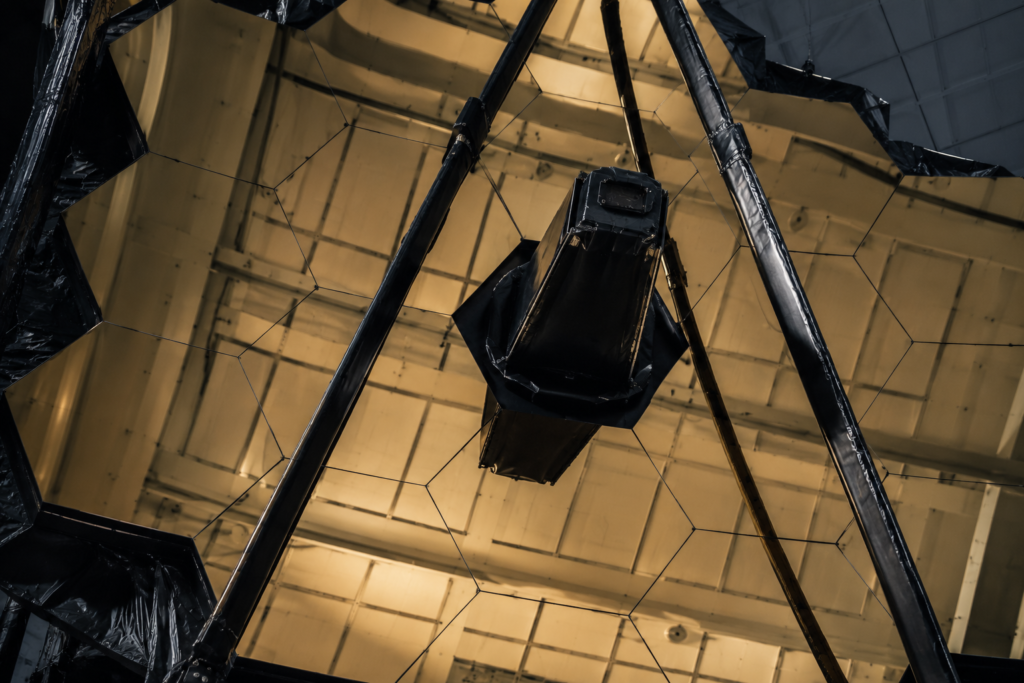
The James Webb Space Telescope sits at the second Lagrange point, roughly 1.5 million kilometres from Earth — four times further away than the Moon, in a place where the gravity of the Earth and the Sun conspire to hold an object in a stable, slow orbit around nothing in particular. Behind it, always, is a five-layer sunshield the size of a tennis court. On the hot side, facing the Sun, temperatures reach roughly 85°C. On the cold side, where the mirror lives, the instruments run at around 40 kelvin — some thirty degrees above absolute zero. The mid-infrared camera has to be chilled further still, to about 7 K, by a dedicated cryocooler.
This is not fastidiousness. It is the entire design brief. Webb was built to see heat, and a warm telescope trying to see heat is a candle trying to observe a candle. Everything about the machine — the shield, the orbit, the segmented beryllium mirror plated in gold because gold reflects infrared better than aluminium does — follows from a single decision made decades ago: point it at the infrared, because that is where the beginning of the universe has gone.
On 11 July 2022, the first deep image was released. Within weeks, papers began appearing on the arXiv preprint server with a word in them that professional astronomers do not use lightly.
Impossible.
The Universe Breakers
In February 2023, Ivo Labbé and colleagues published a paper in Nature reporting thirteen candidate galaxies at redshifts between 6.5 and 9.1 — the universe at somewhere between six hundred million and eight hundred million years old — which appeared to contain as much stellar mass as the Milky Way does today. Six of them were exceptional enough to become famous.
The problem was not that they were bright. The problem was arithmetic, and it was set out with unusual clarity by Michael Boylan-Kolchin in Nature Astronomy the same year.
In the standard cosmological model, structure grows by gravity from tiny fluctuations imprinted on the infant universe. Dark matter clumps first; ordinary matter — the baryons, the stuff stars are made of — falls into those clumps. The fraction of a clump’s mass that can possibly be baryonic is fixed by cosmology itself: roughly sixteen per cent. So the stellar mass of a galaxy can never exceed sixteen per cent of the mass of its dark-matter halo. Not because of engineering, or feedback, or dust. Because there is no more raw material in the box.
Run the numbers on the Labbé objects, at the redshifts and masses reported, and you find galaxies that would need to have converted very nearly every available baryon in their halo into stars — an efficiency of close to one hundred per cent, in a universe where the observed efficiency, everywhere else and at every other epoch, is closer to ten.
Boylan-Kolchin’s argument was rigorous, honest and — this matters enormously — explicitly conditional. If the masses and the redshifts were right, standard cosmology had a serious problem.
The press dropped the conditional. The phrase that went around the world was universe breakers.
“Impossible” was always a claim about our arithmetic, not about the universe. The universe does not do impossible. It does surprising, which is different, and which is the only reason any of us have jobs.
The distinction that the coverage lost, and that the field never did.
How to Weigh a Galaxy Badly
Here is the part that almost never gets reported, because it is technical, unglamorous, and fatal to the headline.
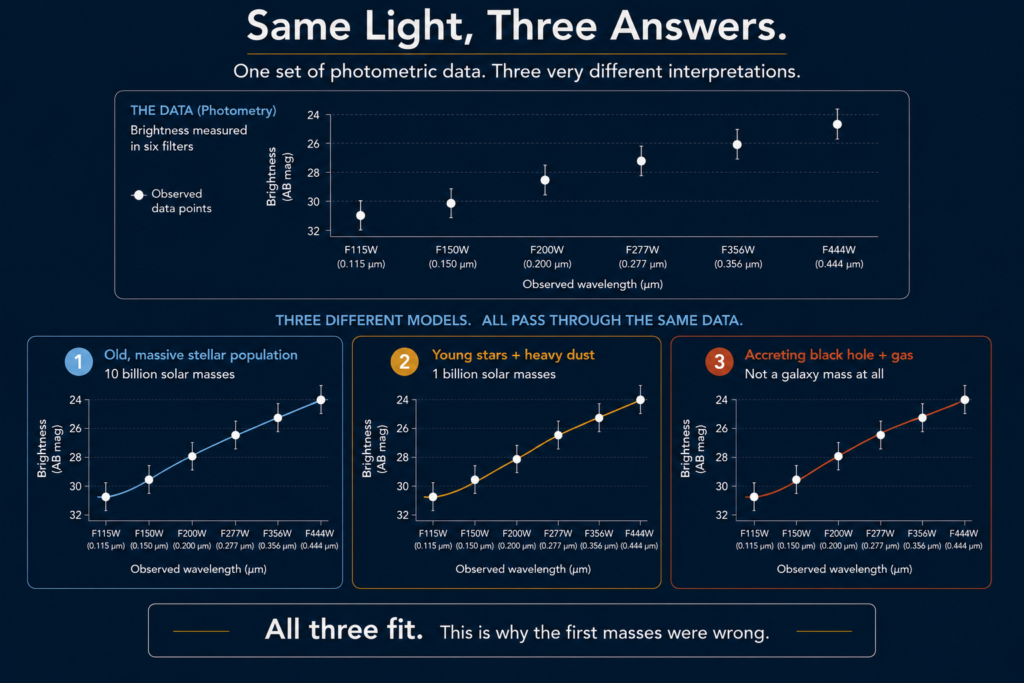
Nobody weighed those galaxies. Nobody could. What was measured was brightness — the amount of light arriving in each of a handful of broad filters. To convert brightness into a mass of stars, you fit a model: you assume a history of star formation, an amount of obscuring dust, a distribution of stellar masses at birth (the initial mass function), and an absence of anything other than stars contributing to the light. Then you ask which combination of those assumptions best reproduces the photometry.
The trouble is that wildly different combinations produce almost identical photometry.
A red object can be red because it is full of old, cool stars — which implies enormous mass, because you need a great many of them and they have had time to age. Or it can be red because it is young and swaddled in dust. Or because it is glowing in a few violently strong emission lines that happen to land inside one filter and fool it. Or — and this is the one that mattered — because there is an accreting black hole at its centre, and the light you attributed to a hundred billion stars was, in substantial part, coming from a single object a few astronomical units across.
Astronomers call this degeneracy. It is not a scandal; it is the known condition of the technique. What was scandalous, briefly, was the confidence.
The corrections arrived over the following two years, and they all pushed the same way. Adding data from Webb’s mid-infrared instrument — which anchors the part of the spectrum where old stars actually dominate — reduced the inferred stellar masses of most high-redshift candidates by around 0.4 dex, a factor of roughly two and a half (Papovich and colleagues, 2023). Accounting for the statistical bias that inevitably inflates the rarest objects in a noisy sample — Eddington bias, an effect known since the 1910s — took more off. Spectroscopy took off more still: when the light was finally split rather than merely counted, several of the reddest, heaviest-looking objects revealed the unmistakable broad emission lines of gas whipping around a black hole.
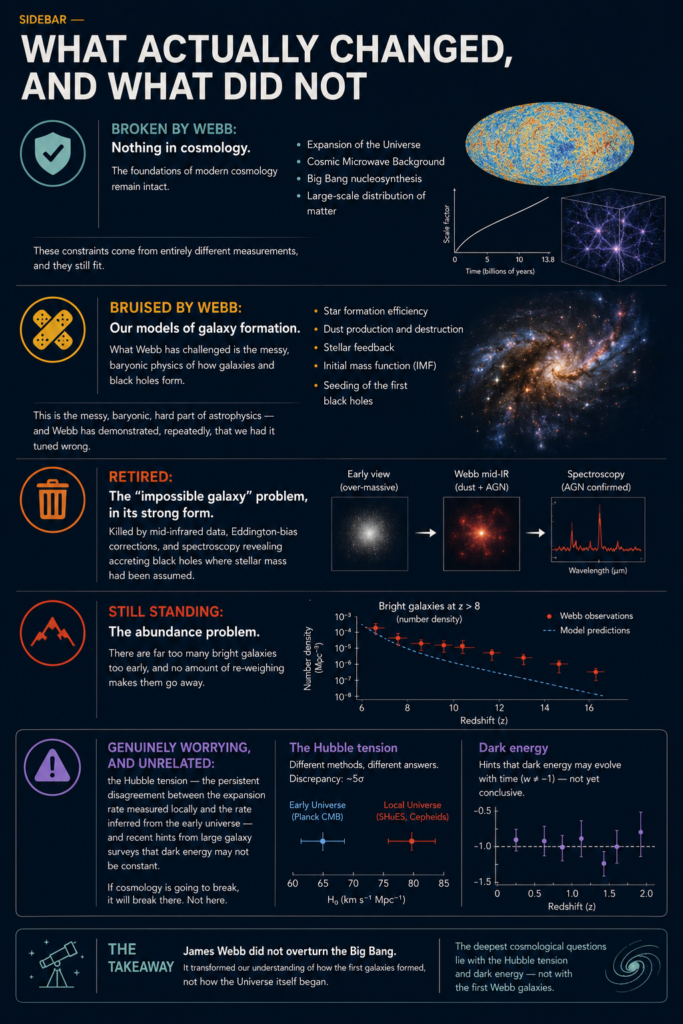
By 2025, the impossible-galaxy problem had, for the most part, quietly dissolved. Not because anyone found an error in Boylan-Kolchin’s mathematics — his mathematics was fine — but because the input he had been given, and had explicitly flagged as provisional, turned out to be wrong.
This is not a failure of science. This is a photograph of science, taken mid-motion, at a speed the public is not used to seeing.
The Little Red Dots
And then the contamination turned out to be the discovery.
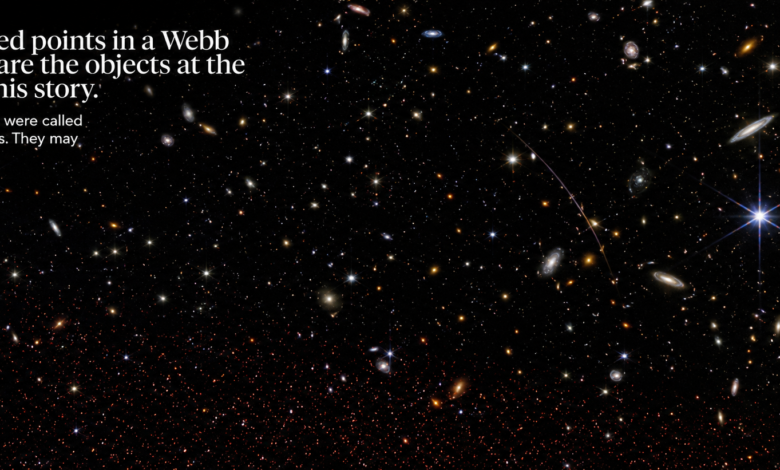
The objects that had been inflating the mass estimates were not a nuisance to be subtracted. They were a population nobody had predicted, nobody had seen before, and nobody, four years on, can fully explain. Astronomers named them with a bluntness that is rare and rather wonderful: little red dots.
They are extremely compact — point-like, unresolved even by Webb, which means they are smaller than a few hundred light years across, a fraction of the size of a normal galaxy. They are intensely red in the rest-frame optical and yet bright in the ultraviolet, giving them a distinctive V-shaped spectrum with a dip in between. Many show broad hydrogen emission lines, the classic fingerprint of gas orbiting at thousands of kilometres per second around something very heavy. The first was confirmed spectroscopically by Dale Kocevski and colleagues in 2023; by 2024 Jorryt Matthee’s team had assembled a sample, and the name stuck.
They are also everywhere, and then nowhere. They appear in abundance around six hundred million years after the Big Bang, in numbers far greater than any model anticipated — and they have largely vanished by the time the universe is two billion years old. Whatever they are, they are a phase, not a fixture.
The competing explanations have arrived at a pace that is itself part of the story. In January 2026, a team led by Vadim Rusakov published in Nature an account of the dots as young supermassive black holes buried inside dense cocoons of ionised gas — considerably less massive than earlier estimates suggested, and shrouded in a way that mimics a stellar spectrum. The idea has attracted an evocative label: black hole stars. In February, Fabio Pacucci and colleagues argued they are direct-collapse black holes, formed not from dying stars but from the wholesale gravitational collapse of primordial gas clouds. In May, Yangyao Chen’s group proposed that they are black holes caught in rare, violent episodes of feeding above the theoretical Eddington limit — and pointed out, with some emphasis, that their model requires no departure from standard cosmology whatsoever.
Three papers. Six months. Three different solutions, each announced in the popular press as the solution.
Take that as a warning about science journalism if you like. Take it, more usefully, as an accurate reading of where the field actually is: converging on the conclusion that the little red dots are powered by black holes rather than starlight, and entirely unresolved as to which kind of black hole, formed how, and why they were so abundant and so brief.
What is no longer seriously contested is the consequence for the original controversy. If a substantial fraction of the light from the impossible galaxies came from accretion rather than from stars, then the stellar masses were never as large as reported, the baryon budget was never violated, and the universe was never broken.
The Anomaly That Survived
Strip out the bad masses and something obstinate remains. It is not the one that got the headlines, and it is the one that should have.
There are too many bright galaxies, too early.
Not too heavy — too luminous, and too numerous. Webb has not found one improbable object and forced astronomers to rationalise it. It has found luminous galaxies in the first few hundred million years so routinely that the pre-launch expectation now looks not merely conservative but wrong.
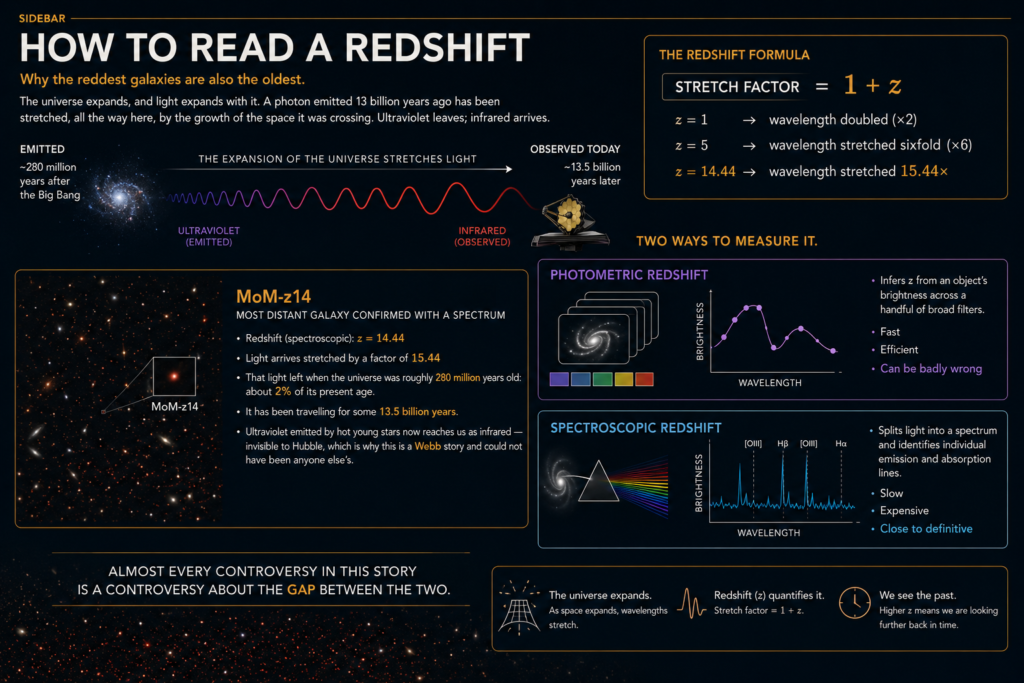
The numbers are worth stating flatly. In 2024, Stefano Carniani and colleagues confirmed JADES-GS-z14-0 spectroscopically at a redshift of 14.32 — light emitted around 290 million years after the Big Bang. In 2025, Rohan Naidu’s team, in a survey given the mordantly honest name Mirage or Miracle, confirmed MoM-z14 at z = 14.44, pushing the frontier to about 280 million years; the result was published in the Open Journal of Astrophysics at the end of January 2026. The galaxy is compact, it shows unexpectedly strong nitrogen enrichment, and its emission lines indicate a star-formation rate that rose by roughly a factor of ten in the final five million years before the light left.
And the number density of bright galaxies at that epoch, as measured across their survey field, came in at more than a hundred times what pre-Webb consensus models had predicted — a factor of 182, with an uncertainty range running from 77 to over 500.
That is not a rounding error. That is a model class being told it was wrong about a whole epoch.
What could do it? Every serious candidate on the table is astrophysics, not cosmology.
Bursty star formation. If early galaxies formed stars in violent, short-lived bursts rather than steadily, then at any given moment a disproportionate number of them will be caught mid-flare, blazing in the ultraviolet. You do not need more galaxies. You need galaxies that flicker — and a survey that keeps catching them lit.
Missing dust. Dust absorbs ultraviolet light and re-emits it in the infrared; it is the great dimmer switch of galaxy surveys. If the earliest galaxies had less dust than expected — or, as Andrea Ferrara and colleagues have argued, if their sheer radiative intensity drove the dust out of them entirely in powerful outflows — they would appear far brighter than models allowed, without containing a single extra star.
Higher star-formation efficiency. Perhaps the early universe was simply better at turning gas into stars: denser, more compact haloes, less effective feedback from supernovae to blow the gas back out. Not impossible physics. Just physics we had calibrated on a nine-billion-year-old universe and assumed would hold in a three-hundred-million-year-old one.
A top-heavy initial mass function. The first stars formed from gas with essentially no elements heavier than helium, which cools very differently. They may have been systematically more massive than stars forming today — and massive stars are savagely more luminous. Double a star’s mass and you can multiply its light output more than tenfold. A galaxy could then be far brighter than its mass suggests, which would explain the luminosity without breaking any budget.
Each of these is testable. Several are already being tested. None of them requires touching the Big Bang.
Anomaly Is Not Refutation
There is a sentence that appears every time a telescope surprises us, and it is always wrong in the same way: this overturns everything we thought we knew.
It is worth being precise about why.
The standard cosmological model — cold dark matter plus a cosmological constant, ΛCDM — is not a theory of galaxies. It is a theory of the universe’s contents, geometry and expansion history. Its evidence comes from three great independent pillars: the cosmic microwave background, the fossil light of the universe at 380,000 years old, whose temperature fluctuations encode the composition of everything; big-bang nucleosynthesis, which predicts the primordial abundances of hydrogen, helium and lithium and gets them right; and the large-scale distribution of galaxies, whose pattern preserves the imprint of sound waves in the primordial plasma.
Webb does not observe any of these things. It observes galaxies — objects made of baryons, which are the four or five per cent of the universe that behaves badly. Star formation, dust, supernova feedback, black-hole accretion: this is the part of astrophysics that is not derived from first principles but calibrated against observation, because nobody can solve it from the top down.
So when Webb finds galaxies brighter and more abundant than expected, the honest inference is that our calibration of the messiest part of the model was wrong — which is roughly what one should expect of a calibration made almost entirely on a universe billions of years older than the one now being observed for the first time.
Could the surprise, in the end, point somewhere deeper? Yes. That is not a rhetorical concession. If a cleanly measured, spectroscopically confirmed population of genuinely massive galaxies were found at redshifts where the halo mass function simply cannot produce enough dark matter to host them, the baryon-budget argument would bite for real, and cold dark matter would be in trouble. That test is live. It has not yet been passed by the data — but it is the right test, and it is being run.
What would be intellectually indefensible is to take a measurement whose systematic uncertainties are large, poorly understood and known to run in one direction, and to use it to overthrow a framework supported by three independent, high-precision, mutually consistent lines of evidence. That is not boldness. It is arithmetic performed in the wrong order.
And there is an irony worth holding onto. Cosmology does have serious problems in 2026 — the stubborn disagreement between local and early-universe measurements of the expansion rate, and mounting hints from galaxy surveys that dark energy may not be the unchanging constant we assumed. Those anomalies are cleaner, better measured, and far harder to explain away than anything Webb has found in the early universe.
The crisis, if there is one, is not where anyone was looking.
The galaxies did not break cosmology. They broke a spreadsheet — and then a field of scientists, in public, over three years, fixed it.
Which is the least dramatic and most reassuring sentence anyone can write about the last decade of astronomy.
The Machine Is Working
Set aside the headlines and consider what the record actually shows.
A telescope observed something unexpected. A team published the observation, with its uncertainties stated. A theorist took the numbers at face value and demonstrated, correctly, that they would be very difficult to reconcile with the standard model — and said explicitly that this conclusion depended on the numbers holding. Other groups attacked the numbers, which is their job. Better data arrived: mid-infrared photometry, then spectroscopy. The masses came down. The interpretation shifted. The anomaly did not vanish so much as change its shape, from a problem about mass into a problem about light — and, in the process, threw up an entirely new class of object that nobody had ordered.
All of this happened in under four years, in the open, on a public preprint server, with the disagreements visible to anyone who cared to look.
This is not what a science in crisis looks like. It is what a science in good health looks like from the inside — and the reason it reads as chaos is that we are almost never permitted to watch.
The uncomfortable truth is that the version of science the public is sold — a stately accumulation of settled facts — is a fiction constructed in the editing. Real science looks like the little red dots: three incompatible explanations in six months, each announced as final, each probably partly right, none of them yet the answer.
There will be more. Webb is now finding candidates at redshifts beyond fifteen, and there is no technical reason it cannot reach twenty. Each one will arrive first as a photometric estimate, be described somewhere as impossible, and then be tested.
Some of them will survive the testing. That is when it gets interesting.
Until then, hold two things at once, and refuse to trade one for the other: something genuinely strange is happening in the first half-billion years of the universe, and the Big Bang is fine.
Both are true. Only one of them sells.