




The Amazon is approaching a threshold below which it cannot water itself
A rainforest is usually explained as a thing the rain makes. The Amazon is the reverse: it is a forest that makes the rain. Half the water that falls on it is water it put into the air itself, recycled again and again on its way west across the continent. That single fact is the difference between a jungle and a machine — and it is why the Amazon has a threshold that an ordinary forest does not. Clear enough of it, and the machine can no longer prime its own pump. Scientists think that line lies somewhere around a fifth to a quarter of the forest gone. We are, depending on how you count, most of the way there.
The River That Flows Through the Air
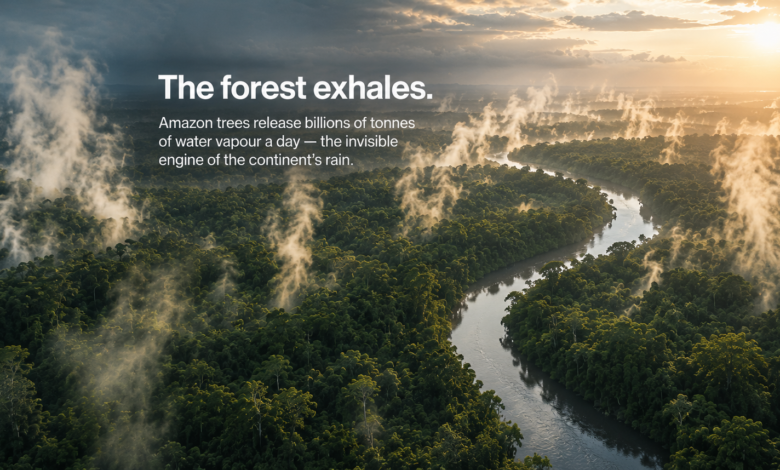
Stand beneath the canopy at dawn near Santarém, where the dark blue Tapajós pours into the brown flood of the Amazon, and you can watch the forest begin to smoke. It is not smoke. It is water. As the sun warms the leaves, the trees exhale — a single large tree can release hundreds of litres of water into the air in a day — and the vapour rises off the canopy in visible sheets, gathers into cloud, and falls again as rain a little to the west. Then it happens again. And again.
Hydrologists call these aerial rivers, or flying rivers, and the name is not a metaphor. The quantity of water moving west through the air above the Amazon rivals, and by some measures exceeds, the volume moving through the great brown river below it. This airborne flow, wrung from the Atlantic and then passed hand to hand by the forest itself, waters not only the basin but the farms of southern Brazil, the cities of the south-east, and the highlands of Bolivia and Peru. The Amazon is the continent’s rain pump, and the trees are its pistons.
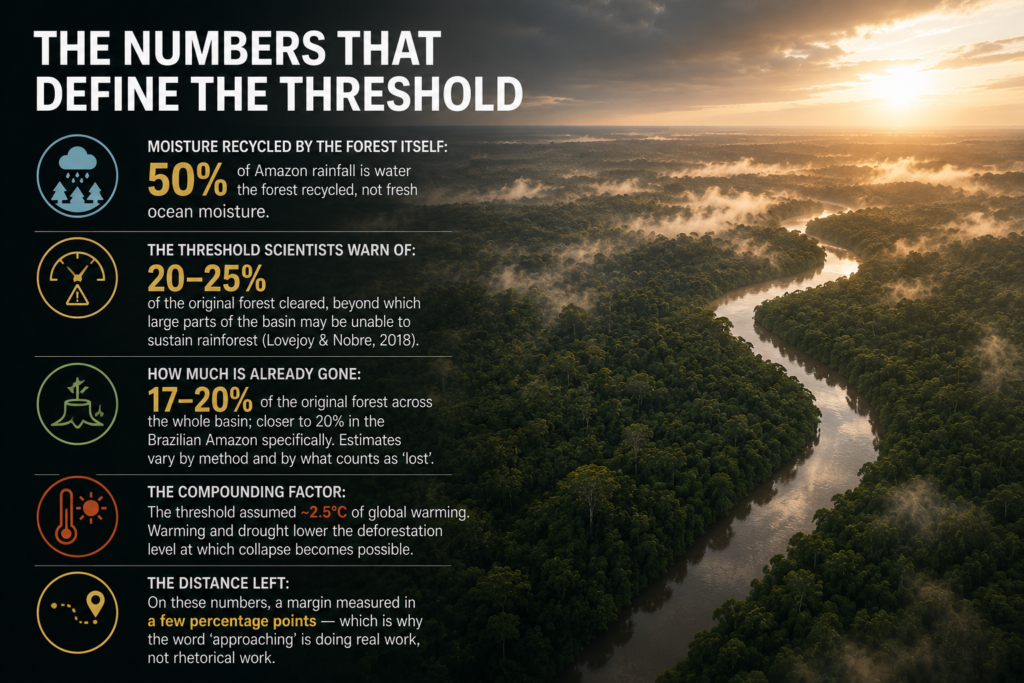
Here is the mechanism that makes the whole story turn, and it is worth stating precisely because everything else depends on it. Roughly half of all the rain that falls on the Amazon is moisture the forest recycled from itself, rather than fresh water arriving off the ocean. A raindrop entering the eastern basin from the Atlantic may fall, be drawn up through a tree’s roots, transpired back into the sky, blown west, and fall again five, six, seven times before it finally reaches the Andes. Each recycling is a favour the forest does itself. Remove the trees that perform it, and the favour stops.
That is what makes the Amazon categorically different from an ordinary forest, and it is why it possesses something an ordinary forest does not: a threshold. A temperate woodland that is half cleared is simply a smaller woodland. A rainforest that recycles its own rain is a system that can, past a certain point of clearing, lose the ability to generate the very climate it needs to exist. Below that line, the forest does not merely shrink. It ceases to be able to water itself — and begins, irreversibly, to become something else.

Savannisation: What the Forest Would Become
The word scientists use for the feared transformation is savannisation, and it describes not death but replacement. The Amazon would not turn to desert. It would turn to something that looks, superficially, alive: a scrubby, open, fire-prone savanna of grasses and scattered drought-hardy trees, resembling the Cerrado that already borders the forest to the south.
The mechanism is a feedback loop, and its logic is pitiless. Less forest means less transpiration, which means less recycled moisture, which means less rain, which means a longer and harsher dry season. A longer dry season stresses the remaining trees, which respond as any plant does under water stress — by shedding leaves to conserve moisture, which further reduces transpiration, which further reduces rain. Drier forest is also flammable forest, and fire — mostly set by people to clear land, then escaping — kills more trees, opens the canopy, lets in more sun and wind, and dries the interior further. Each turn of the loop makes the next turn easier. This is what a tipping point is: not a cliff you fall off once, but a slope that, past a certain steepness, carries you down on its own.
The consequence would not stay in the Amazon. The flying rivers that fail would have carried rain to the soy and cattle country of central and southern Brazil, to the reservoirs that generate the country’s hydroelectric power, to the taps of São Paulo. A savannised Amazon is not only a biodiversity catastrophe — though it is that, the richest terrestrial ecosystem on the planet reduced to something far poorer. It is an agricultural and economic one, striking the very farmland whose expansion drove the clearing in the first place. The forest’s enemies are among its most dependent beneficiaries. They are, in the most literal sense, sawing through the branch that waters them.
A tipping point is not a cliff you fall off once. It is a slope that, past a certain steepness, carries you down on its own.
The Forest That Started to Exhale Carbon
For most of human history the Amazon has been a carbon sink: it absorbed more carbon dioxide from the atmosphere, through the growth of its trees, than it released. This is one of the great unpaid services the forest performs for the world, and it is the reason the Amazon is spoken of as a lung of the planet — imprecisely, since it consumes roughly as much oxygen as it produces, but accurately in the sense that matters, which is carbon.
That service is now failing in places, and the evidence is among the most alarming in all of climate science.
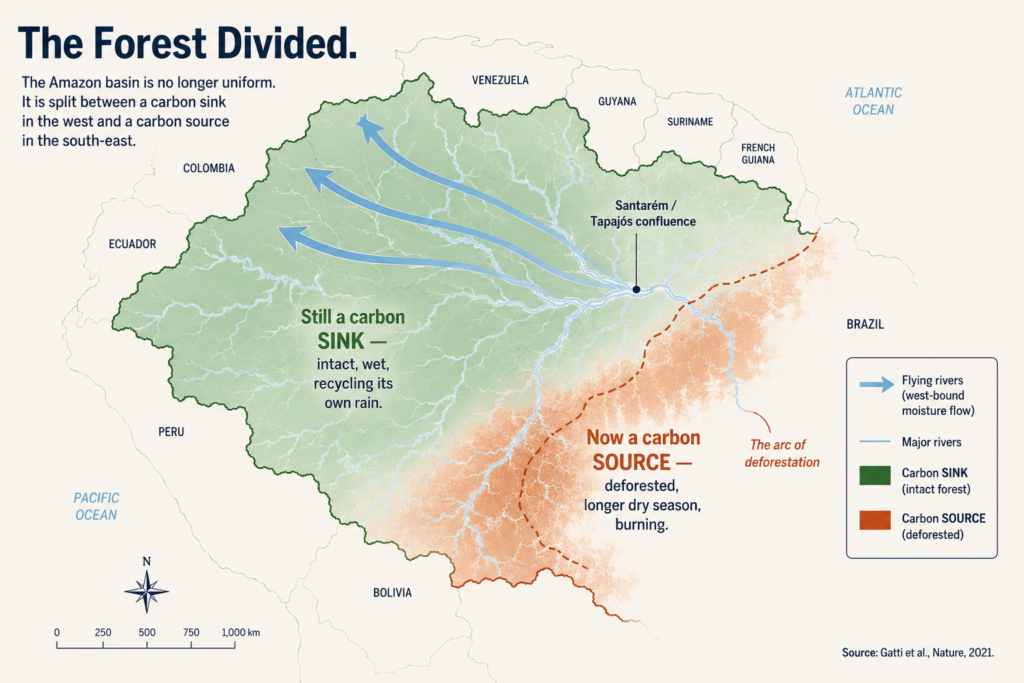
Between 2010 and 2018, the atmospheric chemist Luciana Gatti and her colleagues did something laborious and definitive: they flew regular vertical profiles over four regions of the Brazilian Amazon, sampling the air itself to measure whether each region was, on balance, breathing carbon in or out. The results, published in Nature in 2021, drew a line down the middle of the forest. The western and central Amazon, still largely intact and still wet, remained a sink. But the eastern Amazon — and especially the south-east, the arc of heaviest deforestation, longest dry season and most frequent fire — had flipped. It was now a net source, exhaling more carbon than it absorbed.
The cause was not mysterious, and that is the point. The regions that had crossed over were precisely the regions most deforested and most burned. Where the forest had been cut and dried, its trees died faster and burned more, and the carbon they had stored for centuries went back into the sky. Carlos Nobre, the Brazilian earth-system scientist who first modelled the tipping point in the 1990s, put it starkly when the data came in: what he had predicted might happen in two or three decades appeared to be happening already, in the south-eastern quadrant of the forest, now.
This is the single most important empirical fact in the whole debate, and it deserves to be stated without softening. Part of the Amazon has already crossed the line the rest of it is approaching. The tipping point is not entirely a forecast. In the east, it is a measurement.
How Close Is Close? An Honest Accounting
Here the article has to slow down and do something that alarmed coverage rarely does: state carefully what is known, what is estimated, and what is genuinely uncertain. The tipping point is real. It is also frequently misdescribed, and the misdescription does its own kind of damage.
The threshold most often cited — 20 to 25% of the forest cleared — comes from work by Thomas Lovejoy and Carlos Nobre, refined in 2018. Earlier estimates had put it around 40%; the figure was revised sharply downward once the compounding effects of fire and global warming were included. The best current tallies put cumulative loss across the whole basin at roughly 17 to 20%, and closer to 20% in the Brazilian Amazon alone. Set those two numbers side by side and the reason for concern is obvious: the distance between where we are and where the forest may break is now measured in single-digit percentage points.
But precision requires three honest caveats, and leaving them out is a form of dishonesty even when the cause is good.
First, the threshold is not a single sharp number. It depends on how much the planet warms: the 20–25% figure assumed around 2.5°C of global heating, and a hotter world tips at a lower level of clearing. It is a moving line, not a fixed one.
Second, and most important, the science itself has moved. A major 2024 review in Nature, led by Bernardo Flores, found limited evidence for a single, basin-wide tipping point that flips all at once. Instead it emphasised that different regions have different thresholds, and that the collapse, when it comes, is likely to be a patchwork — the south and east transitioning while the wet north-west holds on far longer. This is not reassuring. It is arguably worse, because a patchwork collapse is already beginning, region by region, rather than waiting politely at a single line for the whole forest to reach it together.
Third, deforestation is no longer the only driver, or even the fastest-growing one. Degradation — forest that is not cleared but thinned, burned at the edges, fragmented by roads and dried by a warming climate — now damages enormous areas that the deforestation statistics do not count. The record drought of 2023–24 turned vast stretches of standing forest into tinder. A forest can be technically still ‘there’, still green on a satellite map, and functionally halfway to savanna.
So the honest sentence is this. There is almost certainly not a single magic number that, once crossed, flips the entire Amazon overnight. What there is, instead, is a forest already tipping in its most damaged quarter, a threshold for the rest that is uncomfortably close and moving closer as the world warms, and a growing consensus that ‘how close are we?’ is the wrong question. The right one is ‘how much of it is already going, and how fast?’ The answer to that is: the south-east, and faster than the models expected.
The One Thing That Actually Worked
If the science is frightening, the policy history is the opposite — and this is the part of the story that alarmed coverage almost always omits, to its cost. Because we are not speculating about whether Amazon deforestation can be reduced. We have done it, twice, at scale, on purpose, and we know precisely how.
Between 2004 and 2012, Brazil cut deforestation in the Amazon by roughly 80%. This was not the result of a global treaty or a technological breakthrough. It was a deliberate, unglamorous, enforcement-driven policy programme, and its components are known. Real-time satellite monitoring, through the space agency INPE, meant clearing could be detected as it happened rather than tallied years later. That intelligence was handed to an environmental enforcement agency, IBAMA, with the authority and the funding to fine, seize and prosecute. Credit was denied to landowners in municipalities with high deforestation, turning banks into enforcers. Protected areas and Indigenous territories — which are, consistently and measurably, the best-defended forest in the basin — were expanded. And a soy moratorium, under which major traders refused to buy from newly cleared land, aligned commerce with the forest instead of against it.
Then, between 2019 and 2022, the same machine was run in reverse, and the result was a natural experiment nobody wanted. Enforcement was gutted, agencies defunded, fines left uncollected, the monitoring agency’s own findings publicly disparaged. Deforestation surged to a fifteen-year high. The lesson was brutal and clarifying: the forest’s fate is not fixed by economics or geography. It tracks, almost in real time, the political decision to enforce the law or not.
And then it was demonstrated a third time. Since 2023, the same levers — monitoring, enforcement, protected areas, denied credit — have been pulled again, and deforestation in the Brazilian Amazon has fallen for three consecutive years, roughly halving from its 2022 peak. In the twelve months to July 2025 it reached one of its lowest levels since records began in 1988. In the first half of 2026 it fell to the lowest for that period in a decade. Burned area, after the catastrophic drought of 2024, dropped sharply the following year.
This is the rarest thing in environmental journalism: a problem with a proven, repeatable solution, demonstrated three times in twenty years. The Amazon is not waiting on an invention. The tools exist, they work, and they are cheap relative to the loss they prevent. What they require is political will — which is exactly why the forest’s trajectory has swung so violently between Brazilian governments, and why it remains, ultimately, a choice rather than a fate.
The forest’s fate is not fixed by economics or geography. It tracks, almost in real time, the political decision to enforce the law — or not.
The lesson of three Brazilian governments in twenty years.
The New Threats, and the Fragile Present
It would be dishonest to end on the recovery without naming what still endangers it, because the good news of 2025 and 2026 is real but not secure.
The nature of the loss is changing faster than the policy is. As outright clearing has fallen, fire and degradation have risen to take its place — driven less by the chainsaw than by a warming, drying climate that the best Brazilian enforcement in the world cannot switch off. A government can stop a rancher felling trees. It cannot, by itself, stop the drought that turns the trees a rancher left standing into fuel. This is the trap the Amazon is now in: even a well-governed forest is being cooked from outside by a global climate that Brazil does not control.
The pressures on the policy are mounting in step. A proposed highway, BR-319, would cut through one of the most intact stretches of the basin, and roads in the Amazon are the reliable precursor to clearing — the spine from which the ‘fishbone’ of deforestation always grows. The soy moratorium that helped break the link between agriculture and clearing has been suspended, reinstated and challenged again, its future uncertain. Gold prices are high, drawing illegal miners deep into Indigenous land. And the Brazilian government that has driven the recent progress has simultaneously backed oil exploration near the mouth of the Amazon River — a contradiction that captures the whole predicament of a developing country asked to forgo the resource wealth its predecessors were free to burn.
At the COP30 summit hosted in Belém, at the forest’s edge, the centrepiece proposal was a fund — the Tropical Forest Forever Facility — designed to pay tropical nations to keep their forests standing, potentially generating billions a year for more than seventy countries. Whether it is financed at the scale promised is, at the time of writing, unresolved. It points, though, at the real economic logic: the standing forest is worth more to the world than the cattle pasture that replaces it, and until the world is willing to pay something toward that difference, it is asking Brazil to shoulder a global benefit as a national cost.
The Machine and the Choice
Return to the trees exhaling their water at dawn over the Tapajós. That vapour, rising and blowing west to fall and rise again, is the forest doing the one thing that makes it more than a collection of trees: manufacturing the climate of a continent. It is a machine of staggering scale and staggering efficiency, and it has been running, unpaid and unthanked, for tens of millions of years.
What the science of the last decade has established is that this machine has a minimum operating size. Below it, the pistons cannot prime the pump, the flying rivers thin, the dry season lengthens, the fires spread, and the forest begins its slow conversion into something that cannot do the job — a savanna where a rainforest used to be, exhaling the carbon it once stored. In the south-eastern Amazon, that conversion has already begun; the air samples prove it. Across the rest of the basin, the margin before it becomes possible is now measured in a handful of percentage points, and shrinking as the planet warms.
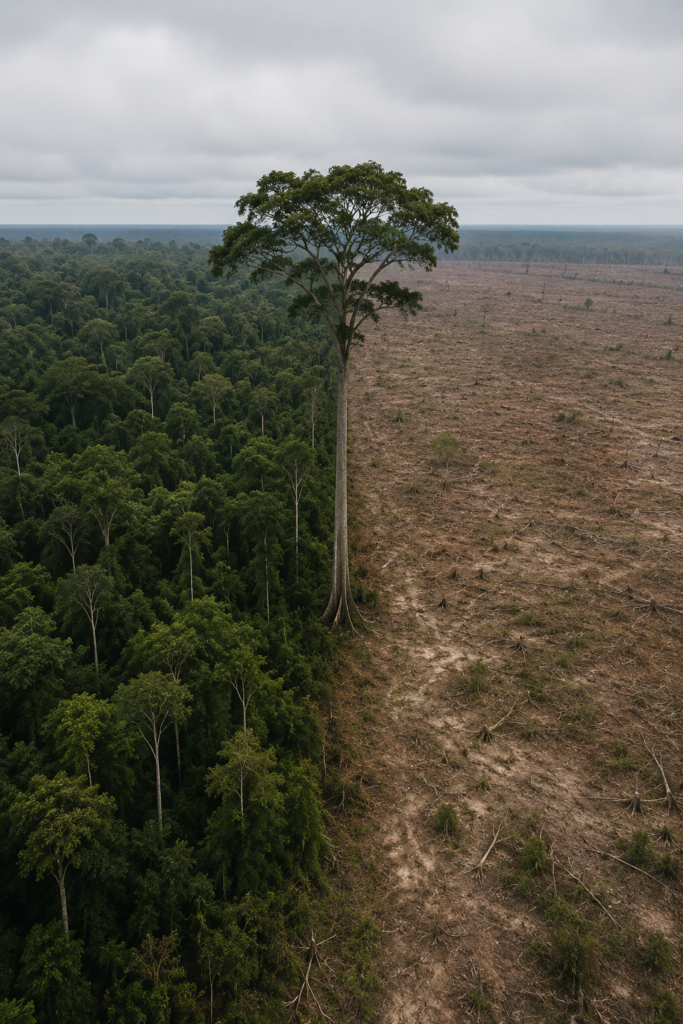
And yet the most important thing to hold onto is not the threshold. It is the choice. Unlike almost every other planetary tipping point — the melting of an ice sheet, the acidifying of an ocean — this one has a demonstrated, affordable, repeatable intervention that works within a single political term. Brazil has proved it three times: cut the monitoring and enforcement, and the forest falls; restore them, and it recovers. The Amazon is not a patient with an untreatable disease. It is a patient whose treatment is known, effective and periodically withdrawn for political reasons.
That is the genuine finding, and it is neither the despair of the collapse narrative nor the complacency of the recovery headline. The forest that makes its own rain is approaching the point where it can no longer make enough. It is close. Part of it is already past. And whether the rest follows is not a question of physics we cannot answer or economics we cannot afford. It is a question of whether the law is enforced — which means it is, uncomfortably and hopefully, a question of choice.
The pump is still running. The decision about whether to let it stop is, for now, still ours
The Numbers, and How Far to Trust Them
~50% of Amazon rainfall is recycled by the forest. Widely established in the moisture-recycling literature (Staal et al. and others); the forest transpires roughly 20% of rainfall directly, and total recycling across multiple events approaches half. Confidence: high on the ~half figure; the exact share varies by season and method.
20–25% deforestation threshold. Lovejoy & Nobre, Science Advances, 2018 (revised down from earlier ~40% estimates once fire and warming were included); assumes ~2.5°C warming. Confidence: high that this is the scientific consensus figure; medium on its precision — it is a modelled estimate, not a measured constant, and see the 2024 caveat below.
~17–20% already lost. Varies by source and definition: ~17% often cited basin-wide, closer to 20% for the Brazilian Amazon, ~13–14% by some forest-only methods (MAAP, TNC). Confidence: medium-high on the range; the spread reflects genuine methodological differences in what counts as ‘lost’, and all such figures should be given as a range.
Eastern/south-eastern Amazon is now a net carbon source. Gatti et al., Nature, 2021, based on aircraft air-sampling 2010–2018. The single strongest piece of evidence that part of the forest has already crossed over. Confidence: high.
‘Not a single basin-wide tipping point; regional transitions.’ Flores et al., Nature, 2024 (‘Critical transitions in the Amazon forest system’). An important scientific update that complicates the popular single-threshold framing. Confidence: high — and deliberately included because omitting it would overstate the single-number story.
2004–2012: deforestation cut ~80%. Well documented; attributed to INPE monitoring, IBAMA enforcement, the soy moratorium, protected-area expansion and credit restrictions. Confidence: high.
2023–2026 recovery. INPE PRODES: Amazon deforestation down ~11% in the year to July 2025 (5,796 km², third-lowest since 1988); down ~50% versus 2022; first half of 2026 the lowest for that period in a decade (1,295 km²). Burned area down ~45% in the year to Sept 2025. Confidence: high — official INPE data, corroborated by independent monitors (Imazon, MapBiomas). Note Mato Grosso rose even as most states fell.
COP30 / Tropical Forest Forever Facility. Proposed ~$125bn fund, potentially ~$4bn/year for 70+ nations; hosted at Belém, 2025. Confidence: medium on the figures and future — a proposal whose financing was unresolved at the time of writing. Date-stamp it.
To Go Deeper
Lovejoy, T. E., & Nobre, C. (2018). Amazon tipping point. Science Advances, 4(2), eaat2340. The paper that set the 20–25% threshold.
Gatti, L. V., et al. (2021). Amazonia as a carbon source linked to deforestation and climate change. Nature, 595, 388–393. The air-sampling study showing the eastern Amazon has flipped.
Flores, B. M., et al. (2024). Critical transitions in the Amazon forest system. Nature, 626, 555–564. The essential recent update — read it against the single-threshold framing.
Instituto Nacional de Pesquisas Espaciais (INPE), PRODES and DETER systems. The authoritative, near-real-time record of Brazilian Amazon deforestation and degradation.
