
Vision or Mirage?
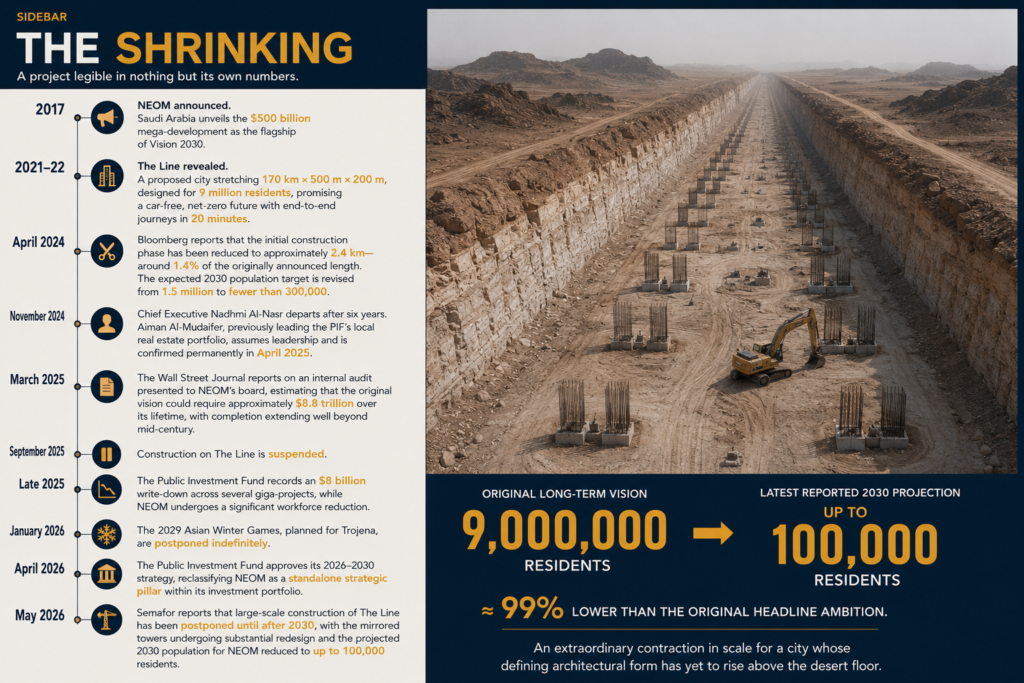
They promised a city one hundred and seventy kilometres long and five hundred metres high, walled in mirrors, home to nine million people who would never see a car. Nine years and some fifty billion dollars later, the desert holds foundations for two and a half kilometres, and nothing above ground. This is the anatomy of the most expensive idea of the twenty-first century — and of the moment a rendering lost its argument with the physical world.
The Trench
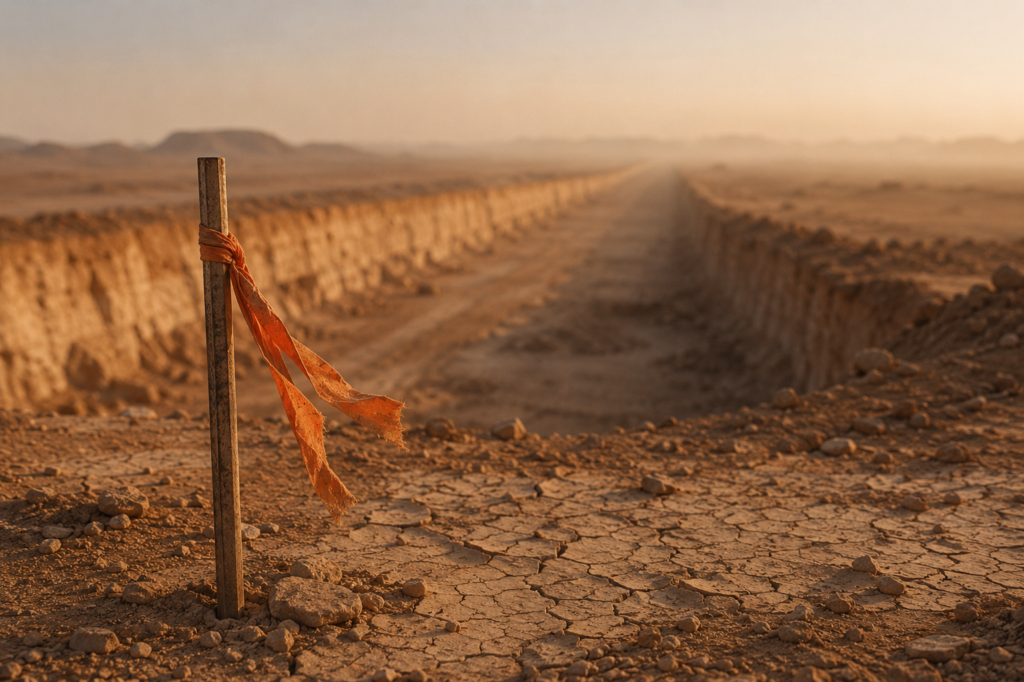
The wind arrives from the Red Sea in the early afternoon and lifts the ochre dust off the excavation floor in slow, curling sheets, and for a few minutes the corridor disappears entirely.
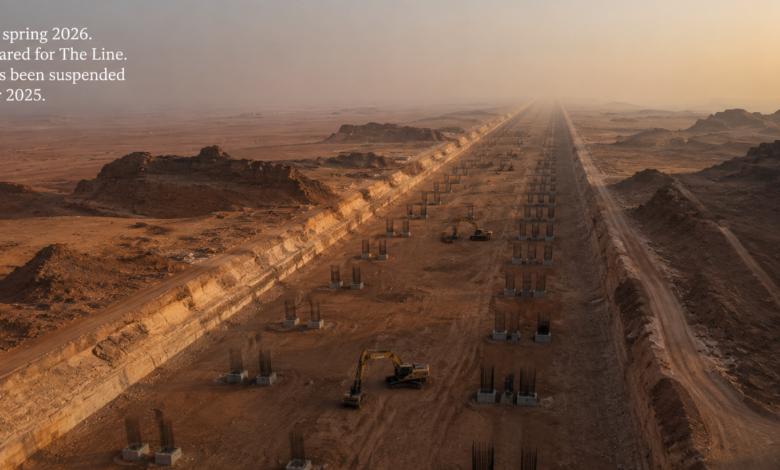
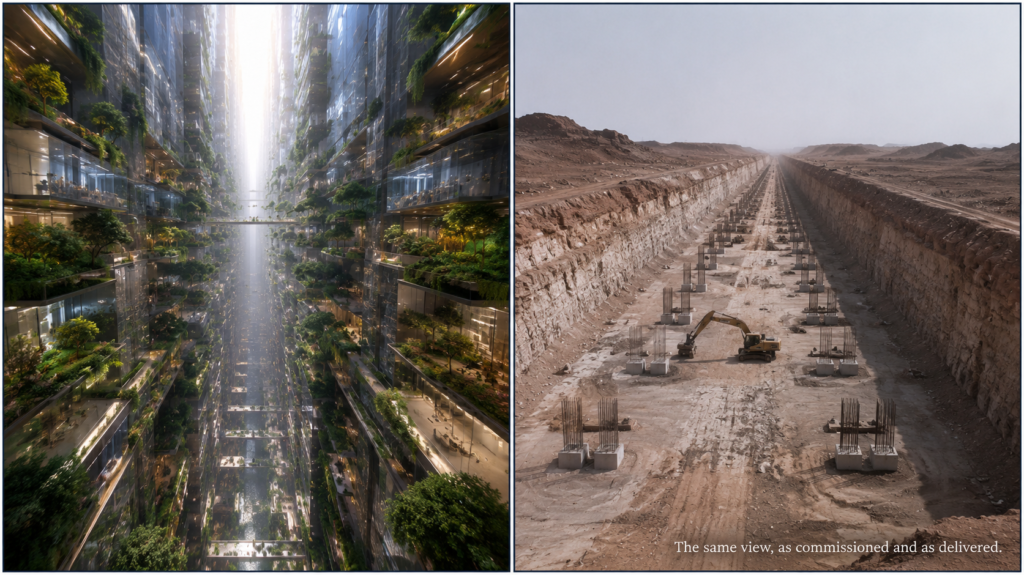
When it settles, the line is still there. It runs east from the coastal plain of Tabuk into the granite of the Hijaz mountains, unbending, indifferent to the wadis it crosses and the ridges it cuts. From altitude it reads as a scar with the confidence of a decision. On the ground it reads as something stranger: a trench, several hundred metres wide, its floor gridded with concrete pile caps and forests of rebar, the steel already going orange in the salt air. Haul roads loop away into the sand and end in nothing. Two excavators sit at the edge with their booms folded down.
There are no workers in this frame. There have not been, in any real number, since September 2025.
This is the site of The Line: the most ambitious construction project ever proposed by a modern state, and the single most successful piece of architectural imagery ever distributed. You have seen it, whether or not you can name it — the mirrored wall sliding across the desert, half a kilometre high, taller than the Empire State Building and 170 kilometres long, its glass returning the dunes to themselves so that the city vanishes into the landscape it obliterates. Nine million people. No cars. No streets. No carbon. Twenty minutes end to end.
That video is still online. It has been watched more times than any building that actually exists.
The city is not being built.
“A line is the least efficient possible shape of a city.”
— Rafael Prieto-Curiel, Complexity Science Hub Vienna
What the Arithmetic Knew in 2023
The most devastating critique of The Line cost nothing to produce, required no site visit, and was published two years before the first excavator stopped.
In June 2023, Rafael Prieto-Curiel, a mathematician, and Dániel Kondor, a physicist, both of the Complexity Science Hub in Vienna, took Neom’s own published specifications and did the sums. Their paper appeared in npj Urban Sustainability under a title that is itself an argument: Arguments for building The Circle and not The Line in Saudi Arabia.
The findings are usually garbled in the retelling, so here they are exactly.
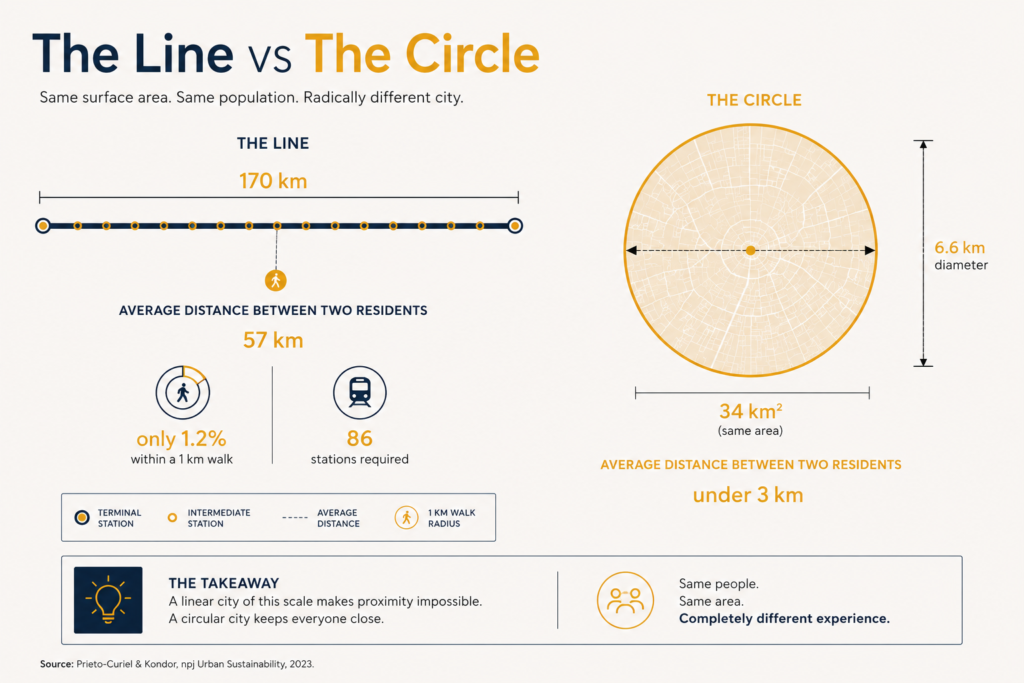
Distribute nine million people along 170 kilometres and pick two of them at random, and they will be, on average, fifty-seven kilometres apart. In Johannesburg — a city fifty times larger in surface area — two random residents are only thirty-three kilometres apart. Assume a willingness to walk one kilometre, and just 1.2 per cent of The Line’s population is within walking distance of one another.
A city sold as the apotheosis of proximity would, by the pure fact of its geometry, be the most spread-out settlement on Earth.
Then the train. The Line’s answer to distance is a high-speed underground spine promising a twenty-minute end-to-end run. But a city needs stations, and a car-free city needs them close: Prieto-Curiel and Kondor calculate that to keep everyone within a walk of a stop, The Line requires at least eighty-six stations. Eighty-six stops across 170 kilometres is a train that spends its life braking and accelerating. The advertised twenty minutes becomes kinematically unreachable — you cannot decelerate a train eighty-six times and average the speeds required, not without subjecting the passengers to forces the human body does not survive. Cut the stations, and the promised five-minute city dissolves into a string of isolated islands separated by an hour of travel.
The researchers then offered the remedy, and named it. Take the same buildable floor area — roughly 34 square kilometres — and arrange it as a circle. The diameter falls to about 6.6 kilometres. The average distance between two random residents falls from fifty-seven kilometres to under three.
Nobody at Neom has ever answered this. Not because it is unanswerable in principle, but because answering it would require conceding that the line was never an urban decision at all.
A circle does not photograph like that. A circle does not travel.
The Physics Bill
Geometry was the cheap objection. Physics sends a bigger invoice, and it arrives in four parts.
Heat. Picture a slot in the earth five hundred metres deep and two hundred metres wide, in the Saudi interior, containing several million human bodies and everything they run — appliances, industry, transport, and in later drafts of the plan, data centres. Every watt consumed inside that slot becomes, eventually, heat that has to leave it. Natural cross-ventilation, the mechanism that cools every conventional city on the planet, is precisely the thing the two parallel walls annihilate. The cooling load required to make the interior survivable would be without precedent — and cooling does not delete heat. It relocates it. The desert immediately outside absorbs the difference, along with whatever lives there.
Glass. A continuous mirrored facade 170 kilometres long would be the largest reflective surface ever assembled by human beings. It stands directly across the Gulf of Aqaba flyway, one of the busiest bird migration corridors on Earth: hundreds of millions of birds a year, a great many of them soaring species that navigate by sight and by thermals. To a migrating stork, mirrored glass is not a wall. It is sky. No mitigation technology exists at that scale, in that geometry. This objection was never solved. It was never seriously engaged.
Matter. The quietest number in the entire file, and the one that ends the conversation. Reporting on Neom’s internal audit noted that the concrete required for the first operational segment alone would exceed France’s total annual cement production. Not the 170 kilometres — the segment. Cement accounts for roughly eight per cent of global carbon emissions. A city marketed as net zero would have opened its account by emitting on the scale of an industrial nation.
Structure. Two parallel towers, half a kilometre tall, running unbroken for 170 kilometres across dunes, wadis, hard granite and mountain, along the seismically live margin of the Red Sea rift. No construction methodology exists for this. Techniques that hold over a 2.4-kilometre test section do not scale by a factor of seventy; they fail differently. That is not a resourcing problem to be solved with money. It is a different problem, wearing the costume of the first one.
The Document That Ended It
Every objection above was in the public domain by 2023, argued by people with nothing to gain. None of it stopped anything. What stopped The Line came from inside the building.
The internal audit presented to Neom’s board — reported by the Wall Street Journal in March 2025 — did not find cost overruns. Cost overruns are the ordinary weather of infrastructure; every great project in history has run over. The audit found something categorically different. It found that the city as conceived could not be built at any price the Kingdom could ever plausibly assemble.
Eight point eight trillion dollars. Roughly twenty-five times Saudi Arabia’s entire annual government budget. More than four times its GDP. Nine times the total value of the sovereign wealth fund created to pay for it. And a completion date of 2080 — beyond the working lifetime of every person who signed off on the thing.
The audit reportedly went further still. It documented what its authors called deliberate manipulation of cost projections by members of management, including internal instructions to consultants not to raise cost concerns in advance of meetings.
That sentence changes the genre of this story.
Up to that point, The Line was a tale of hubris — of an over-reaching vision colliding with an unforgiving world. Hubris is at least honest; it is the biography of the Suez Canal and the Channel Tunnel and half of modern engineering. After that sentence, The Line becomes something colder: a proposal that kept attracting capital because the people whose job was to report on it accurately had powerful incentives not to.
This is not a failure of ambition. It is a failure of the information system inside a structure where telling the chairman that his signature idea is arithmetically impossible is not a career move anyone survives.
$8.8 trillion. Twenty-five times the national budget. Completion: 2080.
The number that ended The Line as an engineering proposition — before a single residential wall was raised.
The Money, and the Firewall
The reckoning did not arrive on the site. It arrived on the balance sheet.
The Public Investment Fund booked an $8 billion write-down against its giga-projects. Its uncommitted cash fell toward $15 billion — a multi-year low — at precisely the moment its obligations multiplied: Expo 2030 in Riyadh, the 2034 World Cup, Qiddiya, Diriyah, the Red Sea resorts, a national AI build-out, and a treasury running a deficit against oil prices well beneath the level Riyadh needs to balance its books. Reported PIF construction contracting fell by around sixty per cent year on year. Western engineering firms began losing Saudi work; the money moved toward data centres and stadiums.
Then, in April 2026, came the manoeuvre that tells you how this ends.
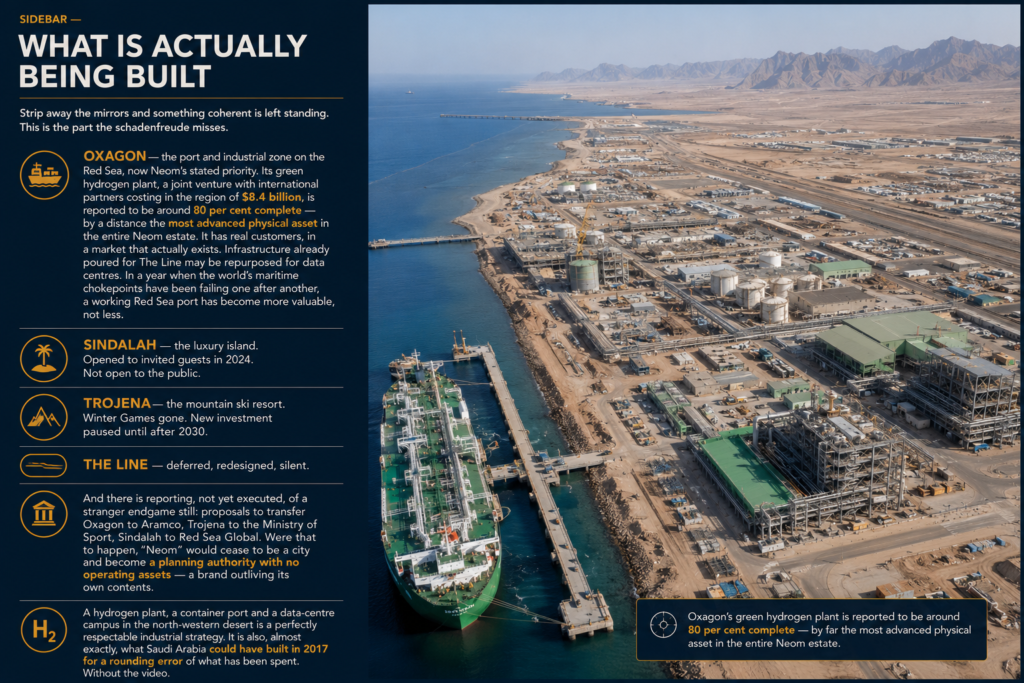
The fund’s 2026–2030 strategy organises its domestic portfolio into six pillars. Five are sectors: tourism, urban development, manufacturing, industrials, clean energy. The sixth is not a sector. The sixth is a single project — Neom — designated a standalone pillar.
Read it as a promotion if you like. Institutions do not ring-fence an asset from every other asset because it is going well. They do it when the losses need to stop contaminating the rest of the book. Regional analysts reading the allocation concluded that the greater part of Neom’s remaining five-year budget will be consumed not by building anything but by settling with contractors being paid to stop — the Kingdom spending more, over the next half-decade, to unwind The Line than to construct it.
There is a temptation, in the summer of 2026, to reach for the obvious alibi: the war with Iran, the closure of the Strait of Hormuz in February, the fiscal violence that followed. The chronology forbids it. The Line’s construction was suspended in September 2025 — five months before a single missile flew.
The trap was built inside the palace. Nobody imposed it from outside.
The Price of the Sand
None of the above is the most serious charge, and an honest account has to say so before it says anything else.
Tabuk is not empty land. It is the ancestral territory of the Huwaitat, a Bedouin tribe whose presence there long predates the state that is now clearing them from it. To open the corridor, human rights organisations — among them ALQST and Human Rights Watch — have documented forced evictions of thousands of tribe members, arrests, and death sentences handed down to those who refused to go.
In April 2020, Abdul Rahim al-Huwaiti posted a series of videos saying he would not leave his home. Saudi security forces killed him in it. The authorities said he opened fire first. His relatives said he was unarmed. Several of them were subsequently detained; some were sentenced to death.
Beyond the Huwaitat, there is the workforce. Investigations published in 2024, drawing on Saudi records and origin-country data, documented very large numbers of migrant worker deaths across Vision 2030 construction — tens of thousands nationally since 2017, in a system where cause of death is routinely recorded as “natural” and post-mortems are frequently not performed. Attributing a specific death toll to a specific site is genuinely difficult. That difficulty is itself the finding. A construction economy that cannot say how its workers died is a construction economy that cannot be audited.
Now set these facts beside the promotional language. A civilisational revolution in urban living. A new model for how humanity lives. A city built for people.
The moral defence of megaprojects has always been consequentialist. The pyramids, the transcontinental railroads, the Hoover Dam: terrible human cost, enduring public good. The argument requires the second half of the sentence to be true.
In Tabuk, the eviction happened. The killing happened.
The city did not.
The Advertisement
So: vision, or mirage?
The honest answer is neither, and the reason is the whole point.
A mirage is something that was never there. A vision is something not yet there. The Line was a third thing, and we lack a comfortable word for it: a real project — real excavators, real concrete, real contractors, real evictions, real deaths — executing an idea that the arithmetic had already disproved before the first pile went into the ground.
Because The Line was never, at root, an urban proposal. Urban proposals answer urban questions. How do people get to work. How does the air move. What does a school cost, and who pays for it. The Line answered none of those, and it was never asked to. It answered a different question, and it answered it with genius:
How does a young Crown Prince make the world stop thinking about oil, and clerics, and a journalist dismembered in a consulate — and start thinking about the future?
Judged as urbanism, The Line is among the worst ideas ever seriously funded by a sovereign state. Judged as an image — as an instrument of national repositioning, aimed squarely at sovereign wealth funds, football federations, technology founders and the wandering attention of a bored planet — it worked extraordinarily well. Riyadh has the World Cup. It has Expo 2030. It sits at every table where artificial intelligence, critical minerals and the post-oil order are discussed. Whatever else the last nine years purchased, they purchased that.
The bill has now arrived, and somebody has to sign it. An $8 billion write-down. Roughly fifty billion dollars poured into a hole in the desert. A workforce cut by a third. A sovereign wealth fund quietly constructing a firewall around its own flagship. And a corridor of land whose inhabitants were removed to make way for a city that will not be built there.
The renderings will outlive all of it. They are already, by some margin, the most-viewed architecture in human history, and they depict a place that does not exist, could not be cooled, could not be crossed, and was never going to be paid for.
That is not a vision. It is not quite a mirage either.
It was an advertisement.
We mistook it for a plan.