


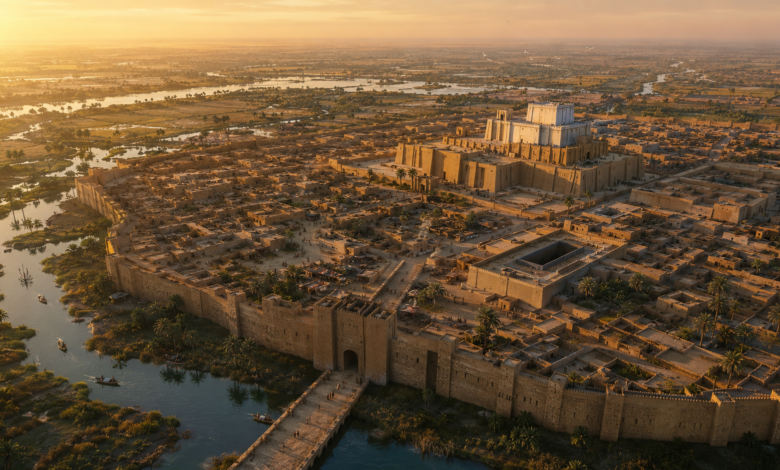
Fifty centuries before spreadsheets, a city on a shrinking river solved a problem no human community had faced before — how to trust a crowd of strangers. Its answer was not a king or a god but a clay tablet. From that ledger came writing, the state, the standard measure and the bureaucracy we still live inside.
The accountant of the House of Heaven
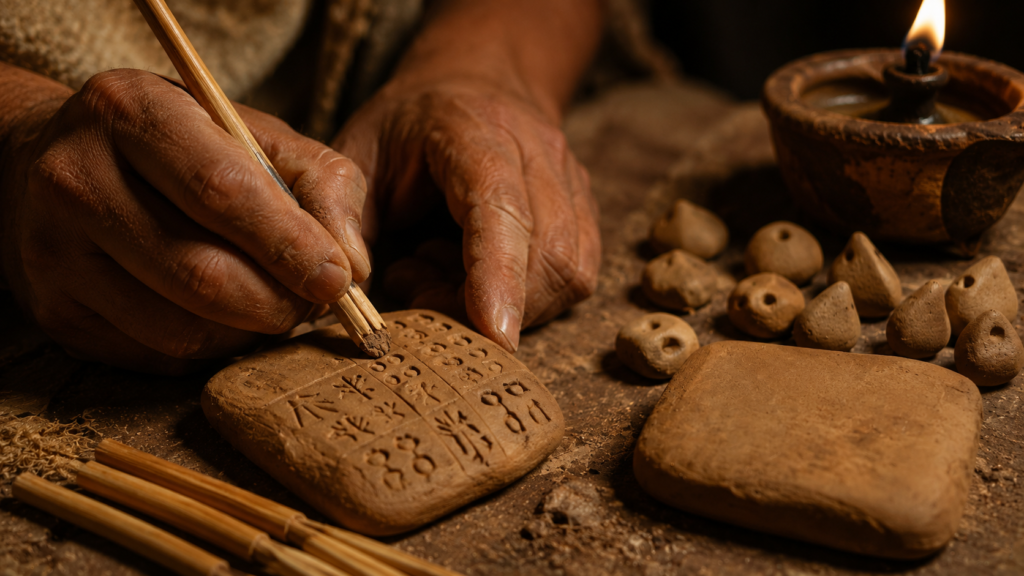
The light in the storeroom was failing, and the man with the reed worked faster because of it. In front of him lay a fist-sized cushion of river clay, still damp, its surface smoothed by his thumb. He pressed the cut end of the reed into it — once, twice, a cluster of round and wedge-shaped marks — and beside them scratched the small standardised picture of a jar, and then the sign of an ear of barley. He was not writing a prayer, or a poem, or a law. He was recording that a certain quantity of grain had come into the temple, and that a certain measure of it would go out again as rations to the people who owed their labour to the god. When the tablet dried it would be filed with thousands like it. It was, in every sense that matters, a receipt.
We do not know his name; the tablets of this period almost never give one. We know only that he worked in the Eanna, the great temple quarter of a city the Sumerians called Unug and we call Uruk, on the southern floodplain of what is now Iraq, in the last centuries of the fourth millennium BCE. And we know that in his unremarkable act of bookkeeping lies one of the most consequential inventions in the human story — not because of what he wrote, but because of why.
The conventional sentence about Uruk is that it was the world’s first city. It is a good sentence, and it may even be true, though as we shall see it is fiercely contested. But it is also far too small. Uruk did not merely gather people into an unprecedented density of mudbrick. It confronted, for the first time at scale, a problem that no village had ever needed to solve: how do thousands of strangers, most of whom will never know one another, cooperate reliably enough to eat? The city’s answer to that question was a set of inventions so fundamental that we no longer see them as inventions at all. We call them writing, administration, standardised measurement, the impersonal state. They began here, and they began as accounting.
The first city did not start with a king or a story. It started with a receipt.

A world without strangers
The farming villages of the Ubaid period, which spread across southern Mesopotamia in the sixth and fifth millennia BCE, worked more or less on this human scale. They had temples, some social ranking, real skill in pottery and irrigation. What they did not have was the specific, grinding problem of the metropolis: the need to coordinate the labour and provisions of a population too large to know itself. A settlement of a few hundred is an extended family with disagreements. A settlement of tens of thousands is something categorically different. It is a society of strangers, and a society of strangers cannot run on memory.

This is the hinge on which the whole story turns, and it is worth stating plainly because it is so easily missed. The institutions we are about to watch Uruk assemble — the account, the seal, the standard measure, the ration list — are not luxuries that a rich city could afford. They are the load-bearing machinery that made the city possible in the first place. Take them away and the crowd does not become a simpler city; it stops being a city at all and disperses back into villages. The metropolis and the ledger were born together, because neither could exist without the other.
Why here: the wealth of a poor land
There is a paradox at the heart of Uruk’s rise, and the historian Guillermo Algaze has made it central to how we now understand the city. Southern Mesopotamia is, in raw terms, a poor place. The alluvial plain between the lower Euphrates and Tigris has almost nothing a complex society is supposed to need. No stone for building or tools. No metal ores. No timber worth the name. Rainfall too meagre and unreliable to farm without help. By the ordinary logic of geography, civilisation should not have concentrated here first.
And yet it did, precisely because of what the plain does possess: flat, staggeringly fertile silt, laid down over millennia by the two rivers, and the water of the rivers themselves. Lead that water into fields through canals and the barley yields become extravagant — a surplus far beyond what the farmers themselves consume. That surplus is the raw material of everything else. It feeds people who do not grow food: potters, weavers, metalworkers, builders, and the administrators who keep track of them all. Algaze’s argument is that the very poverty of the land was a spur. A society sitting on a mountain of grain but lacking stone, metal and wood is a society compelled to trade, and to organise itself well enough to trade at scale. Scarcity, not abundance, drove the managerial revolution.
The rivers gave with one hand and menaced with the other. The Euphrates does not run in a single fixed bed but wanders across the plain over centuries, and much of the early landscape was not dry field but shifting marsh and waterway — a Mesopotamian Venice, in the phrase archaeologists now use for Uruk, threaded with canals and reed islands. Living well here meant reading the water: digging and dredging canals, timing the sowing to the flood, storing grain against the years the river failed. None of that is the work of a single household. It is collective labour, sustained across seasons, and collective labour has to be organised, fed and accounted for. The canal and the account are the same project seen from two angles.
| Reading the evidence How we date a city with no calendar Uruk left no dated records of its own founding. Its chronology is built instead from stratigraphy — the layered mounds of a site occupied for four thousand years — cross-checked against pottery styles and, increasingly, radiocarbon dates from organic material in the debris. Archaeologists label the phases by excavation levels: the Ubaid, then the Uruk period (roughly 4000–3100 BCE), subdivided into Early, Middle and Late, then the Jemdet Nasr period (about 3100–2900 BCE). The famous inscribed tablets belong to the levels called Uruk IV and Uruk III. All dates in this article are approximate and, for the earliest phases, still moving. Recent radiocarbon work has tended to push the first writing earlier than the round figure of 3200 BCE long quoted in textbooks. |
Building the first metropolis
Uruk did not begin as one city but as two. Two sacred settlements, Kullaba and the Eanna, grew toward each other on the plain until, over the Uruk period, they fused into a single sprawling whole. This detail matters, because it hints that the first city was less a thing that was founded than a thing that accreted — villages flowing together under some pressure of advantage until their edges dissolved.
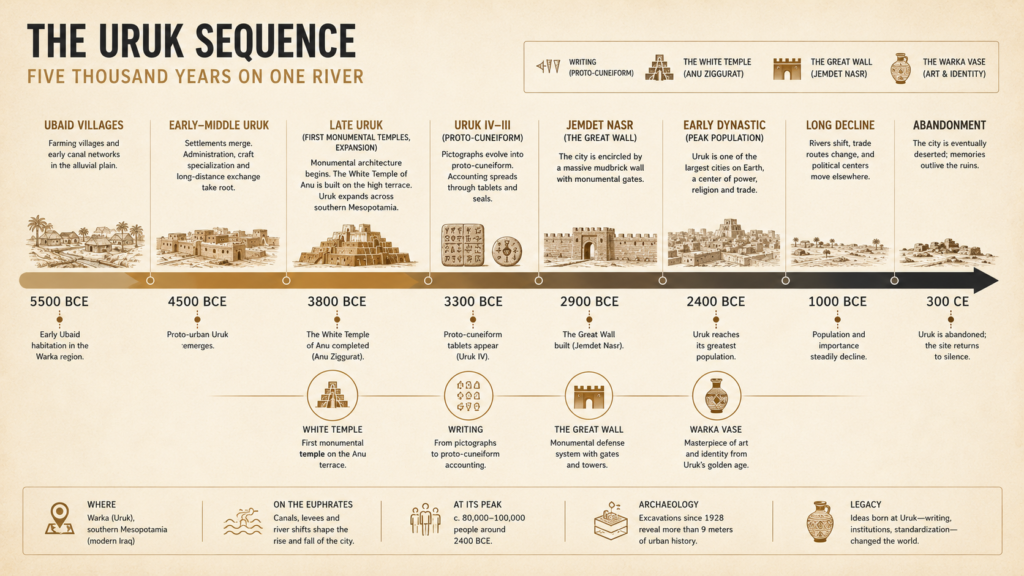
What they became was, for its moment, staggering. At its height the walled city enclosed on the order of four hundred and fifty hectares — several square kilometres of continuous urban fabric — and estimates of its population, while genuinely uncertain, commonly land around forty thousand people within the walls, with tens of thousands more in the countryside it commanded. For the late fourth or early third millennium BCE, these are numbers without precedent anywhere on Earth. Nothing else came close.
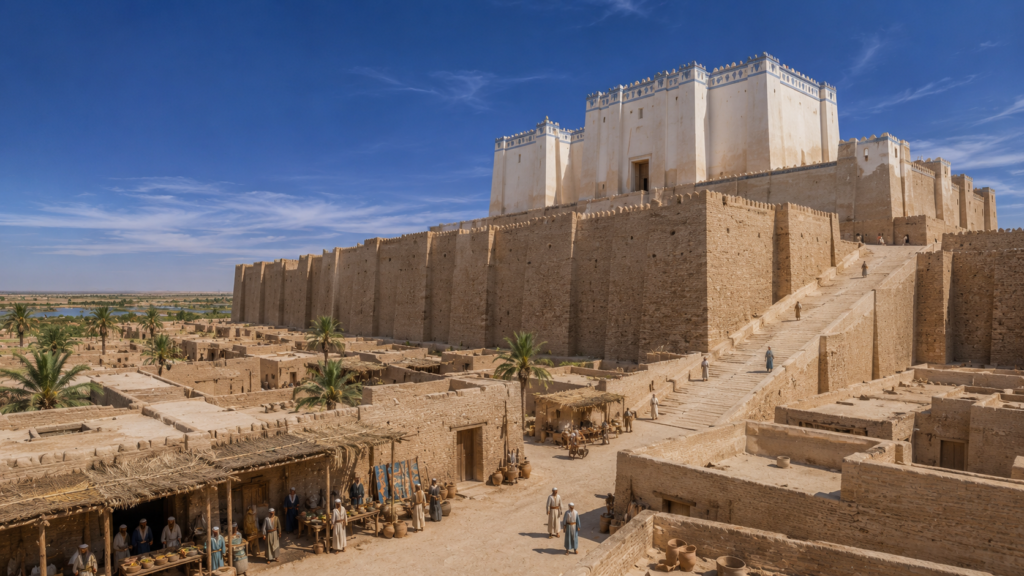
At the centre rose two temple complexes that doubled as the engines of the city. On the Anu terrace, a stepped mudbrick platform built up over centuries, stood a shrine so brilliantly whitewashed that archaeologists named it the White Temple; it caught the sun above the flat plain and could be seen, it is thought, from far beyond the walls. Nearby lay the Eanna, the House of Heaven, sacred to the goddess Inanna, a dense palimpsest of temples and courts rebuilt again and again on the same holy ground. The builders had no stone, so they made monumentality out of mud — sun-dried brick by the million — and they clothed the most important façades in a technique that is unmistakably Uruk: thousands of small clay cones, their ends dipped in black, red and white, pressed into wet plaster to form shimmering geometric mosaics. Denied marble, they invented a way to make mud glitter.
Later tradition would credit the city’s great wall to Gilgamesh, the semi-legendary king whose name heads the Sumerian King List and whose epic is the oldest long poem humanity has kept. The wall archaeologists have traced — some nine and a half kilometres of it — was probably raised in the centuries just after the classic Uruk period, and no inscription ties a single brick of it to a historical Gilgamesh. But the association is telling. When the Mesopotamians wanted to praise a king, they praised him as a builder of walls and a maker of order. Kingship, when it came, defined itself against the city it claimed to protect.
The House of Heaven was a warehouse
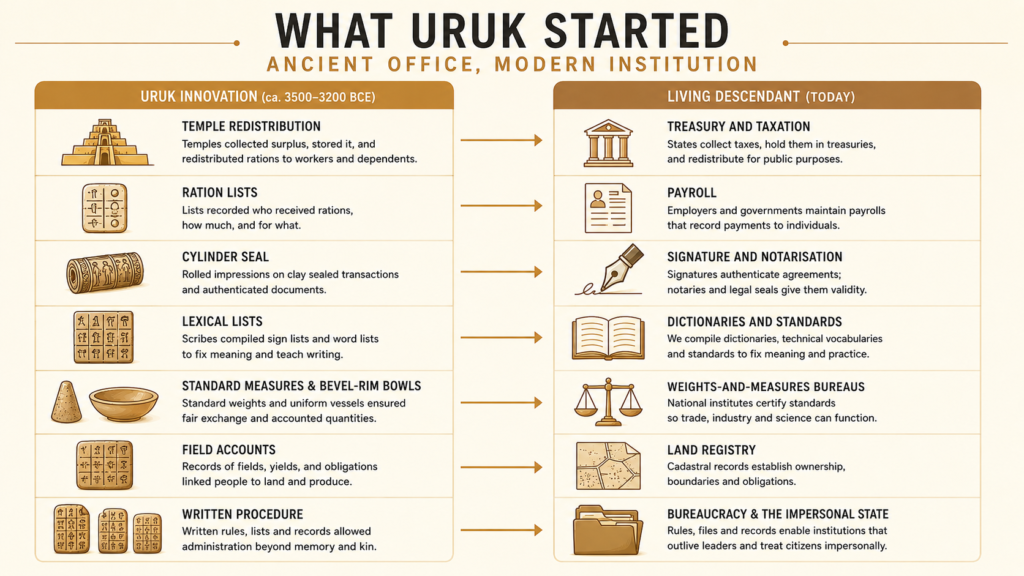
To modern eyes the word temple suggests a place set apart from economic life. In Uruk it was economic life. The great precincts were not only where the gods were served; they were the city’s central institutions — granaries, workshops, herds, storehouses and the offices that managed them, all held in the name of a deity. Grain, livestock, wool, dates and beer flowed in as offerings, dues and the yield of temple estates, and flowed out again as rations to the labourers, artisans and dependants the institution supported. The temple was, functionally, a redistributive engine: a machine for gathering the surplus of a whole society and sharing it out under central control.
No object captures this better than the carved alabaster vessel found in fragments in the Eanna and known as the Warka Vase — well over a metre tall, dating to around 3200 to 3000 BCE, and among the earliest works of narrative sculpture anywhere. Its carved bands read from bottom to top like a diagram of the economy itself. At the base, water and cultivated plants: the irrigated abundance of the plain. Above them, a file of rams and ewes: the herds. Above them, a procession of men carrying baskets and jars heaped with produce. And at the summit, that produce is presented to the goddess Inanna, represented by her looped reed emblems, before her storehouse of goods. The whole vessel is a single argument in stone: the wealth of the land rises through the people and is gathered to the temple, which holds and redistributes it. It is the temple economy carved as scripture.
Who exactly ran this machine, and how much of the economy it controlled, is one of the field’s long arguments. An older view, associated with the German scholars Anton Deimel and Adam Falkenstein, imagined an almost total temple-state in which the sanctuary owned essentially everything and everyone worked for it. Later historians — Ignace Gelb, Benjamin Foster and others — pushed back hard, showing that private households, family land and other centres of power coexisted with the temples; the economy was plural, not a single sacred monopoly. The modern consensus sits between the poles: the great institutions were dominant and set the terms, but they never swallowed the whole of society. What matters for our story survives the argument intact. Power in early Uruk expressed itself first as administration — as the management of stores and labour and accounts — and only later hardened into the familiar shape of monarchy. Before the throne, there was the office.
Before the city had a king it had an administration. Power here began as bookkeeping and only later put on a crown.
Why writing was invented
Here is the fact that ought to overturn a cherished assumption. The oldest substantial body of writing on Earth is not literature, or scripture, or law. It is administration. Of the roughly five thousand inscribed tablets recovered from Uruk and its immediate successors, the overwhelming majority are economic documents — accounts of grain, livestock, land, labour, textiles and beer. In the corpus from the Uruk III phase, of some forty-nine hundred texts, only around seven hundred are of the other early genre — lexical lists, to which we will return — and the rest, more than four in every five, are bookkeeping. Writing does not begin with someone trying to record speech. It begins with someone trying to record stock.
Why should this be? Return to the problem of the city of strangers. A temple gathering grain from hundreds of suppliers and paying out rations to hundreds of workers cannot run on trust and memory. It needs a durable, checkable record of who delivered what and who is owed what — a record that outlives the particular official and cannot be quietly rewritten. Writing is the technology that met that need. The city did not invent writing and then discover it was useful for accounts. It invented accounts, and writing was what accounts became when they grew too complex to hold any other way.
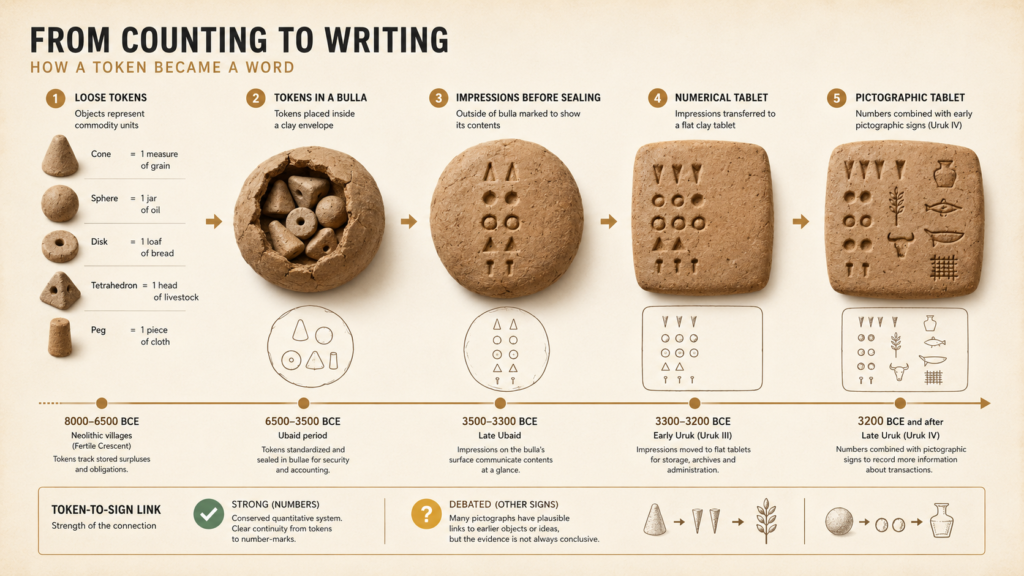
The deep prehistory of this leap is one of the most elegant, and most disputed, ideas in archaeology. From at least the eighth millennium BCE, communities across the Near East used small clay tokens of standard shapes — cones, spheres, disks, cylinders — as counters, each shape standing for a unit of some commodity: a measure of grain, a jar of oil, a head of livestock. In the fourth millennium, administrators began sealing bundles of these tokens inside hollow clay balls, called bullae, to certify a transaction — a tamper-proof envelope of obligations. The archaeologist Denise Schmandt-Besserat argued that the crucial step to writing happened on the surface of those envelopes: to show what was sealed inside, officials pressed the tokens into the wet clay of the ball before enclosing them, and eventually realised that the impressions on the outside made the tokens within redundant. The three-dimensional counter collapsed into a two-dimensional sign; the sealed ball flattened into a marked tablet; and the marks, once freed from the clay, could multiply into a script.
It is a beautiful account, and it is not universally accepted. Scholars including Robert Englund and Paul Zimansky have pointed out that, beyond the numerical notations, clean one-to-one matches between specific tokens and specific written signs are hard to demonstrate; the earliest sign forms probably drew on several sources, not tokens alone. So the field holds two things at once. That writing grew out of the machinery of accounting is broadly agreed. That it descends in a straight line from Schmandt-Besserat’s tokens is a strong claim still under argument. We can tell the reader both, and should.
There is a second, quieter first here, and it deserves more attention than it usually gets. Alongside the accounts, Uruk’s scribes produced lists — standardised catalogues of signs grouped by category: kinds of officials, professions, animals, vessels, place names. These lexical lists were copied and recopied, handed down almost unchanged for centuries across sites hundreds of kilometres apart. They are, in effect, the world’s first reference works and the first curriculum: an attempt to fix and transmit a body of knowledge beyond any single memory. The same instinct that produced the ledger produced the encyclopaedia. Both are technologies for defeating forgetting.
One caution the tablets themselves impose: we cannot be sure what language stood behind these earliest signs. The script records quantities and things, not grammar, so it rarely betrays the speech of its makers. Later Mesopotamian writing renders Sumerian, and most scholars assume a Sumerian-speaking milieu at Uruk, but the archaic tablets keep that inference cautious rather than certain.
| The Uruk III written corpus | Approx. count | Share |
| Administrative accounts | ~4,200 texts | ~85% |
| Lexical lists (word-lists) | ~700 texts | ~14% |
| Total catalogued | ~4,900 texts | 100% |
The earliest large body of writing is a filing cabinet, not a library. Figures after the archaic-text corpus of the Uruk III phase; counts are approximate.
Standardising the world
A ledger is only as good as the units it counts in. If a measure of barley means one thing to the supplier and another to the store, the whole system of trust collapses. So the same administrative impulse that produced writing produced its indispensable twin: standardisation. Uruk’s accountants worked with fixed metrologies for grain, area, labour and time, and with an approach to number that would echo down five thousand years. Mesopotamian counting was built around the base of sixty — the sexagesimal system whose fossil survives in our sixty-minute hour, our sixty-second minute and the three hundred and sixty degrees of the circle. Its full mathematical flowering came later, but its roots are here, in the number-signs of the archaic accounts, where quantities were already reckoned in interlocking systems tuned to what was being measured.
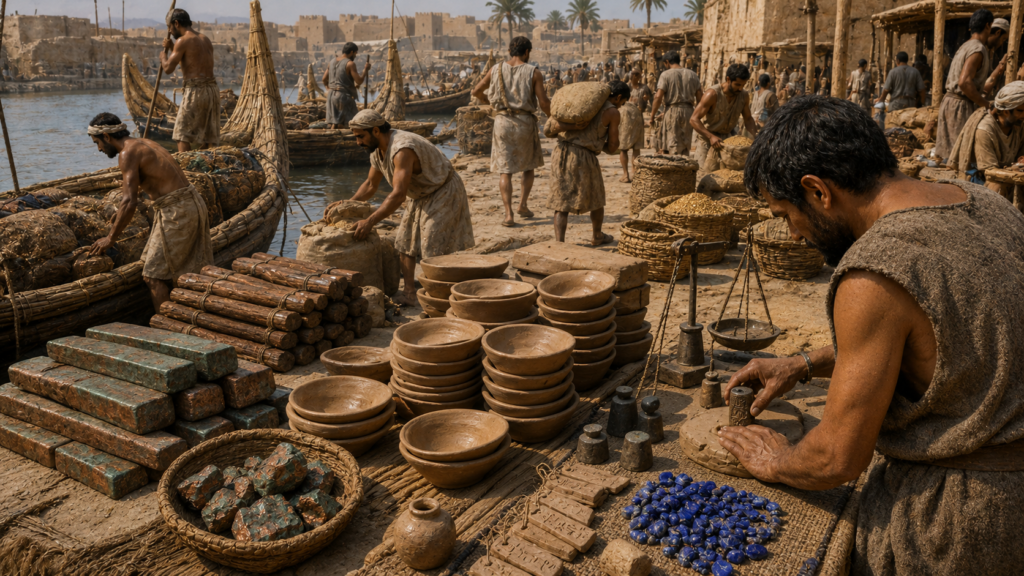
The most eloquent artefact of Uruk standardisation is also its ugliest. The bevel-rim bowl is a coarse, thick-walled, undecorated clay cup, mass-produced in the millions and so ubiquitous that it makes up something like three-quarters of all the pottery found at Uruk-culture sites. Wherever the Uruk world reached, these crude bowls appear, roughly uniform in size, discarded in heaps. They are among the earliest evidence anywhere of the mass production of a single standardised object — a production line in clay.
What were they for? The leading interpretation reads them as ration containers: standardised measures in which the temple or estate paid out grain, or perhaps baked bread, to the labourers it fed — an edible wage, issued in a bowl of fixed volume. On this view the bevel-rim bowl is a pay-stub in ceramic, and one of the first hard traces of organised, compensated, non-kin labour in history. Others are sceptical, arguing that the bowls are not in fact standardised closely enough to be trusted measures and proposing other uses, from bread moulds to salt production. The debate is unresolved and worth presenting as such. But even the cautious reading leaves the headline standing: a society that produced a single object in such numbers, to such a pattern, had crossed into standardised industrial output and the managed labour that goes with it.
There was one more instrument of trust, small enough to wear on a cord. The cylinder seal — a little engraved stone drum rolled across wet clay to leave a continuous frieze — let an official stamp a jar-stopper, a door-lock or a tablet with a mark that was theirs alone. It is, in effect, the first signature: a portable, hard-to-forge token of authority and consent, binding a named responsibility to a specific act. The seal did for individuals what standardisation did for goods. It made accountability impersonal and transferable — no longer a matter of a face remembered, but of a mark that any stranger could verify. Notarisation, authentication, the audit trail: they start as a stone rolled through mud.
| Contested ground Four arguments still running Was Uruk truly the first city, or one of several? Northern sites, above all Tell Brak, complicate the southern claim (see below). Did writing descend directly from clay tokens? The accounting origin is agreed; the strict token-to-sign lineage is not. What were bevel-rim bowls for? Ration measures, bread moulds and other uses are all defended; their standardisation is itself disputed. How total was the temple economy? Once imagined as owning everything, it is now seen as dominant but sharing the field with private households. |
The first world system
A city that produces grain, cloth and pottery in surplus but has no stone, metal or timber must reach outward or stagnate. Uruk reached — with a vigour that has led some scholars to speak, provocatively, of the world’s earliest colonial network. Across the fourth millennium, unmistakably Uruk material culture appears far from the southern plain: the same bevel-rim bowls, the same seal styles, the same administrative habits, turning up along the Euphrates into Syria, up into the Zagros foothills of Iran, and into southeastern Anatolia. Bevel-rim bowls have even been found on the coast of the Gulf of Oman, near what is now Pakistan — the debris of a reach that spanned a subcontinent.
Some of these are not merely trading contacts but transplanted pieces of Uruk itself. At Habuba Kabira, on the middle Euphrates in Syria, archaeologists uncovered a planned town of the Late Uruk period laid out on a deliberate grid, with a city wall, gates and streets — southern urbanism exported wholesale, roughly thirteen hundred kilometres from home, and then, after a few generations, abandoned. Outposts at Godin Tepe in the Zagros and Hacınebi in Anatolia show southerners living among, and trading with, local communities at the sources of the very materials the plain lacked: copper, timber, silver, lapis lazuli, semi-precious stone. Algaze has framed this whole phenomenon as an early world system — a resource-hungry core drawing raw materials from a periphery it partly colonised and partly simply influenced.
As always, the interpretation is contested at the edges. Were these outposts colonies in any political sense, or trading enclaves, or local emulations of a prestigious southern style? The mix surely varied from site to site. But the core observation is secure and remarkable: within a few centuries, the institutions and even the tastes of one city on the lower Euphrates had propagated across the whole of the ancient Near East. The city was not only a place. It was a template, and it travelled.
The northern rival: was Uruk really first?
For a century the story of the first city was a story of the south — of Uruk and its Sumerian neighbours, with the plains of southern Iraq as the singular cradle of urban life. In the last two decades that story has been unsettled from an unexpected direction: the north. At Tell Brak, in the Khabur plains of northeastern Syria, Joan Oates, Augusta McMahon, Jason Ur and their colleagues have documented a settlement that was already growing to genuinely urban scale in the fifth millennium BCE — early enough to rival, and by some measures precede, the southern giants.
What is most striking is not only the date but the shape of the growth. Surveys of Brak and its surroundings suggest a city that assembled itself from the outside in: separate clusters of settlement around a central mound, expanding toward one another until they coalesced. That is close to the opposite of the tidy, top-down model in which a central authority plans a city into being. It hints that early urbanism could emerge in more than one way, and in more than one place, rather than radiating from a single southern source. And the northern evidence carries a darker note: mass graves at Brak, studied by Augusta McMahon and colleagues, record episodes of lethal violence during the very period of the city’s growth — a reminder that the first cities were arenas of conflict as much as cooperation, and that crowding strangers together solved some problems by creating others.
How should a responsible account weigh this? Not by crowning a new single winner. The honest reading is that urbanism was probably polycentric — that large, complex settlements arose around the same broad era in both the north and the south, by somewhat different routes. What remains distinctive about Uruk is subtler and, for our argument, more important than being first through the door. It is that Uruk is where the administrative technology of urban life — the writing, the sealing, the standardised accounting that let a city of strangers be governed at scale — was carried furthest and preserved best. Brak may show that the city had more than one birthplace. Uruk shows most clearly how the city learned to keep its own books. The renversement survives the revision: the deepest invention was never the crowd of mudbrick. It was the ledger that made the crowd governable.
Tell Brak suggests the city had more than one cradle. Uruk shows most clearly how the city learned to keep its books.
The reach of an idea, and its limits
How far did Uruk’s influence travel, and how much of later civilisation can honestly be laid at its door? Here rigour demands as much restraint as enthusiasm. The clearest long-distance echo runs toward Egypt. In the centuries around 3300 to 3100 BCE, as the Egyptian state was forming, a set of distinctly Mesopotamian features surfaces in the Nile valley: the cylinder seal; recessed, niched mudbrick façades of a type long used in the south; and certain artistic motifs, most famously the ivory-handled Gebel el-Arak knife in the Louvre, whose carved scene of a hero mastering two beasts is Mesopotamian to its bones. That contact happened is not in doubt. How it happened — through trade, intermediaries, travelling craftsmen, or the mere prestige of southern forms — and how decisive it was for Egypt’s own trajectory, remains a genuine scholarly debate. Egypt was no passive imitator; it took a few ideas and made something wholly its own. The influence is real; its magnitude is argued.
Other connections the popular imagination likes to draw deserve more caution still. Direct Uruk influence on the distant Indus Valley is not something the evidence supports; sustained contact between Mesopotamia and the Indus belongs to the third millennium, generations later, and flowed as trade between mature civilisations rather than as anything Uruk seeded. It is better history — and, incidentally, better practice under any honest editorial standard — to name that limit than to paper over it. The story of Uruk is extraordinary enough without inflating it.
And then there is Gilgamesh, the figure through whom most people meet Uruk at all. The Sumerian King List places a Gilgamesh among the early rulers of the city; later poets made him the hero of an epic about mortality, friendship and the walls of Uruk themselves. Whether a flesh-and-blood king of that name walked the city we cannot prove and probably never will. But the legend preserves a genuine historical truth in mythic form: that Uruk’s people understood their city as a made thing, a work of collective construction embodied in its walls, and worth an epic. The first city was also the first to sing about itself.
Why we still live inside Uruk
Walk the machinery of any modern state and you are walking through rooms Uruk furnished. A treasury that gathers revenue and disburses it is the temple’s redistributive store under a secular name. A tax roll is a list of who owes the centre what. A payroll is a ration list. A land registry is the descendant of the field-and-surface accounts Uruk’s scribes kept of who held which plot. A signature, a notary’s stamp, a chain of authenticated approvals — these are the cylinder seal, rolled through mud, made into paper and pixels. Standards bureaus that fix the exact length of a metre or the precise content of a litre are doing, with lasers, what the keepers of the bevel-rim bowl did with clay. And the reference shelf — the dictionary, the code, the standard that everyone agrees to consult — is the lexical list, copied and handed down so that knowledge outlives the knower.
Above all, Uruk bequeathed the idea that made all of these possible: that a society can be run by impersonal, written, checkable procedure rather than by personal memory and face-to-face trust. That is the true meaning of bureaucracy, a word we use as an insult and could not survive a week without. It is what lets a stranger transact with a stranger, a citizen with a state, across distances of space and time that no relationship could bridge. We did not inherit it from Rome, or from the Enlightenment. We inherited it from a temple storeroom on a shrinking river, five thousand years ago.
There is a final inheritance, and it is a warning. Uruk’s wealth rested on irrigation, and irrigation on the southern plain carries a slow poison: water drawn across hot, flat land evaporates and leaves its salt behind, and over centuries the salt creeps up into the soil and strangles the crops. The same intensive cultivation that fed the first city also degraded the ground beneath it — one of the earliest documented instances of an environment wrecked by the very success it enabled. The Euphrates eventually wandered away from the walls; the fields soured; the population thinned. By late antiquity Uruk was all but empty, its temples melting back into the mounds from which their bricks had come.
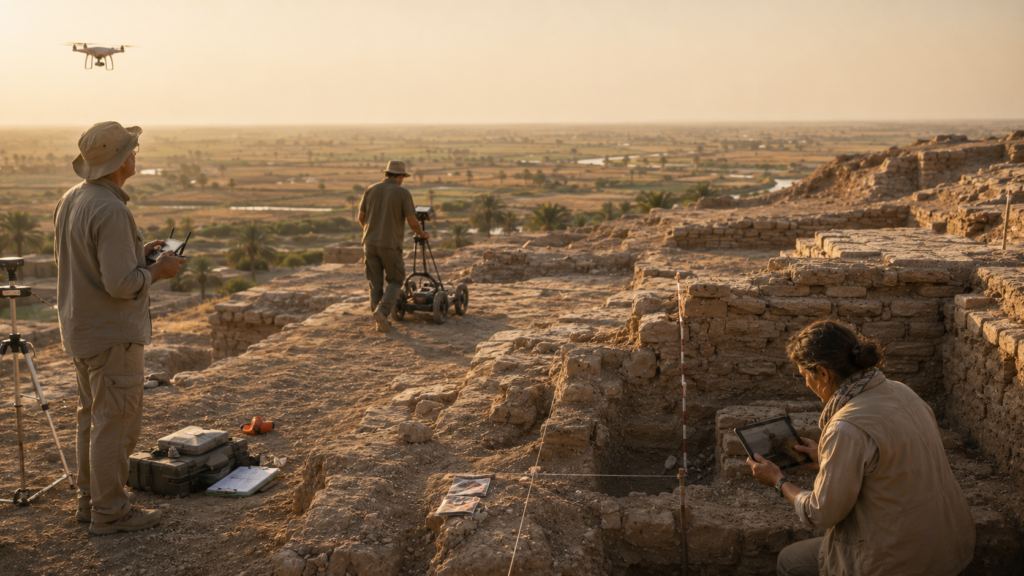
Today those mounds are being read again, and by instruments Uruk’s scribes could not have dreamt of. For more than a century the German Archaeological Institute has excavated at Warka; in recent decades its teams, working with geophysicist Jörg Fassbinder and the archaeologist Margarete van Ess, have mapped the buried city with caesium magnetometers, tracing walls, canals, gates and houses metres beneath the surface without turning a single spade of earth. Winged drones photograph the ruins into precise digital models. The oldest bookkeeping on Earth is now itself an object of measurement — the counted city, at last, being counted.
The man with the reed in the failing light could not have imagined any of it: the magnetometer, the tax office, the payroll, the signature, the state. He was only trying to make sure the grain added up. But in insisting that it add up — that a promise be written, a measure be fixed, a responsibility be sealed — he and the thousands like him built the quiet foundations on which every later city, including ours, still stands. Uruk did not merely become the first city. It wrote the operating system of civilisation, and we are running it yet.
We did not inherit the ledger-run society from Rome or the Enlightenment. We inherited it from a temple storeroom on a shrinking river.