


Everyone knows rockets now land themselves. Far fewer can say what that actually changed. The honest answer is not the one on the billboards: the sticker price per kilogram fell less than advertised, while the thing that truly exploded was the flight rate. This is an attempt to measure the revolution rather than admire it.
The day the rocket came back
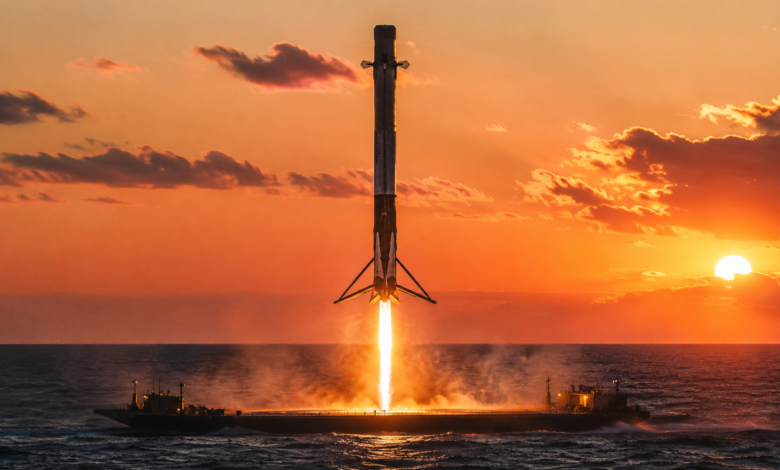
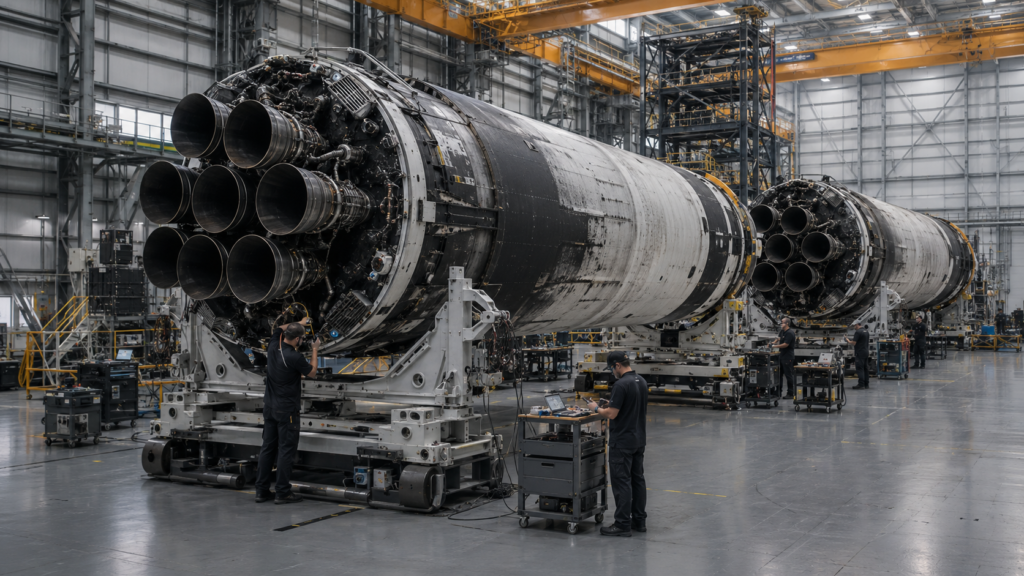
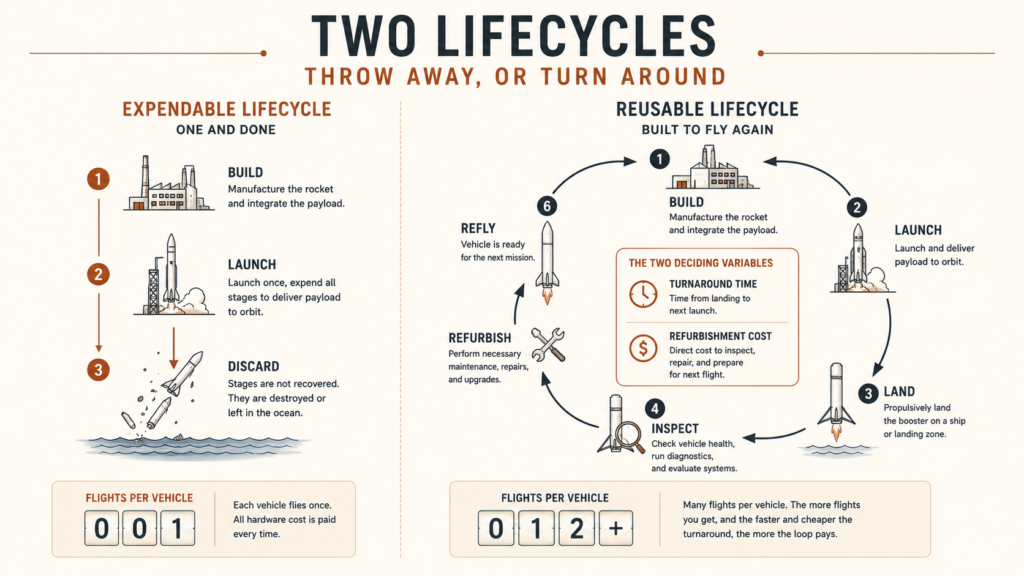
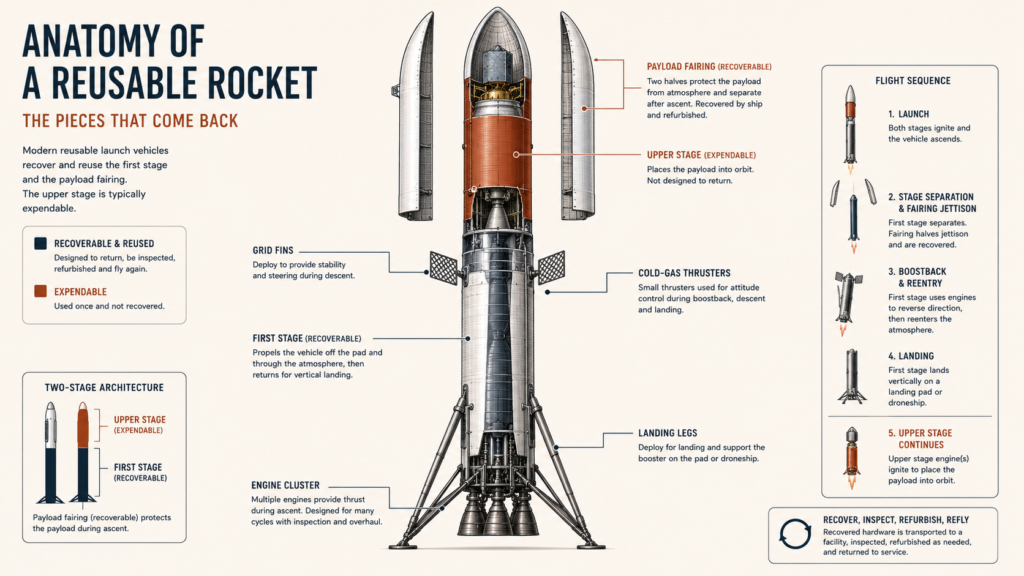
A recovered rocket does not look triumphant up close. It looks used. Walk the deck of the droneship after the ship has been towed back to port and the first stage that stands there is streaked with soot, its aluminium-lithium skin darkened where the descent burn licked back up the airframe, the nozzles of its nine engines glazed and discoloured by heat they were never, in the old way of doing things, meant to survive. Engineers move around it with borescopes and checklists, peering into turbopumps, mapping every scorch. The question they are asking is not whether the thing flew. It obviously flew. The question is whether it can fly again soon, and cheaply, and safely — and that question, not the fire and the landing, is where the revolution actually lives.
For most of the space age, this scene was impossible, and not for want of imagination. Engineers had sketched reusable rockets since before the first satellite reached orbit. The problem was that nobody could make the economics and the physics agree. A rocket spends almost all of its mass on propellant; the hardware is a thin, exquisitely expensive shell wrapped around a controlled explosion. To bring the most valuable piece of that shell — the first stage, with its costly engines — back through the atmosphere and set it down intact, you must carry extra fuel to slow the fall, which eats into the payload you were paid to lift. For decades the consensus held that the trade was not worth it: that a rocket, like a rifle cartridge, was simply something you spent.
Then the stages began to return. The first controlled landing of an orbital-class booster came in December 2015, when a Falcon 9 first stage settled back onto a pad in Florida minutes after sending its payload toward space. What had been a staple of science fiction became, over the following decade, a matter of routine — so routine that by 2025 a single company was landing boosters more often than most nations launched at all. But routine is not the same as understood. The landings are televised; the accounting is not. This article asks a deceptively simple question: how would we actually measure whether reusability changed spaceflight — and what does the measurement show once we stop watching the fireworks?
A recovered booster does not look triumphant. It looks used. The revolution is not in the landing; it is in what happens after.

Why spaceflight was built to be thrown away
To understand what changed, you have to understand why the disposable rocket made sense for so long. It was not stupidity or lack of ambition. It was arithmetic, institutions and risk, braided together into a system that resisted change for fifty years.

The arithmetic first. Reaching orbit is uniquely unforgiving. To stay in low orbit an object must travel at roughly seven and a half kilometres per second — fast enough to cross a city in the time it takes to read this sentence — and a rocket must burn through the overwhelming majority of its launch mass as propellant to get there. What remains for structure, engines and payload is a sliver. In that regime, every kilogram set aside for landing hardware, legs, steering fins and reserve fuel is a kilogram of paying cargo you forgo. For a long time the recoverable value seemed smaller than the payload it would cost you.
Then the institutions. The launch business of the twentieth century was largely a government business, and governments were buying missiles first and space launchers second. Expendability was baked into the DNA of the vehicles because it was baked into the ballistic weapons they descended from. Contracts were written cost-plus, which rewarded building new hardware rather than reflying old; and cadence was low enough — a handful of flights a year — that no operator felt the pressure of a production line straining to keep up. When you launch a dozen times a year, throwing the rocket away is an expense. When you aim to launch a hundred and sixty times a year, it becomes an impossibility. The old market never generated the demand that would have made reuse pay.
Finally, risk. A reused rocket is a rocket with a history, and history in aerospace has usually meant accumulated fatigue: micro-cracks, heat damage, the thousand small insults of a first flight. The engineering culture that grew up around human spaceflight was, understandably, terrified of flying tired hardware. The burden of proof sat on reuse to show it was not quietly trading money for reliability. That burden could only be discharged by data — by flying the same hardware again and again and measuring what broke. Nobody had that data, because nobody had been allowed to gather it.
The engineering of coming back
Landing a booster is often described as balancing a broom on your palm, and the image is apt, but it undersells the specific problems that had to fall, one by one, before the broom would stand. Each was a genuine barrier; none was solved by a single stroke of genius so much as by relentless, instrumented iteration.
The first was throttling and relighting. A first stage returning to Earth is far lighter than at launch, its tanks nearly empty, so its engines must be able to throttle down deeply — to burn gently enough not to fling the near-empty stage back upward — and to relight on command, in the cold and near-vacuum of the upper atmosphere, sometimes more than once per descent. Engines built to fire once, at full thrust, on the pad, had to learn to breathe.
The second was steering a falling tube through the thick lower air. Returning boosters deploy grid fins — waffle-like panels that bite into the airflow — and gimbal their engines to hold a controlled attitude against aerodynamic forces that want to tumble them. The guidance problem is brutal: the vehicle must plan and re-plan its own trajectory in real time, hitting a target the size of a landing pad after a fall from the edge of space, with no second chance and almost no margin. The software to do this — to solve, moment by moment, the equations of a powered descent — is as much the invention as the hardware.
The third was heat and reuse economics together. Coming back means facing heating and aerodynamic loads the stage was not, in the disposable era, designed to endure; surviving them is necessary but not sufficient. The stage must survive in good enough condition that returning it to flight costs far less than building a new one. A booster you can land but must then nearly rebuild has proved a stunt, not an economy. The whole enterprise turns on that margin — on how little work the vehicle needs between flights — which is why the truest measures of reusability are not altitude or landing accuracy but turnaround time and refurbishment cost.
| Plain terms A short glossary for the measurements that follow Propulsive landing: slowing a stage with its own engines to set it down upright, rather than parachutes or wings. Turnaround: the time between a booster landing and flying again — a direct proxy for how much work reuse really takes. Marginal cost: the cost of one more flight given the hardware already exists, as distinct from the price charged to a customer. Life-cycle cost: the full cost of a vehicle across its flying life, including development, spread over every mission it flies. Cadence: the flight rate — launches per month or year — and, this article argues, the metric that moved most. |
Measuring the revolution: price, cost and the gap between them
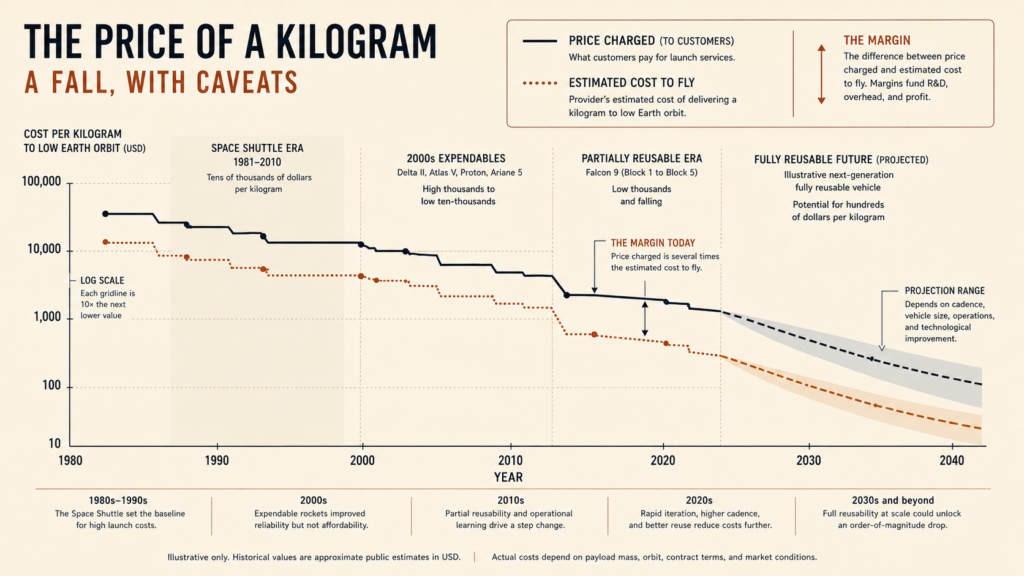
Here is where the popular story and the measurable one part company. The billboard number for the reusability revolution has always been dollars per kilogram to orbit, and by that number the change looks enormous. In the Space Shuttle era, delivering a kilogram to low orbit cost on the order of tens of thousands of dollars — figures around fifty thousand dollars per kilogram are commonly cited, though the exact number depends heavily on how you amortise the programme. Expendable rockets of the 2000s typically ran somewhere in the region of ten to twenty thousand dollars per kilogram. Against that backdrop, a partially reusable Falcon 9 advertised at roughly seventy million dollars for a vehicle that can loft on the order of seventeen to eighteen tonnes to low orbit works out near two and a half to three thousand dollars per kilogram at the list price — a reduction of very roughly an order of magnitude from the recent past, and far more against the Shuttle. That is the number you see on the slides.
But the list price is the wrong instrument, and understanding why is the whole point. A dollars-per-kilogram figure computed from a published price tells you what a customer is charged, not what a launch costs to fly. Those are very different numbers, and the gap between them is where much of the reusability story is hiding. Estimates assembled from the operator’s own past statements and from independent analysts put the marginal cost of flying a reused Falcon 9 — the incremental cost of one more flight, given that the booster already exists — at something in the region of fifteen to twenty million dollars, dominated not by the reusable first stage but by the expendable upper stage that is still thrown away on every flight. If those estimates are even roughly right, the price charged to customers is several times the marginal cost of the flight.
That gap is not a scandal; it is a measurement, and it tells us something the billboard hides. It means the cost of access to space fell considerably faster than the price of access to space. The operator captured much of the difference as margin — reinvested, by all accounts, into building the next vehicle and its own satellite constellation — rather than passing it wholesale to the market. An independent way to see the same thing: analysts note that these unusually wide margins are sustained by a near-monopoly position and are likely to compress as genuine competitors arrive. In other words, the customer-facing price cut we celebrate is partly a real efficiency and partly a deferred one, held back behind the pricing power of a dominant supplier. The revolution in cost is more complete than the revolution in price.
The cost of reaching orbit fell faster than the price of reaching orbit. The difference is margin — and a clue about who the revolution has served first.
There is a second reason to distrust the per-kilogram figure: it flatters whichever rocket is biggest, regardless of whether anyone needs to launch that much at once. A more honest family of metrics measures the thing reuse was supposed to enable — flying often, turning hardware around quickly, and driving the marginal cost of a flight toward the cost of its fuel. On turnaround, the change is stark: a booster that once might have taken months to inspect and refly has, in the best cases, flown again within roughly three weeks, and individual first stages have now flown well over two dozen missions apiece. Those are the numbers that actually measure reusability — not the price on the brochure, but the tempo of the hardware.
| Era / vehicle | Illustrative cost to LEO | What it reflects |
| Space Shuttle | ~$54,000 per kg | Partially reusable, high refurbishment |
| Expendables, 2000s | ~$10,000–20,000 per kg | New vehicle every flight |
| Falcon 9 (list) | ~$2,500–3,600 per kg | Partial reuse, high cadence |
| Falcon 9 (est. marginal) | far below the list price | Cost of one more flight, not the price |
| Starship (target) | <$500 per kg (projected) | Aspiration; not yet demonstrated |
Cost-per-kilogram figures are list or effective prices, are methodology-dependent, and mix distinct things; they are best read as orders of magnitude, not precise values. The Starship figure is a target, not a measurement.
Cadence: the number that actually moved
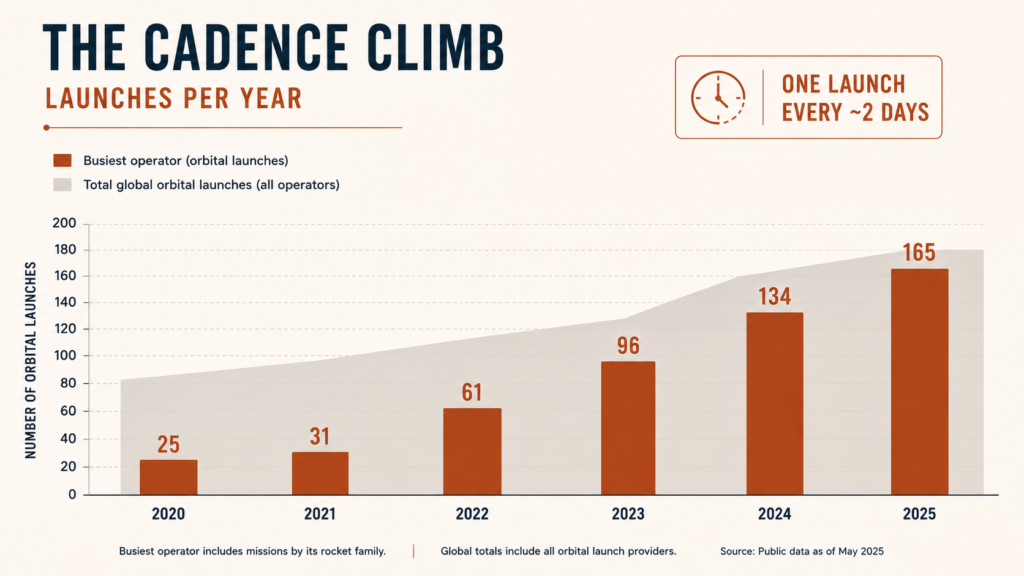
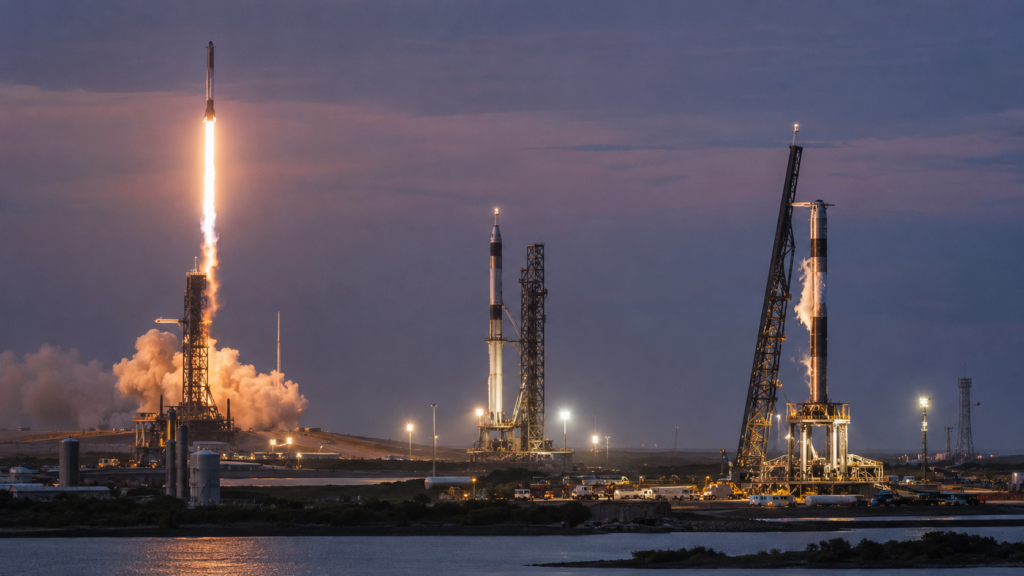
If a single measurement captures the reusability revolution, it is not a price. It is a count. In 2020, the busiest launch operator in history flew twenty-five times. The following years read like a chain reaction: thirty-one, then sixty-one, then ninety-six, then a hundred and thirty-four, and then, in 2025, a hundred and sixty-five orbital flights from one company — a launch roughly every other day, sustained across an entire year without a single failure. Worldwide, 2025 saw on the order of three hundred and twenty-nine orbital attempts, itself a record; the United States accounted for around a hundred and ninety of them and China for about ninety. A single company launched nearly twice as many times as an entire spacefaring nation, and more than the rest of the world combined.
This is what reuse bought: not primarily a cheaper ticket, but a faster clock. A rocket you throw away must be built anew for every flight, and factories set the ceiling on how often you can fly. A rocket you fly again turns the problem from manufacturing into maintenance, and maintenance scales differently. The pace of improvement has followed the kind of learning curve economists recognise from other industries: with each doubling of total flights, the time between launches has fallen by a large and remarkably steady fraction, as manufacturing, refurbishment, pad operations and recovery all improved together. This is the same species of curve that drove down the cost of Model T production and, later, the price of solar panels — the compounding gains of doing the same thing many times and measuring what slows you down.
But the cadence number carries a warning that the headline usually omits, and honesty demands stating it plainly. Of those hundred and sixty-five flights in 2025, a hundred and twenty-three carried the operator’s own internet satellites. The single busiest launch enterprise on Earth is, to a great extent, one company using its own rockets to build its own constellation — more than ten thousand spacecraft now operating overhead, with thousands added in a single year. That is a staggering feat of vertical integration, but it is not the picture of a broad, competitive open market that the raw launch count might suggest. Much of the demand that reuse unlocked, reuse also created, and largely for one customer: itself.
| Year | Orbital launches (busiest operator) | Note |
| 2020 | 25 | First reused-booster era matures |
| 2021 | 31 | |
| 2022 | 61 | Constellation deployment accelerates |
| 2023 | 96 | |
| 2024 | 134 | |
| 2025 | 165 | ~one flight every 2.2 days |
The steepest measurable effect of reusability is a rising flight rate, not a falling ticket price. Figures for the single busiest launch operator; most 2025 flights carried the operator’s own satellites.
The rest of the field: landing is common, reflight is rare
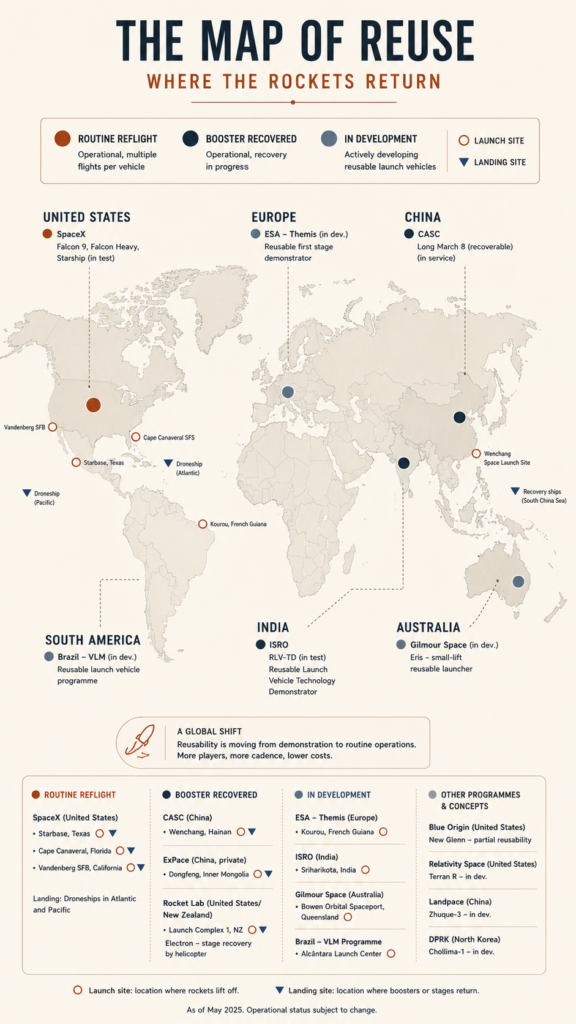
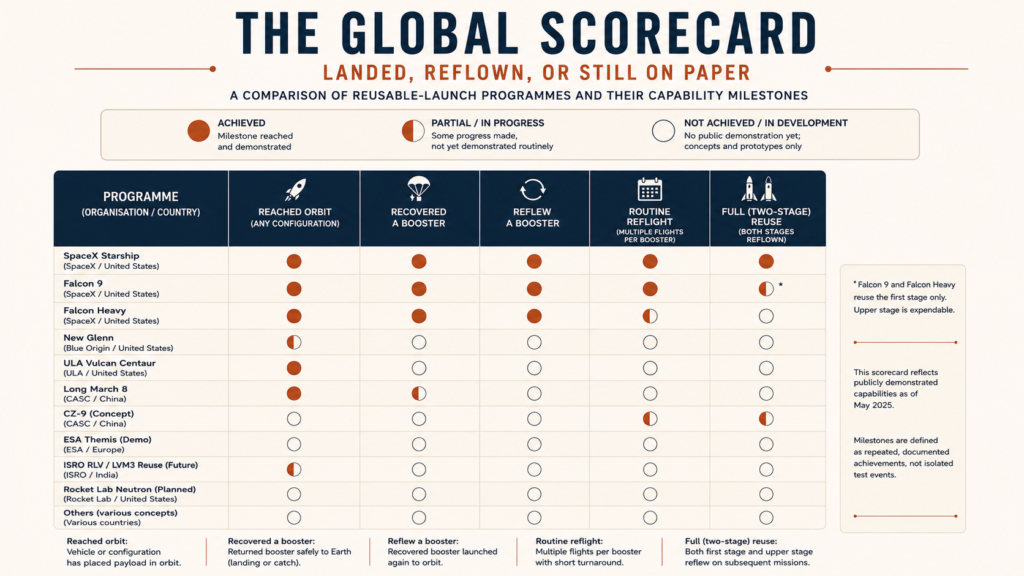
For years reusability had exactly one practitioner at orbital scale, and sceptics could argue it was a company-specific trick rather than an industry transition. By 2026 that argument no longer holds — but the shape of the catch-up is itself revealing, and the cleanest way to summarise it is a line drawn from the field’s own mid-decade stocktaking: landing an orbital booster is no longer rare; flying one again remains the achievement of a very few.
Blue Origin is the clearest second entrant. Its heavy New Glenn rocket reached orbit, and in November 2025 it landed its methane-fuelled first stage on a droneship in the Atlantic while delivering a pair of NASA science probes toward Mars — becoming only the second entity ever to recover an orbital-class booster. In April 2026 it reflew that same booster, though the mission it carried failed to reach its correct orbit. The capability is proven; the cadence is not. Where the incumbent flies every other day, its nearest rival has so far flown a handful of times, and openly aims to reach reuse every thirty days rather than demonstrating it.
China has moved with striking speed and breadth. In December 2025 the private firm LandSpace flew Zhuque-3, a stainless-steel, methane-fuelled vehicle explicitly modelled on the reusable playbook; it reached orbit but did not recover its first stage. Then, in July 2026, a state Long March 10B became the first Chinese orbital booster recovered — caught in a tensioned net on an offshore platform — with a reflight promised before year’s end. Behind these run a crowd of Chinese firms racing toward reusable debuts, propelled less by an open commercial market than by the state’s need to loft its own vast planned internet constellations. The strategic logic is the same as the incumbent’s: cheap, repeatable launch is the enabling infrastructure for owning low orbit.
Elsewhere the gap is wider. Rocket Lab, long the busiest small-satellite launcher, is bringing a reusable medium-lift rocket, Neutron, toward its first flight — a vehicle sized to break the near-monopoly on medium launch — but as of this writing it has yet to fly. Europe, which retired one expendable flagship and fielded another, has no operational reusable rocket at all; its answer is a set of demonstrators and a reusable methane engine feeding a future vehicle still years from service, alongside a clutch of startups whose reusable designs remain mostly on the drawing board. India is flight-testing a winged reusable demonstrator and planning a reusable heavy launcher for the 2030s. The revolution, measured honestly, is real and spreading — but it is still, in operational terms, extraordinarily concentrated.
| Programme | Reuse status, mid-2026 | Cadence reality |
| Falcon 9 (US) | Routine reflight; 500+ landings | ~165 flights in 2025 |
| New Glenn (US) | Landed 2025; reflew 2026 | A handful of flights |
| Long March 10B (China) | First booster recovery, Jul 2026 | Reflight pending |
| Zhuque-3 (China) | Reached orbit; recovery pending | Early flight tests |
| Neutron (US) | Debut expected 2026 | Not yet flown |
| Europe (Themis / Maia) | Demonstrators only | No operational reuse |
| India (RLV / NGLV) | Winged tests; reuse in 2030s | Experimental |
Recovering a booster and reflying it routinely are different achievements. As of mid-2026 only one operator does the latter at scale.
What cheaper, more frequent access actually changed
Set the competition aside and ask what the new tempo has done to the things that ride on rockets. Here the effects are concrete, and they run deeper than any single spacecraft.
The most visible is the megaconstellation. Networks of thousands of small satellites, delivering broadband from low orbit, are only buildable if you can launch often and deploy dozens of spacecraft at a time; at the prices and cadence of 2010 they were economically unthinkable. The reusable-launch era did not just make them cheaper — it made them possible, and it is why several nations and companies are now racing to fill low orbit with tens of thousands of satellites. That is a strategic transformation as much as a commercial one, and it flows directly from the flight rate.
Less obvious but just as real is the change in scientific access. Rideshare launches — where a single rocket carries scores of small satellites from many operators, each paying only for its slice — have driven the entry cost for a university or a startup to reach orbit down to something a research grant can contemplate. Cheaper heavy lift has also rippled into planetary science: interplanetary probes that once demanded scarce, costly rockets can increasingly fly on cheaper commercial vehicles, and mission designers have begun to plan around the assumption of abundant, affordable launch rather than treating each kilogram as precious. When launch is cheap and frequent, the optimal spacecraft changes: you can afford to build more simply, fly sooner, and accept more risk on any single mission because the next opportunity is weeks away rather than years.
It is worth being precise about the direction of causation, because it is easy to overclaim. Cheaper launch has not yet delivered the long-promised exotica — space mining, orbital factories, solar power beamed from orbit. Analyses of those activities suggest they need launch costs far below even today’s, and their bottleneck was never launch alone. What reuse has measurably enabled is more modest and more real: constellations, cheaper science, faster iteration, and a launch market that for the first time behaves a little like a transport industry rather than a bespoke craft.
The strategic dividend: launch as national power
Cadence is not only a commercial metric. A nation or a military that can launch on short notice, replace lost satellites quickly and deploy proliferated constellations of small, cheap spacecraft has an advantage that expendable, low-rate launch simply cannot provide. The logic of national security space has shifted accordingly — away from a few exquisite, irreplaceable satellites and toward large, resilient meshes of many cheap ones, precisely the architecture that frequent reusable launch makes affordable. Responsiveness — the ability to put something in orbit in days rather than years — has become a strategic quantity in its own right.
The plumbing of this shift is visible in government paperwork as much as on launch pads. Oversight bodies now write about reusable boosters and rideshare as established features of the launch market, and about the strain that a booming commercial cadence places on shared infrastructure: the ranges, tracking assets and safety systems that every launch consumes. One government review noted that as commercial launches surged after 2016, so did the burden on federal ranges — and the difficulty of even billing accurately for their use. The reusability revolution, in other words, has outrun some of the institutions built for a slower age, from range scheduling to the safety analysis of new methane-fuelled vehicles.
There is a geopolitical measurement here too, and it is uncomfortable. When one company in one country can out-launch the rest of the planet combined, launch capacity becomes a form of concentrated power — commercial, scientific and military at once. That concentration is exactly why other states are pouring resources into reusable programmes of their own: not merely to save money, but to avoid dependence on a capability they do not control. The race to reuse is, at bottom, a race for sovereign access to orbit.
Toward full reuse — and the limits of what we can yet measure
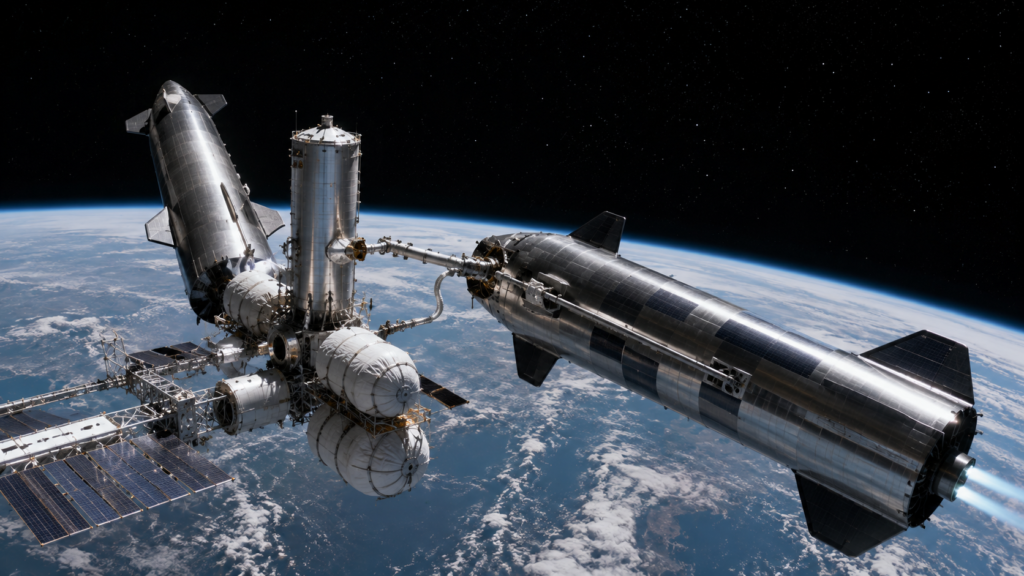
Everything measured so far concerns partial reusability: a recovered first stage and, in some cases, a recovered fairing, atop an upper stage that is still thrown away every flight. That expendable upper stage is the single largest remaining cost in a reused launch, which is why the frontier — and the loudest promises — concern full reusability, in which every major piece returns and flies again.
The vehicle carrying most of that ambition is a fully reusable super-heavy system under development, the largest and most powerful rocket ever flown, designed so that both its booster and its upper stage return to be caught and reflown. Its progress must be described carefully, because the gap between demonstrated and projected is exactly what this article is about. As of mid-2026 the programme had flown a series of integrated test flights; it had, on several occasions, caught its enormous booster back at the launch tower; and on its most recent flight it deployed a batch of next-generation internet satellites from orbit for the first time. It had also, on that same flight, failed to land the booster, and its upper stage was still flying suborbital test profiles rather than being caught and reused. The in-orbit refuelling that a lunar mission would require — transferring propellant between vehicles in space — remained in active testing, not demonstrated at scale.
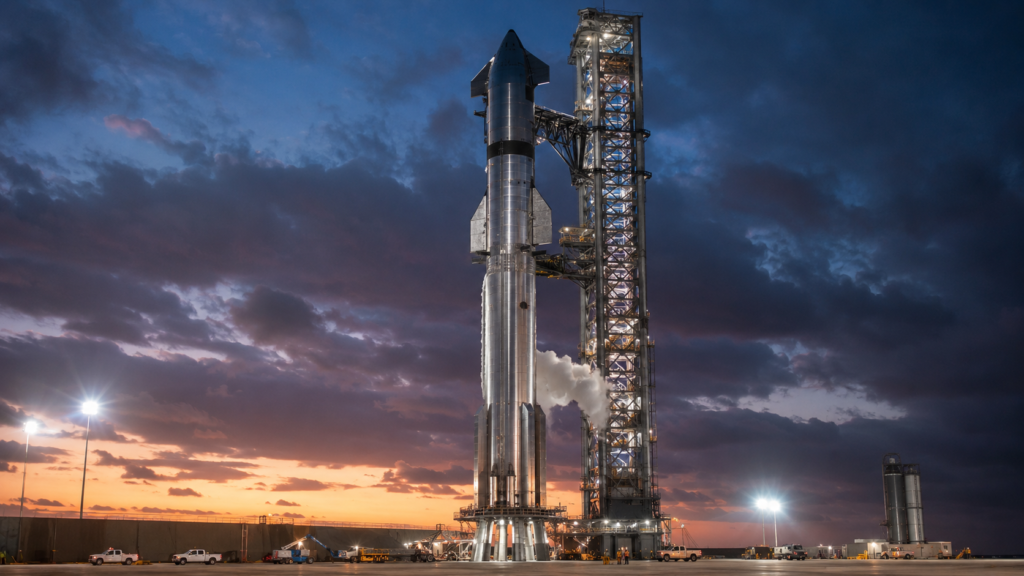
So the honest status is this: full reusability has been partly demonstrated and not yet operationally proven. The projected economics — costs per kilogram an order of magnitude below today’s, perhaps far below — are genuine engineering targets, not measured results, and they depend on the hardest part of the whole enterprise: rapid reflight of both stages with minimal work in between. If that is achieved, the effect on everything downstream, from lunar and Martian exploration to whatever industries a truly cheap launch might seed, would be profound. But a target is not a measurement, and a documentary that respects its reader must keep the two apart. The right posture toward full reuse is neither dismissal nor faith. It is patience, and a close eye on the turnaround clock.
What we should measure next
If the argument of this piece is that we have been measuring the revolution with the wrong ruler, then it owes the reader a better set of instruments. Five measurements would tell us more about the next decade than any advertised price.
- Reflight rate, not landing rate. How many vehicles actually fly again, and how many times each — the line that separates a genuine reusable industry from a collection of impressive recoveries.
- Turnaround time. The days between a landing and the next flight, tracked across the fleet, is the cleanest single proxy for how much work reuse truly demands.
- Marginal cost, disclosed. The incremental cost of one more flight — not the customer price — is what determines how low access can ultimately go. It is the number operators are least eager to publish.
- Price passed through versus margin retained. The gap between falling cost and falling price measures who the revolution is serving, and how competition is redistributing its gains.
- Upper-stage reuse. The expendable second stage is the largest remaining cost. Whether it can be recovered economically is the hinge on which full reusability, and its promised economics, actually turns.
Watch those five, and the fireworks become legible. Ignore them, and you are left admiring the landing while missing the revolution — which was never really about rockets returning home, but about turning the most wasteful transport system humans ever built into something that begins, at last, to behave like a machine that can be run rather than merely fired.
How the histories will judge it
It is worth imagining how this transition will read in a century, because the comparison changes what we notice now. The revolutions that reshaped the modern economy were rarely single inventions; they were reductions in the cost of movement that quietly rearranged everything else. When the shipping container arrived in the 1950s, the marvel was not the steel box but the collapse in the cost of loading a ship — economic historians estimate it fell from several dollars a tonne to a small fraction of that — which in turn made global supply chains, and much of modern manufacturing, thinkable. The jet engine did not merely fly faster; by lowering the cost per seat-mile it turned air travel from a luxury into a utility. In each case the technology that drew the crowds was less important than the curve it bent: the cost of doing the same thing, again and again, at scale.
Reusable launch belongs in that lineage, but the histories will likely be careful in a way the present is not. They will note that the sticker price fell by roughly an order of magnitude while the true cost fell further and the flight rate exploded; that for a crucial decade the revolution was concentrated in a single company largely serving itself; that the promised second act — full reuse, and the truly cheap orbit it implies — was still unproven when the decade turned. And they will judge the whole enterprise not by the boosters that came home to applause, but by the boring, decisive numbers underneath: how often the hardware flew, how little it cost to fly it again, and how widely those gains were finally shared. The reusability revolution is real. Whether it becomes the container ship of the space age, or merely its most photogenic decade, is a question that will be answered in turnaround times and marginal costs — measured, not admired.
It will be judged not by the boosters that came home to applause, but by how often they flew, how cheaply, and how widely the gains were shared.
THE ROAD TO REUSABILITY
A Timeline of the Reusable Launch Revolution
1960s–1970s
Engineers envision reusable boosters and winged spacecraft decades before technology can support them. Limited computing power, materials, and economics keep the concept on the drawing board.
1981
The Space Shuttle enters service as the world’s first partially reusable orbital launch system. Although revolutionary, extensive refurbishment between flights prevents the dramatic cost reductions originally promised.
2010s
A new generation of private launch companies begins systematically testing powered landings, demonstrating that orbital-class first stages can survive return to Earth.
December 2015
For the first time in history, an orbital-class booster successfully lands upright after delivering a payload to space—marking the beginning of practical rocket reusability.
2016
A booster lands successfully on an autonomous droneship at sea, making recovery possible for missions that cannot return to the launch site.
2020
Reused boosters become the industry’s standard for one leading operator, which completes twenty-five orbital missions during the year.
2023–2024
Launch cadence accelerates dramatically as annual flight totals surpass ninety and later exceed one hundred thirty missions, setting consecutive industry records.
November 2025
A second launch provider joins the reusable era by recovering the first stage of an orbital-class heavy rocket after an ocean landing.
December 2025
China achieves its first privately developed reusable-orbit launch. The rocket reaches space successfully, although recovery of the booster is unsuccessful.
2025
One operator completes approximately 165 orbital launches—roughly one mission every two days—setting a sixth consecutive annual record.
April 2026
The second reusable launch provider flies a previously recovered booster for the first time, demonstrating repeatability beyond a single recovery.
July 2026
China successfully recovers a state-developed orbital booster while continuing work toward fully reusable launch systems. Super-heavy vehicles also demonstrate increasingly ambitious orbital operations.
The Rest of the Decade
Europe, India, China, the United States, and emerging commercial companies compete to make rapid, fully reusable launch systems commercially routine.
WHAT REALLY CHANGED
- Launch frequency became the defining metric. Reusability transformed annual launch rates from dozens of missions into well over one hundred per year.
- Operating costs declined faster than market prices. The cost of flying reused hardware fell dramatically, while launch providers retained much of the resulting economic advantage.
- Advertised price tells only part of the story. Price per kilogram reflects what customers pay—not the actual cost of operating reusable rockets.
- Fast turnaround became the true breakthrough. The ability to inspect, refuel, and relaunch boosters within weeks proved that reuse could function as an industrial process rather than a technological demonstration.
- New demand emerged because launches became abundant. Large satellite constellations expanded rapidly once launch capacity and frequency increased.
- Recovering boosters is becoming common. Reusing them repeatedly at industrial scale remains a capability demonstrated by only a limited number of operators.
- Competition is expanding globally. American, Chinese, European, and Indian programmes are all pursuing reusable launch technologies using different technical approaches.
- Mega-constellations became practical. Thousands of satellites can now be deployed because launch systems operate more frequently and at lower cost.
- Space became accessible to more users. Universities, startups, scientific institutions, and small nations gained opportunities previously limited by launch costs.
- Launch capability evolved into strategic infrastructure. Countries able to sustain exceptionally high launch rates now possess significant economic and geopolitical advantages.
- Complete reusability remains the next milestone. Fully reusable two-stage launch vehicles have shown encouraging progress but have not yet demonstrated routine commercial operations.
- The most important numbers are operational. Flight frequency, refurbishment time, and reliability ultimately matter more than spectacular landing videos.
FAST FACTS
- A spacecraft must reach roughly 7.5 km/s to remain in low Earth orbit.
- More than 90% of a rocket’s launch mass consists of propellant rather than payload or hardware.
- The first successful landing of an orbital-class booster occurred in December 2015.
- Around 165 orbital launches were completed by a single operator during 2025, nearly one mission every other day.
- The upper stage remains expendable on most reusable launch systems and represents a significant share of launch cost.
- Some reusable first stages have completed more than two dozen flights.
- Reusable launch systems improve through learning curves: the more frequently they fly, the faster refurbishment and operations become.
- Large low-Earth-orbit broadband constellations now include more than ten thousand active satellites.
- In July 2026, China achieved its first successful recovery of a state-developed orbital booster, marking another milestone in the global race toward reusable spaceflight.