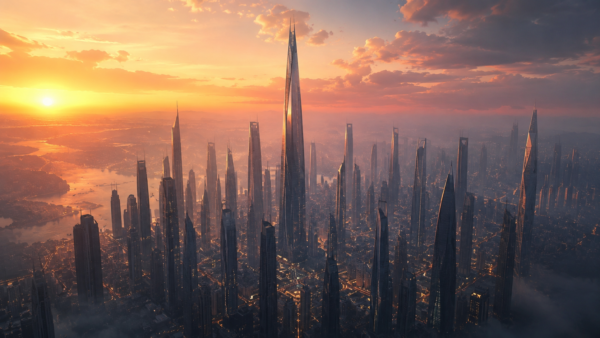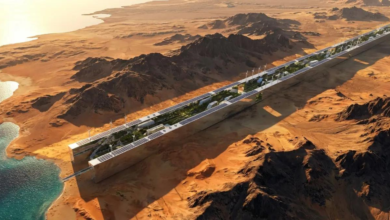

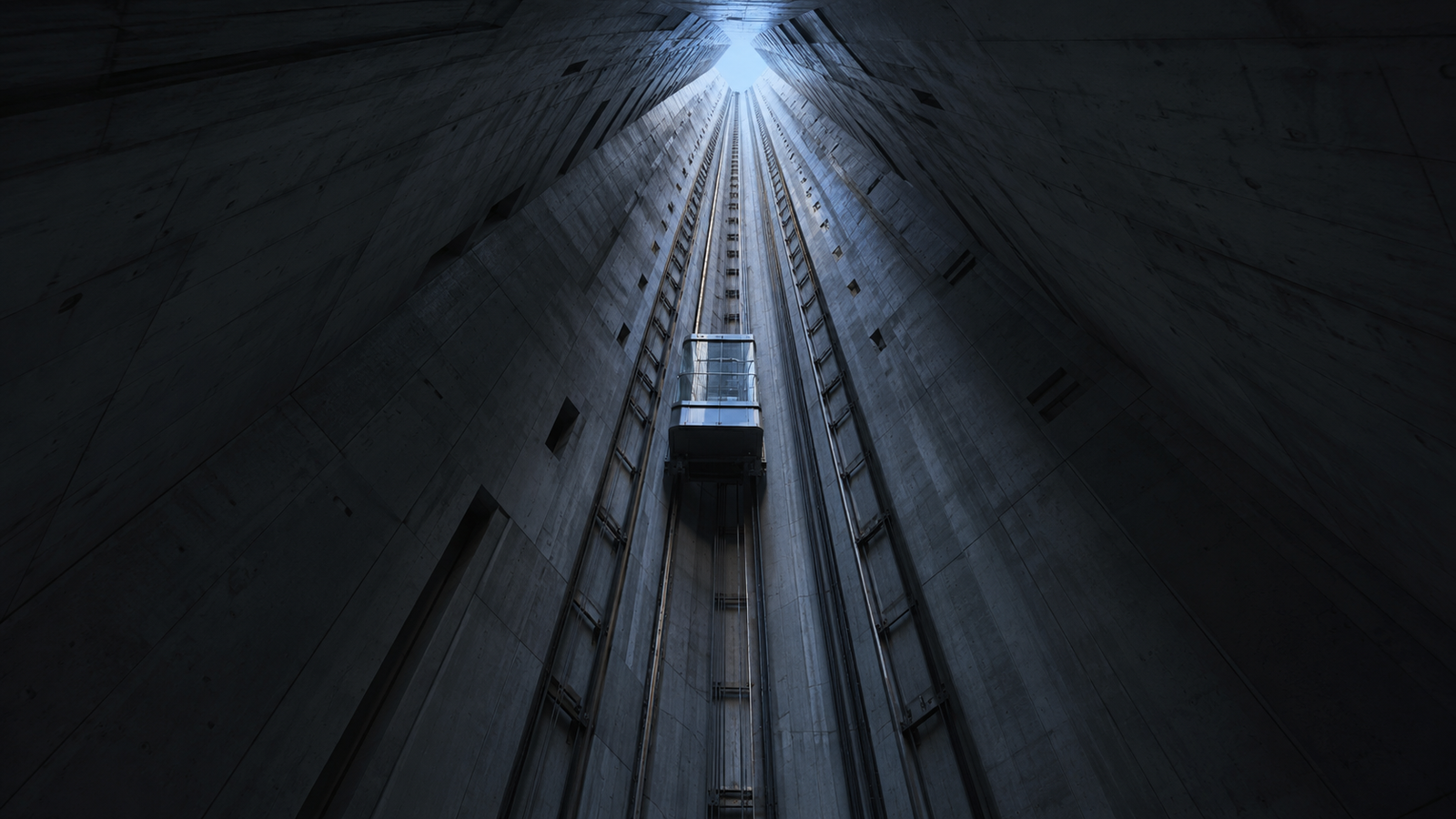


We already know how to build a tower a mile high. The reason we haven’t has almost nothing to do with steel and concrete — and almost everything to do with the box that carries you up
Ask why skyscrapers are not taller and most people picture the obvious villain: gravity, wind, the limits of steel and concrete. This investigation shows that intuition to be wrong. Structural engineers have known for decades how to build a tower a kilometre or even a mile high; the buttressed cores and tuned dampers that hold up today’s giants have plenty of headroom left. The true ceiling on height has been vertical transportation — the humble lift.
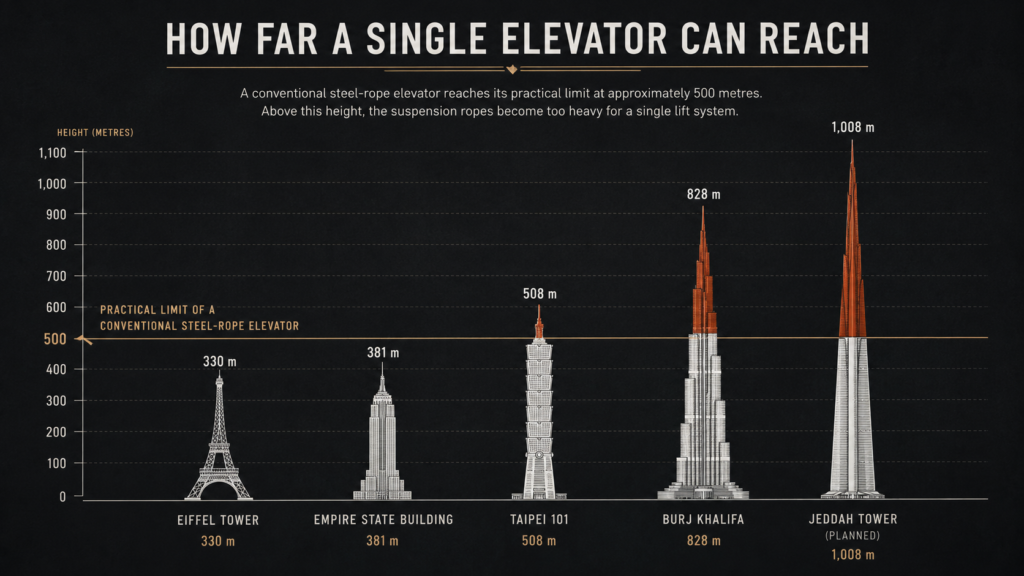
The constraint arrives in two forms. First, physics: a conventional steel hoisting rope grows so heavy that beyond about 500 metres it can barely lift itself, capping how far a single lift can travel. Second, economics: the higher a building climbs, the more lifts it needs, and their shafts devour the very floor space the building exists to sell. From Elisha Otis’s safety brake to carbon-fibre ropes and cable-free magnetic lifts, the story of the skyscraper is really the story of the machine inside it. Readers will finish understanding that the sky was never the limit — the lift was.
| ▪ IN BRIEF ▪ The binding constraint on skyscraper height is vertical transport, not structural strength. Engineers can already design towers far taller than any yet built.▪ Conventional steel lift rope becomes unsupportable under its own weight at around 500 metres — the reason the Burj Khalifa’s record lift travels 504 metres and no further in one run.▪ The lift is also an economic ceiling: in a supertall tower, lift shafts can consume so much of the core that the building stops being profitable to build.▪ The safety elevator did not merely assist the skyscraper — it created it. Before Elisha Otis, buildings rarely exceeded the height people would willingly climb.▪ Carbon-fibre rope (KONE’s UltraRope) weighs about a fifth of steel and can, in principle, carry a single lift a full kilometre.▪ The frontier is the cable-free lift: magnetically levitated cabins that move sideways as well as up, with no height limit at all.▪ Height is now as much a political and economic choice as an engineering feat — Saudi Arabia races past one kilometre while China bans new towers above 500 metres. |
The Building That Cannot Be Reached
Imagine a tower that stands, perfectly sound, a mile into the sky — and whose top floors no one can conveniently reach.
The structure is not the problem. Its core of high-strength concrete is braced against the wind; its foundations reach deep into bedrock; computer models confirm it will not fall, will not sway beyond comfort, will shrug off a century of storms. The engineering of holding the building up has been solved. The problem is subtler and, once you see it, impossible to unsee. It is the problem of getting a human being from the ground floor to the nine-hundredth in a time they will tolerate, in a machine that fits inside a building whose purpose is to be occupied and sold.

This is the paradox at the heart of the tall-building era. For more than a century, popular imagination has assumed that skyscrapers stop where materials give out — that somewhere above the clouds, steel simply cannot bear its own weight. It is a satisfying story, and it is false. The people who design the world’s tallest towers will tell you, almost with a shrug, that they could build considerably higher tomorrow. What stops them is not the frame. It is the lift: the slender shafts that move people vertically, and the stubborn physics and economics that govern them.

To understand why a building can be structurally possible and practically unreachable, we have to follow the machine that made the skyscraper conceivable in the first place — and then discover how the same machine quietly became its ceiling.
| ▪ WHY IT MATTERS If the limit on height is transport rather than structure, then the race to build ever taller is not a materials-science story but a puzzle of movement, space and money. It changes what we should ask of a supertall tower — and whether the pursuit of record height makes sense at all. |
The Machine That Made the Sky Possible
Before 1853, the height of an inhabited building was set by human legs. A person could be persuaded to climb perhaps five or six flights of stairs; above that, upper floors were undesirable, cheap, the domain of servants and storage. Cities were low not because no one could raise a wall higher, but because no one wanted to live at the top of it. The vertical dimension of urban life was, in effect, closed.
What opened it was not a taller wall but a safer rope. Elisha Graves Otis, a mechanic working in a Yonkers bedstead factory, was troubled by a simple danger: if a hoist’s cable snapped, the platform plunged. He devised a spring-loaded catch that, the instant the rope went slack, snapped a pair of pawls into toothed guide rails and locked the car in place. In 1854, at the Crystal Palace exposition in New York, he staged one of history’s great pieces of engineering theatre. Riding a platform high above the crowd, he ordered the single supporting rope cut with an axe. The platform dropped a few inches and stopped dead. “All safe, gentlemen, all safe,” he announced.
The safety brake did not make the elevator faster or the building stronger. It made the machine trustworthy — and trust was the missing ingredient. Once people believed they would not fall, the upper floors of a building could carry passengers rather than crates, and the logic of the city inverted. Height became desirable. Within decades the penthouse, once the worst address in the building, became the best. The skyscraper was not born from steel alone; it was born from a device that let ordinary people rise without fear.
| ▪ HISTORICAL PERSPECTIVE A famous moment that almost no one noticed The Otis demonstration is told as a thunderclap in architectural history. Yet the cultural historian Andreas Bernard, in his study Lifted, went looking for contemporary reports of the 1854 spectacle and found almost none — a couple of marginal mentions and little else. The lesson is not that the moment did not matter, but that its importance was recognised only in hindsight. The technologies that reshape civilisations often pass unremarked at the time, their consequences visible only once the skyline has changed. |
The elevator and the skyscraper then grew up together, in a chicken-and-egg embrace that historians still enjoy untangling. Did the desire to build tall summon faster lifts, or did faster lifts tempt developers upward? Both, in truth. Steel-frame construction, pioneered in Chicago in the 1880s, let buildings rise without impossibly thick load-bearing walls; the safety elevator let people use the floors that resulted. Neither alone would have produced the modern tower. Together they produced the vertical city — and, with it, a new problem that would not become acute for another hundred years.
| ▪ HUMAN PERSPECTIVE Fazlur Khan, the engineer of the vertical No single figure did more to make great height practical than Fazlur Rahman Khan, a Bangladeshi-American structural engineer at Skidmore, Owings & Merrill. He invented the structural systems — the “tube” frames — that let towers climb efficiently, and, crucially for our story, he devised a way to stop lifts from strangling them. His answer, first realised in Chicago’s John Hancock Center in 1969, was the sky lobby: a rethinking of how people move through a tall building that remains, half a century later, the standard tool for taming the elevator problem. |
(Learn more about Fazlur Khan, the engineer who unlocked the modern skyscraper.)
The Weight of the Rope
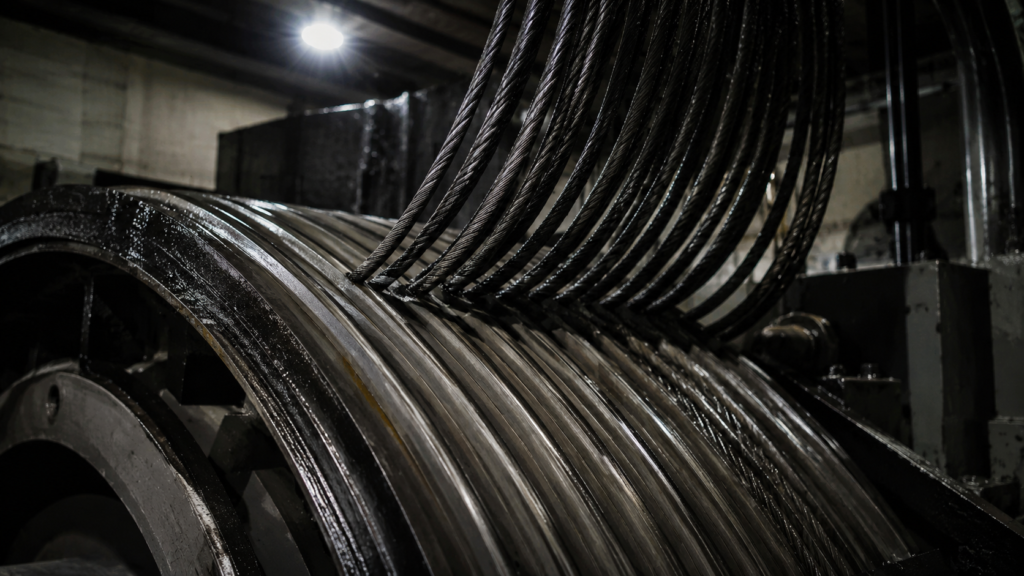
Steel hoisting ropes loop over a grooved sheave in a machine room. Their own weight is what caps how far a single lift can travel — about 500 metres.
Here is the first hard ceiling, and it is made not of steel beams but of steel cable.
A traction elevator hangs from ropes — the industry’s own word for its steel hoisting cables — that loop over a driving sheave at the top of the shaft, the car on one side, a counterweight on the other. The arrangement is elegant and efficient. It also carries a hidden penalty that grows with every metre of height. The ropes have weight. The taller the rise, the longer and therefore heavier the ropes, until a point arrives where a dismaying share of the motor’s effort goes not into lifting people but into lifting the cables themselves.
That point sits at roughly 500 metres. Beyond it, as the Council on Tall Buildings and Urban Habitat has put it plainly, the weight of the rope becomes effectively unsupportable for a single continuous run. The rope must hold its own mass plus the car, the counterweight, the passengers and the compensating cables that hang beneath — and steel, for all its strength, is heavy. Push the rise much past half a kilometre and the system begins to defeat itself, the cables sagging, stretching, resonating, demanding ever-larger motors to move an ever-larger dead load.
| ▪ TECHNICAL EXPLAINER Why a rope can only be so long Every material has a “breaking length” — the length at which a strand, hung vertically, snaps under its own weight. For high-strength steel that length is many kilometres in theory. But a lift rope may never approach it: safety codes demand large margins (a rope is sized to hold many times its working load), and it must lift the car, counterweight and payload as well as itself. The result is that the practical single-rise limit for steel-roped lifts is far below the theoretical breaking length — about 500 metres. It is not that the rope snaps at 500 metres; it is that beyond it, the weight of the rope makes the whole system uneconomic and unwieldy. |
The consequence is visible in the world’s tallest building. The Burj Khalifa rises 828 metres, but no lift runs from its base to its summit in a single journey. Its record-setting car travels 504 metres — for years the longest single elevator run on Earth — and to go higher, passengers must change lifts at a sky lobby. A building nearly a kilometre tall cannot, with conventional rope, be climbed in one continuous ride. The structure reaches the sky; the rope stops halfway.
This is the first and purest expression of our thesis. The Burj Khalifa is not limited by whether its frame can stand at 828 metres — it plainly can. It is shaped, floor by floor, by the reach of the machines that carry people up it. Change the rope, and you change what is possible.
| ▪ THE ROPE PROBLEM, IN NUMBERS 500 metres: steel ≈ 27,000–29,000 kg carbon ≈ 13,000 kg 800 metres: steel ≈ 108,600 kg carbon ≈ 13,900 kg |
A Ribbon of Carbon
If the rope is the ceiling, then a lighter rope raises it. In 2013, the Finnish lift-maker KONE unveiled what it called UltraRope: not a rope at all in the old sense, but a flat ribbon with a core of carbon fibre wrapped in a high-friction coating. It looks, engineers like to say, like a strip of black liquorice. It weighs about a fifth of a steel rope of equivalent strength, and that single change cascades through the entire machine.
Because the rope is lighter, the moving mass falls dramatically — and with it the size of the motor, the counterweight, the energy bill and the strain on the building. KONE’s own figures are striking: in a 500-metre building, the mass in motion of a steel-roped lift can approach 29,000 kilograms; with UltraRope it drops to around 13,000. Stretch the building to 800 metres and the steel system balloons past 108,000 kilograms, while the carbon-fibre version barely moves, holding near 14,000. The heavier the building, the more decisively carbon fibre wins. The company says the technology can, in principle, carry a single lift a full kilometre in one continuous run — doubling the old limit at a stroke.
| ▪ ENGINEERING PERSPECTIVE More than just lighter Carbon fibre does not only cut weight. It resonates at a different frequency from steel and most building materials, which matters in a swaying tower: a conventional steel rope can be set oscillating by a building’s movement in high wind, forcing lifts out of service until the sway subsides. A rope that does not share the building’s rhythm keeps running. It also lasts longer and needs less maintenance, and by shrinking the moving mass it can cut a tall building’s lift energy use substantially — by KONE’s reckoning, on the order of 15 per cent over a 500-metre rise and far more over longer ones. |
The carbon-fibre rope reframes the first half of our problem. The physical wall at 500 metres was never a law of nature; it was a property of steel. Replace the material and the wall moves. But raising the rope’s ceiling does not make a supertall tower buildable on its own, because a second constraint has been waiting all along — one that no new material can solve, because it is not about the rope at all. It is about space.
The Tyranny of the Core
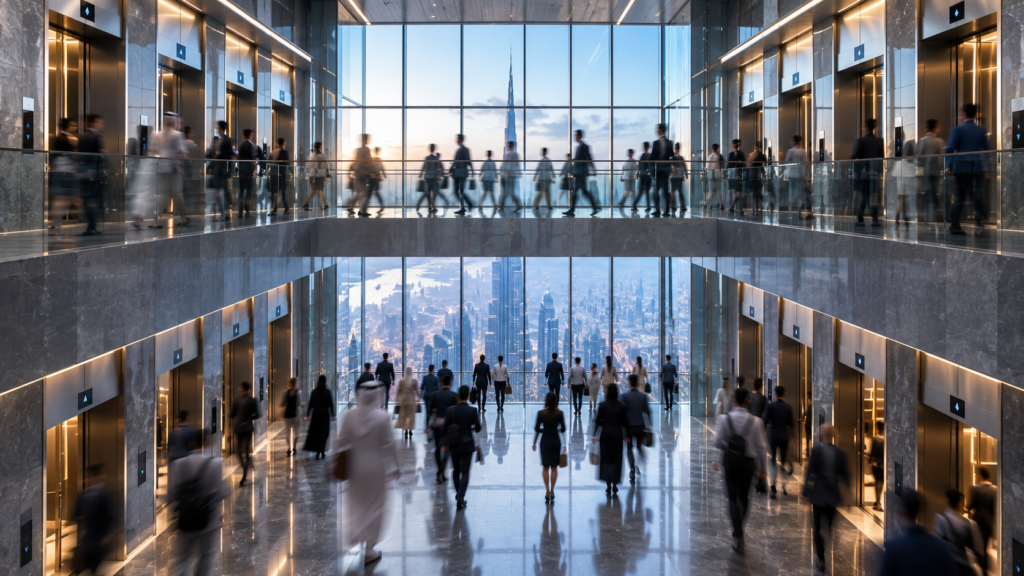
A sky-lobby interchange at rush hour, where passengers transfer from express to local lifts — the trick that stops a supertall’s core from swallowing the building.
Even with a perfect rope, the lift exacts a second tax — and this one is paid in the currency a skyscraper cares about most: rentable floor space.
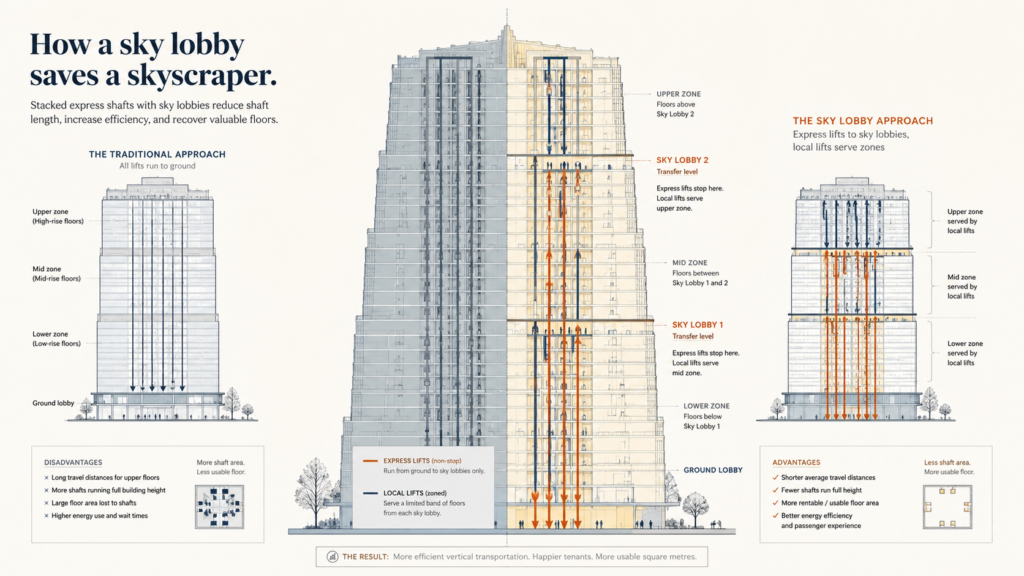
Picture a tower of a hundred floors served the simple way, with lifts that run from the ground to the top and stop wherever they are called. A passenger bound for the ninety-fifth floor might halt a dozen times on the way up as others board and alight. To keep journeys tolerable, you must add more lifts. But every lift needs a shaft, and every shaft is a hole punched through every floor it passes — a column of space that can never be rented, on level after level, all the way to the ground. Serve a very tall building this way and the lifts, quite literally, eat the building.
This is the elevator conundrum, and it bites hardest in exactly the buildings that most want to be tall. Somewhere above eighty floors, the number of shafts required to move people at acceptable speed would consume so much of each floor plate that the tower stops earning enough to justify itself. The engineering of the frame may permit another twenty storeys; the arithmetic of the core forbids them. Height, once again, is capped not by strength but by the machinery of movement.
| ▪ ECONOMIC PERSPECTIVE The disappearing floor In a tall building, a large share of every floor — lifts, stairs, ducts, mechanical plant — earns no rent. This “core” grows with height. A ten-storey office might let some 85 per cent of its area; a fifty-storey tower nearer 70 per cent. By the time a building is very tall, 30 to 40 per cent of its floor area can be unrentable. Developers accept this because a taller tower on a prized plot can still earn more in total — but only up to a point. Beyond it, each added floor costs more rentable space than it creates. That crossover, not the strength of steel, is where many towers quietly decide to stop. |
The solution, like so much in this story, came from Fazlur Khan. His insight was to stop treating the tower as one tall building and start treating it as several buildings stacked on top of one another. In Chicago’s John Hancock Center, completed in 1969, he introduced the sky lobby: an interchange floor partway up the tower. Large express lifts run non-stop from the ground to the sky lobby, bypassing everything in between. There, passengers step out and transfer to a bank of local lifts that serve only the floors above. Because those local shafts do not need to reach the ground, they can be stacked over the express shafts below — two lift systems sharing one vertical footprint. The core stops multiplying.
The trick is borrowed from the motorway. To cross a city you do not crawl through every junction; you take the express road, then rejoin local streets near your destination. Sky lobbies turn a skyscraper into a layered transit network, and the technique, refined with double-deck lifts that carry two cars in the height of one, underlies virtually every supertall tower built since. The World Trade Center used it; the Petronas Towers, Taipei 101 and the Burj Khalifa all depend on it. Without Khan’s idea, the modern supertall would be economically impossible.
Choreography in the Shaft
Solving the rope and the core still leaves a third discipline, less visible than either: the choreography of moving thousands of people at once. A supertall office tower faces a brutal test twice a day. In the morning peak, tens of thousands of workers arrive within a short window, all wanting to go up; in the evening, the flow reverses. A lift system that copes gracefully at noon can collapse into ten-minute queues at nine in the morning. Designing for that peak — not the average — is what governs how many lifts a tower truly needs.
Modern buildings meet the challenge with intelligence rather than brute force. Destination-dispatch systems ask passengers for their floor before they board and group them by destination, sending each lift to serve a cluster of nearby floors and skip the rest. Double-deck cars load two floors of a sky lobby simultaneously. Algorithms predict demand and pre-position empty cars where the crowd is about to form. The aim is to raise “handling capacity” — the share of a building’s population a lift system can move in five minutes — without adding shafts that would eat the core.
| ▪ FACT BOX The lift, by the numbers 500 m — the approximate single-rise limit of a conventional steel-roped lift. 504 m — the Burj Khalifa’s record single lift travel; passengers change at a sky lobby to go higher. ≈20% — the weight of a carbon-fibre UltraRope compared with an equivalent steel rope. 1969 — the year the first sky lobby (John Hancock Center, Chicago) tamed the elevator core. 57 — the number of KONE lifts specified to serve the kilometre-tall Jeddah Tower. |
The human experience of all this engineering is meant to be invisible. A well-designed system delivers you to your floor with one short wait and one smooth ride, and you never sense the mathematics that made it possible. But the constraint is real and ever-present: every second shaved from a wait, every extra passenger moved per minute, is won against the same pressure — the refusal of the building to surrender more of itself to the machinery of going up.
The Speed Limit Is You
If lifts must travel further, why not simply make them faster? Because the ultimate limit on speed is not the motor. It is the passenger.
Lift speed has climbed steadily for a century. In 1968 a fast lift managed 300 metres a minute; today the record belongs to the Guangzhou CTF Finance Centre in China, where two Hitachi lifts race upward at 1,260 metres a minute — 21 metres a second, or about 76 kilometres an hour — lifting passengers to the ninety-fifth floor in some 42 seconds. They hold a Guinness World Record, and they edged past the Shanghai Tower’s Mitsubishi lifts, which reach 20.5 metres a second, and long-since eclipsed the Toshiba cars in Taipei 101 that held the title for over a decade.
Yet the engineers who build these machines say the ascent is nearing a wall — not of power, but of physiology. The obstacle is air pressure. Rise too quickly and the pressure on the inner ear cannot equalise fast enough; ears block, heads ache, stomachs turn. The fastest lifts carry active pressure-control systems, sealing and gently regulating the cabin like an aircraft, precisely to soften the ascent. Even so, one lift-engineering authority, Albert So, has estimated that a vertical cabin cannot comfortably exceed roughly 24 metres a second — not because motors cannot spin faster, but because human bodies cannot cope.
| ▪ DATA BOX The record holders Guangzhou CTF Finance Centre (Hitachi): 21 m/s (≈ 76 km/h) — the world’s fastest lift, ground to the 95th floor in ≈ 42 seconds. Shanghai Tower (Mitsubishi Electric): 20.5 m/s ascending — but only about half that on the way down. Taipei 101 (Toshiba): 16.8 m/s — held the world record for roughly twelve years. Descent is always the slower direction: falling pressure is harder on the ears than rising pressure, so lifts come down more gently than they go up. |
There is a quiet pattern here, and it is the pattern of the whole story. At every turn, the limit on tall buildings has proved to be something other than the thing we expected. Not the strength of the frame, but the weight of the rope. Not the power of the motor, but the tolerance of the ear. Not the ambition of the architect, but the arithmetic of the core. The skyscraper keeps running into ceilings that are invisible until you look closely — and almost none of them are structural.
Cutting the Cord
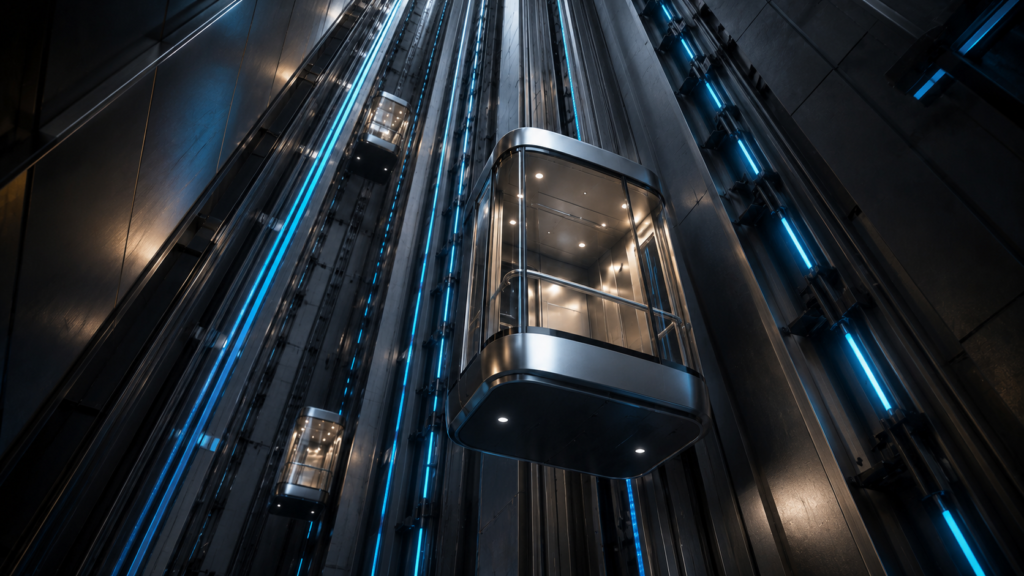
A cable-free, magnetically levitated lift cabin — the technology that could abolish the rope entirely, and with it the height limit.
What if the rope disappeared altogether? For more than a century and a half, every passenger lift has hung from a cable, and every limitation we have traced — the weight, the single-rise ceiling, one car per shaft — flows from that fact. The German engineering group thyssenkrupp, now TK Elevator, asked the obvious heretical question: what if a lift were driven not by a rope but by a magnetic field?
Their answer is MULTI, billed as the world’s first cable-free lift. It borrows the linear-motor, magnetic-levitation technology developed for the Transrapid high-speed train and turns it on its side, propelling each cabin up a track with no rope at all. Freed from the cable, the system does things a conventional lift cannot. Several cabins can run in a single shaft, one above another, circulating like carriages on a vertical metro line. Cabins can move horizontally as well as vertically, letting lifts turn corners and travel sideways through a building. And with no rope to grow heavy, there is no inherent height limit whatsoever.
| ▪ ENGINEERING PERSPECTIVE A vertical metro By putting multiple cabins in one shaft, MULTI can raise a shaft’s passenger capacity by up to half while cutting the space lifts occupy in a building — a direct assault on the tyranny of the core. Fewer, more productive shafts mean a slimmer core and more rentable space. thyssenkrupp built an entire 246-metre tower at Rottweil, in Germany’s Black Forest, purely to test such systems — an elevator laboratory disguised as a landmark, crowned by the highest public viewing platform in the country. |
It would be neat to report that the rope is already obsolete. It is not. Cable-free lifts remain rare, complex and costly, and after years of testing they have appeared in only a handful of real projects; the engineering of moving many independent cabins safely through one shaft, at speed, is formidable. For now, MULTI is a proof that the deepest assumption of the industry — that a lift must hang from a cable — is not a law of physics but a choice, and a choice that can be unmade. Whether the cable-free lift becomes the workhorse of the next century or a brilliant curiosity is one of the open questions of the field.
The Kilometre Club
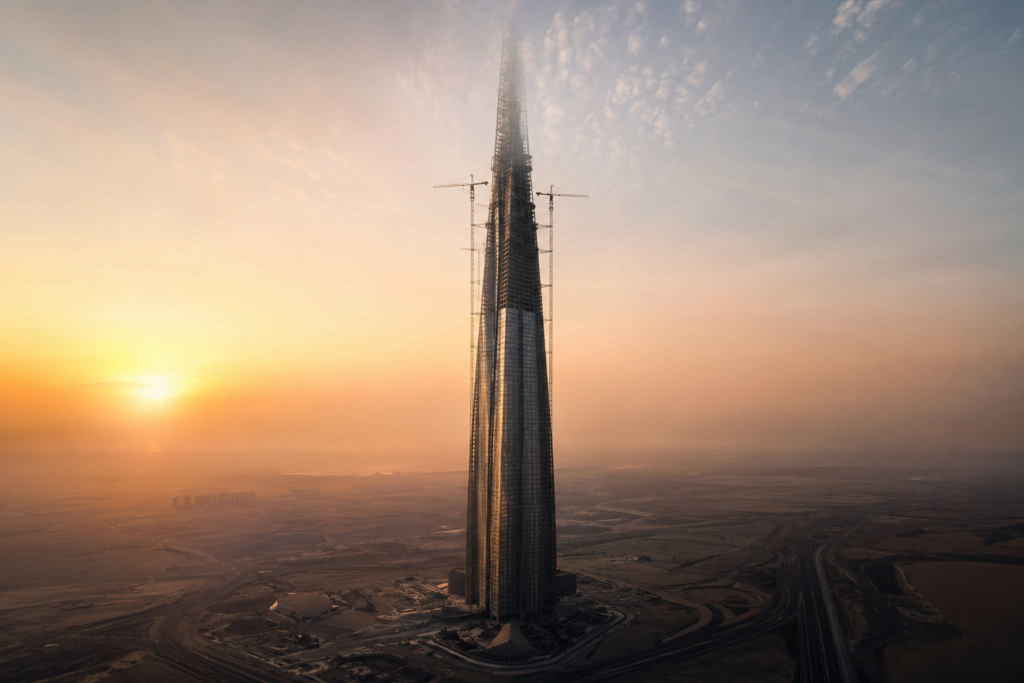
A kilometre-tall tower rises from the desert at dawn. To move people through it, its designers specified 57 lifts.
(Read our feature on the Gulf’s race to build the world’s tallest tower.)
All of this engineering exists to serve an ambition that is, at bottom, human rather than technical: the desire to build higher than anyone has built before. Nowhere is that ambition more concentrated today than on the Red Sea coast of Saudi Arabia, where the Jeddah Tower is rising toward a height no building has ever reached — at least 1,008 metres, the first structure designed to break the one-kilometre mark.
Its pedigree is telling. The tower was designed by Adrian Smith, the same architect who shaped the Burj Khalifa, and its three-petal footprint tapers as it climbs to shed the wind that batters any object a kilometre tall. Begun in 2013, it stalled for years amid financial and political upheaval before construction resumed in earnest in 2025; by 2026 it had climbed past its hundredth floor, with completion projected for the end of the decade. And to move people through a kilometre of building, its designers have specified 57 lifts, most of them from KONE — the clearest possible statement that at this height, vertical transport is not a detail but the central engineering problem. The tower is a monument to structure; it is also, unavoidably, a monument to the lift.
| ▪ GEOPOLITICAL PERSPECTIVE Why nations build tall — and why some stop Record height has always been about more than floor space. It is prestige rendered in steel: a way for a city or a state to announce arrival on the world stage. Saudi Arabia’s kilometre tower is inseparable from its Vision 2030 campaign to remake the kingdom’s economy and image. Yet the mood is not universal. In 2021, China — the world’s undisputed capital of skyscrapers — banned new buildings above 500 metres and tightly restricted those above 250, citing safety, cost and a distaste for “vanity” towers after incidents such as a Shenzhen high-rise that swayed alarmingly in the wind. The country that built most of the world’s giants decided, in effect, that enough was enough. |
The contrast frames a question the engineering alone cannot answer. Having established that we can build past a kilometre — that structure, rope and core can all, with enough money and will, be conquered — the harder question becomes whether we should. A supertall tower is spectacularly expensive per usable square metre, demands a small city’s worth of energy and water, and returns a shrinking slice of rentable space for every floor added. Beyond a certain height, the tower is no longer the most rational way to house people or work; it is a statement. That is not a criticism — civilisations have always built monuments — but it clarifies what the race for height now is. It is not a contest of what is possible. It is a contest of what is worth doing.
▪ THE WORLD’S FASTEST LIFTS
Guangzhou CTF Finance Centre 21 m/s (≈ 76 km/h)
Hitachi · World record; 95th floor in ≈ 42 s
Shanghai Tower 20.5 m/s
Mitsubishi Electric · Far slower on descent
Taipei 101 16.8 m/s
Toshiba · Held the record ≈ 12 years
Burj Khalifa ≈ 10 m/s
Otis · Holds the single-rise record: 504 m
The Ceiling Is a Choice
Return, finally, to the tower that stands sound but unreachable. We can now say precisely why it is a fantasy and not a wall. Its structure would hold; we have known how to brace great height for decades. What defeats it is the sum of smaller, stranger limits: a steel rope too heavy to lift itself past 500 metres; a core that devours the floors it is meant to serve; an inner ear that rebels above 24 metres a second; an economy that stops rewarding each new storey. None of these is the villain of popular imagination. All of them are quieter, and together they are decisive.
Each, too, is yielding — not to a single breakthrough but to a century of patient ingenuity. Carbon fibre lifts the rope’s ceiling. Sky lobbies and double-deck cars tame the core. Magnetic levitation threatens to abolish the cable entirely. The skyscraper advances the way most great engineering advances: not by defeating one grand obstacle but by out-thinking a dozen small ones, each of which had quietly assumed the role of the limit while no one was looking at it.
And so the deepest lesson of the tall-building era is a lesson about where limits really live. We assume the constraint is the obvious, heroic thing — the strength of the material, the power of the engine, the daring of the design. Again and again, it turns out to be the humble, overlooked thing: the box that carries you up, and the rope it hangs from. The machine that first unlocked the sky is the same machine that now guards the ceiling. To build higher, we have never needed only stronger walls. We have needed a better way to rise.
Final Reflection
The next time you stand at the foot of a great tower and tilt your head back, resist the old story that steel and concrete are what hold the record in check. Look instead at the discreet steel doors in the lobby, and the shafts rising unseen behind them.
We have always been able to build higher than we can comfortably climb. The true measure of a skyscraper was never how high its walls could stand — but how gracefully it could carry us to the top.
Timeline — The Race to Rise
1853 Elisha Otis patents the elevator safety brake and founds his company in Yonkers.
1854 Otis stages his rope-cutting demonstration at New York’s Crystal Palace — “All safe, gentlemen.”
1885 Chicago’s Home Insurance Building, an early steel-frame “skyscraper”, points the way upward.
1931 The Empire State Building reaches 381 metres, the tallest in the world for four decades.
1969 Fazlur Khan’s John Hancock Center introduces the sky lobby, taming the elevator core.
2004 Taipei 101 opens with the world’s fastest lifts (16.8 m/s), a title it holds for over a decade.
2010 The Burj Khalifa reaches 828 m; its 504-metre lift sets the single-rise record.
2013 KONE unveils UltraRope, a carbon-fibre rope enabling single runs up to 1 kilometre.
2017 thyssenkrupp opens its 246-metre Rottweil tower to test the cable-free MULTI lift.
2019 Guangzhou CTF Finance Centre lifts (21 m/s) take the world speed record.
2021 China bans new buildings above 500 m, curbing the supertall boom.
2025 Construction of the kilometre-tall Jeddah Tower resumes after a seven-year halt.
2028 (proj.) Jeddah Tower is expected to complete at ≈ 1,008 m — the first building past one kilometre.
Key figures
1850S
Elisha Graves Otis
Invented the safety brake that made passenger lifts — and thus skyscrapers — possible.
1960S–70S
Fazlur Rahman Khan
Structural engineer who devised the sky lobby and the tube frame, unlocking practical supertall height.
2000S–TODAY
Adrian Smith
Architect of both the Burj Khalifa and the kilometre-tall Jeddah Tower.
TODAY
Antony Wood
CTBUH leader and a leading voice on the limits and future of tall buildings.
Frequently asked questions
Why can’t skyscrapers just keep getting taller?
Because the practical limits are transport and economics, not structure. Conventional lift rope becomes too heavy past about 500 metres, and the lift shafts needed to serve a very tall building consume so much floor space that it stops being profitable. Engineers can design far taller frames than these constraints allow us to use.
What is the longest lift ride in the world?
The Burj Khalifa holds the record for the longest single lift travel at 504 metres. To reach floors above that, passengers transfer to another lift at a sky lobby, because a single steel-roped run cannot practically go much further.
What is the fastest lift in the world?
The lifts in the Guangzhou CTF Finance Centre in China, built by Hitachi, reach 21 metres per second — about 76 kilometres an hour — and hold the Guinness World Record. They travel more slowly downward, because falling air pressure is harder on the ears.
Will cable-free lifts replace ordinary elevators?
Possibly, in time. Magnetically levitated, rope-free lifts such as thyssenkrupp’s MULTI can put several cabins in one shaft and move sideways as well as up, with no height limit. But they remain rare and costly, and it is not yet clear whether they will become mainstream or stay a specialist solution.