




A single sentence written twenty-four centuries ago has become the reflex metaphor for the rivalry between the United States and China. It is memorable, it is elegant — and, read closely, it argues almost the opposite of what its popular fame suggests. A case for replacing a prophecy of fate with a working model of choice.
A phrase at the summit
When the leaders of the world’s two largest economies sat down together in Beijing in May 2026, the opening move was not a demand about tariffs or a warning about Taiwan. It was a history lesson. According to the account released by Chinese state media and reported widely, President Xi Jinping asked President Donald Trump whether their two nations could rise above the “so-called Thucydides Trap” and build a new pattern of relations between great powers. The phrase travelled around the world within hours.
There is a striking irony buried in that moment, and it is the reason for this essay. The Thucydides Trap has become the single most quoted idea in the modern conversation about American and Chinese power. It is invoked to warn that a rising state and an established one are pulled, almost mechanically, toward war. Yet the leader of the very power usually cast as the dangerous newcomer reached for the phrase not to announce that conflict was fated, but to insist that it could be avoided. He was using the metaphor against the fatalism most people hear in it.
That tension is worth taking seriously. The Thucydides Trap is a superb piece of intellectual packaging: vivid, ancient, easy to remember and frightening in the right measure. As an analytical model for understanding today’s international system, however, it is far weaker than its fame implies. It compresses a crowded, multi-sided contest into a duel between two figures. It leans on a translation that specialists regard as misleading. And it points toward a conclusion — the near-inevitability of war — that neither the ancient historian who lends it his name nor the modern scholar who coined it actually holds.
This is not an argument that the United States and China are safe from conflict, or that competition is benign. It is an argument about tools. A metaphor can illuminate a problem or it can flatten it, and when a metaphor starts doing the thinking for us, it is time to look for a better instrument. The aim here is to explain where the Thucydides Trap came from, what it gets right, where it strains, and what a richer framework for great-power rivalry might contain.

The making of a metaphor
The phrase is younger than it sounds. The image of a “Thucydidean trap” appears to have been used first not by a political scientist but by the novelist Herman Wouk, who reached for it around 1980 to describe the Cold War stand-off between Washington and Moscow. It entered the vocabulary of strategy through the work of Graham Allison, a political scientist at Harvard University and a founding dean of its Kennedy School. Allison introduced the term in a Financial Times article in August 2012, developed it in a widely read essay in The Atlantic in 2015, and gave it a book-length treatment in 2017 with Destined for War: Can America and China Escape Thucydides’s Trap?

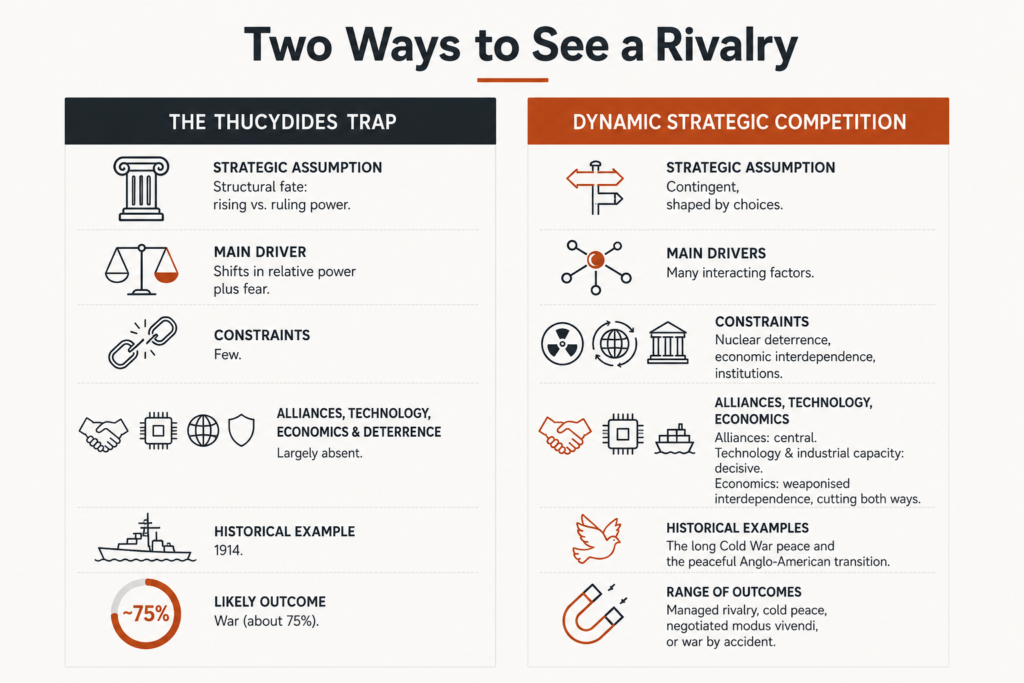
Allison’s starting point is a line from the Athenian historian Thucydides, who chronicled the long war between Athens and Sparta in the fifth century before the common era. In the translation Allison favours, Thucydides identifies the truest cause of that war as the growth of Athenian power and the fear it aroused in Sparta, which “made war inevitable”. From this, Allison draws a general proposition: when a rising power threatens to displace a ruling one, the resulting structural stress makes violent conflict far more likely than not.
To test the claim, Allison and his team at Harvard’s Belfer Center assembled a case file of sixteen rivalries over the past five hundred years in which a rising power challenged an established one. By their reckoning, twelve of those sixteen ended in war and four did not — a figure often rendered as a seventy-five per cent rate of conflict. That single statistic is what gives the idea its grip. It converts an ancient anecdote into what looks like a law of history, and it lands with particular force when the two powers in question are the United States and China.
The phrase converts an ancient anecdote into what looks like a law of history.
It helps to place the idea in its intellectual family, because Allison did not invent the underlying concern. The notion that shifting power balances breed instability has a long pedigree in the study of international relations. The political scientist A. F. K. Organski set out a “power transition” theory in his 1958 textbook World Politics, and refined it with Jacek Kugler in The War Ledger in 1980, arguing that the danger of great-power war peaks as a challenger approaches parity with the dominant state. Robert Gilpin’s work on hegemonic change developed a related account. The Thucydides Trap is best understood as a memorable popularisation of this older, more careful literature — which is both the secret of its success and the source of its problems.

What the model gets right
It would be lazy to dismiss an idea this influential, so it is worth being precise about its genuine strengths. The Thucydides Trap endures because it captures something real. Rapid shifts in relative power do generate friction. A rising state tends to want more say, more status and more room to shape the rules; an established state tends to read those demands as threats to an order it built and benefits from. Each side’s defensive moves can look offensive to the other. This is the classic security dilemma, and Thucydides described its emotional core — the interplay of interest, honour and above all fear — with a clarity that has rarely been bettered.
The model is also pedagogically powerful. It gives non-specialists a handle on an abstract danger, and it does so without cartoonish villains: in Allison’s telling, war often arrives not because a leader wants it but because a third-party crisis, a miscalculation or an accident drags two wary giants past the point of retreat. The First World War, which grew from a Balkan assassination into a continental catastrophe that few of its participants had chosen, is the case that gives the framework its darkest resonance. As a warning against complacency — against the assumption that because a great-power war would be ruinous, it therefore cannot happen — the Thucydides Trap performs a real service.
Crucially, Allison himself is more careful than the slogan that bears his name. He has repeatedly stressed that war is not inevitable; his book is written as a warning designed to be heeded, not a forecast offered with resignation. Its recurring question — can war be escaped? — presumes that escape is possible. The four peaceful cases in his own file are there precisely to show that the trap can be avoided. The problem, then, is less with Allison’s nuanced argument than with the deterministic caricature the phrase invites once it leaves his hands.
Where the model strains
Begin with the foundation, because it is shakier than most readers assume. The famous line about war being “inevitable” rests on a translation that many classical scholars consider inaccurate. Allison draws on the accessible Victorian rendering by Richard Crawley; specialists point out that the Greek verb in the passage carries the sense of being compelled or constrained, so that a more literal reading is closer to “compelled the Spartans to war”. The distinction is not pedantry. “Inevitable” suggests a fate no one could avert; “compelled” describes a pressure that human beings, feeling it, still had to decide how to answer.
The classical scholarship here is unusually pointed. Writing in the Journal of Chinese Political Science, one specialist argued that the Thucydides Trap finds no support even in the case that gave it its name, and that Thucydides’ reference to “the growth of the power of Athens” concerned the expansion of the Athenian empire rather than an abstract shift in the balance of capabilities. Other scholars have drawn attention to a distinction Thucydides himself makes between the deep cause of a war and its immediate pretexts — a subtlety the modern slogan erases entirely. Read whole rather than in a single sentence, the History of the Peloponnesian War is not a treatise on inevitability at all. It is a study of choices: of debates held and votes taken, of leaders who misjudged and cities that could have chosen otherwise.
Thucydides did not write a theory of fate. He wrote a study of choice.
A second difficulty is methodological, and here the critics have been vigorous. To count sixteen cases and derive a seventy-five per cent rate of war is to imply a rigour the exercise cannot really support. Scholars have questioned how the cases were chosen, noting that selecting only pairs already identified as “rivals” builds the conclusion into the sample. They have pointed to the vagueness of the key terms: what exactly counts as a “rising” or a “ruling” power, and at what threshold does a challenge begin? And they have argued that the model omits the variables that most shape whether rivalry turns to war. In a 2021 essay, the political scientist Steve Chan catalogued precisely these concerns — selection bias, measurement problems and underspecified causal mechanisms — as reasons the analogy misinforms more than it clarifies. None of this proves the underlying worry wrong. It does mean the tidy statistic should be read as an illustration, not as evidence.
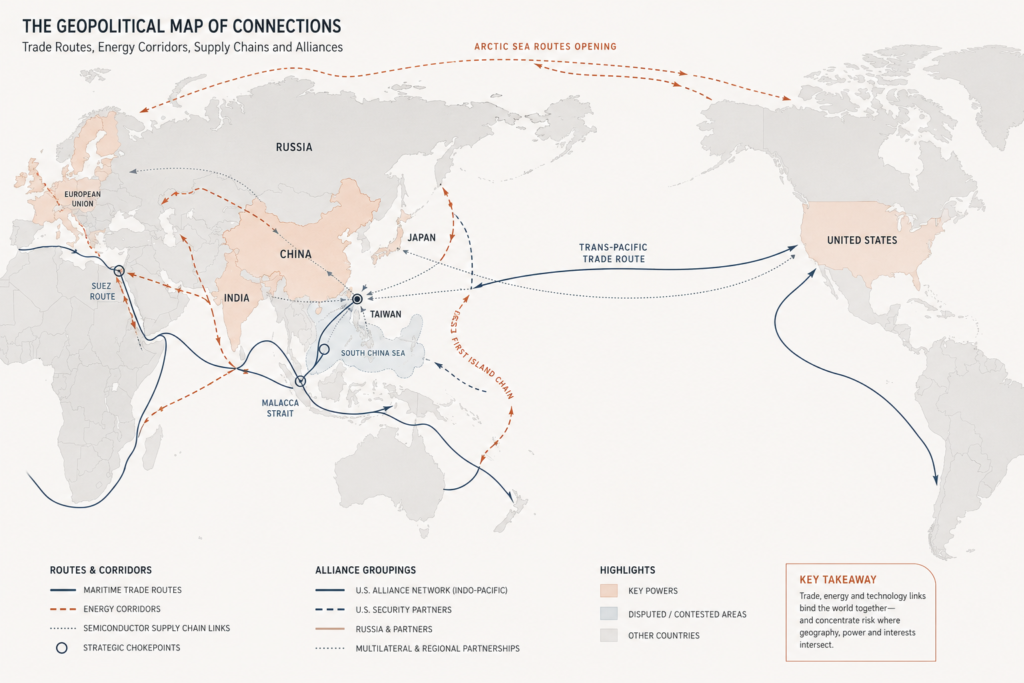
The third and deepest problem is structural. The Thucydides Trap is a two-body model in a many-body world. It asks us to watch a rising power and a ruling power and little else. But the contest of the 2020s is not a duel on an empty stage. It runs through the European Union and Russia, through India and Japan, through NATO and the ten states of ASEAN, through a dense web of alliances, markets, institutions and supply chains that did not exist in the Aegean and that change the physics of the confrontation. A framework that treats these as background noise mistakes the character of the competition it claims to explain.
There is even open disagreement about the premise itself — whether China seeks to displace the United States at all. In a much-debated 2025 study in the journal International Security, David C. Kang, Jackie S. H. Wong and Zenobia T. Chan analysed more than twelve thousand articles from China’s official press and hundreds of Xi Jinping’s speeches and concluded that Beijing behaves less like a would-be global hegemon than like a status-quo power preoccupied with regime stability and a set of aims they describe as limited and enduring, centred on its borders and sovereignty. The finding is contested — critics reasonably note that official rhetoric is an imperfect guide to intentions, and that a state’s capabilities may matter more than its stated goals. But the very fact that serious scholars dispute whether the “rising challenger” is trying to overturn the order shows how much the Thucydides Trap takes for granted before its clock even starts.
A better instrument: dynamic strategic competition
If a single lever — the shifting balance of power — cannot carry the weight, what should replace it? Not another slogan, but a checklist of the forces that actually determine whether a rivalry stays cold. Think of it less as a prophecy and more as a dashboard: a set of dials that push toward conflict or restraint, and that leaders can turn. Several dials matter more than the raw power gap the Thucydides Trap fixes upon.
Deterrence, especially the nuclear kind
The most important fact about a possible war between the United States and China is one the ancient analogy cannot contain: both are nuclear-armed. Athens and Sparta could imagine winning. A direct war between nuclear powers threatens losses so total that victory loses meaning, and that grim arithmetic has, so far, imposed a caution on great powers that no fifth-century general would recognise. Deterrence is not a guarantee — it can fail through miscalculation, and it can be tested at the edges by proxy conflicts and brinkmanship — but any model that leaves it out is describing a different, and more dangerous, world than the one we inhabit.
Economic interdependence — and its weaponisation
Athens and Sparta did not assemble each other’s smartphones. The United States and China are woven together by trade, investment and supply chains to a degree that both restrains and endangers them. Interdependence raises the cost of conflict, giving each side a powerful material reason to avoid a rupture. Yet the same linkages have become instruments of pressure — what scholars call weaponised interdependence. The story of the past few years is largely the story of both powers discovering the chokepoints they hold over the other, and reaching for them.
The clearest example is the trade in critical minerals. China refines roughly nine-tenths of the world’s rare-earth elements and manufactures the overwhelming majority of the high-performance magnets that depend on them, even though it mines a smaller share of the raw ore. In 2025 Beijing repeatedly tightened export licensing on these materials and the technologies used to process them, extending its reach to re-exports abroad, before pausing some of the measures late in the year while keeping the licensing architecture in place. The mirror image is the American-led effort to deny China the most advanced semiconductors and the tools to make them. Here Taiwan sits at the centre of the world economy: a single firm, TSMC, accounted for close to seventy per cent of global foundry revenue in 2025 and produces the great majority of the most advanced logic chips on Earth. Each side, in other words, has learned that it can hurt the other without firing a shot — a form of competition the Thucydides Trap does not describe, because it did not exist.
Each side has learned it can hurt the other without firing a shot.
Alliances and the shape of the board
Alliances are the great amplifier, and they cut both ways. They can restrain a rivalry by reassuring nervous states, deterring adventurism and giving each side confidence that it need not act rashly to secure its position. They can also enlarge a rivalry, turning a local incident into a general crisis — the very mechanism that consumed Europe in 1914. The United States sits at the centre of a web of treaty commitments in Europe and Asia and of newer groupings such as the Quad and the AUKUS submarine partnership; NATO has grown to thirty-two members. China’s alignments are looser but real, most consequentially its deepening partnership with Russia. Whether this architecture makes war more or less likely is not fixed. It depends on how clearly commitments are drawn and how carefully they are managed — which is to say, on choices.
Technology, industry and the sinews of power
Modern competition is fought as much in laboratories and factories as on parade grounds. Leadership in artificial intelligence, the security of cyberspace, the race in space, and above all the capacity to design and manufacture advanced semiconductors have become measures of national strength in their own right. So has raw industrial capacity — the ability to build ships, munitions and infrastructure at scale, an area where the balance has shifted markedly. These contests are continuous and mostly non-violent, and they reward investment, education and openness more than they reward mobilisation. A framework built around a single decisive clash misses a rivalry whose most important battles are measured in patents, production lines and standards.
Geography, the sea and strategic ambiguity
Finally, geography still shapes strategy. Much of the friction between Washington and Beijing is maritime — in the South China Sea, along the first island chain, and increasingly across newly navigable Arctic routes — because control of sea lanes translates directly into economic and military reach. Over the flashpoint of Taiwan, the United States has long practised a deliberate strategic ambiguity, leaving its exact response to an attack unstated in the hope of deterring both a Chinese assault and a unilateral bid for independence. Ambiguity is a tool of statecraft with no place in a model of fate; that it remains central to the most dangerous question in the relationship is itself a reminder that human judgement, not structural destiny, holds the wheel.

Which histories actually travel
If 1914 is over-used, are there better historical companions for the present? Two from Allison’s own file repay attention, precisely because they did not end in war.
The first is the peaceful passing of primacy from Britain to the United States around the turn of the twentieth century. A declining power chose, over time, to accommodate a rising one rather than to resist it to the last — trading short-term precedence for a durable partnership. The case is instructive without being a template: the two shared a language, a broadly liberal order and, before long, common enemies, advantages the United States and China plainly lack. But it demonstrates that a transition of power need not be settled by arms, and that the ruling power’s statecraft is part of what decides the outcome.
The second, and perhaps the more apt, is the Cold War itself — the very rivalry for which the “Thucydidean trap” image was first coined. For more than four decades two nuclear-armed superpowers waged an intense, global, ideological struggle that repeatedly brought them to the brink, yet never to direct great-power war. It was expensive, frightening and punctuated by proxy conflicts and near-misses; it was also, in the end, resolved without the catastrophe that many had thought unavoidable. As an analogy for a protracted, managed, nuclear-shadowed competition, the Cold War arguably fits the US–China case better than the headlong slide of 1914 — a point several strategists have made. Historical analogies are aids to thought, not proofs; the honest use of them is to hold several in mind at once and to notice where each breaks down.
A transition of power need not be settled by arms. Statecraft is part of the outcome.
The present landscape
Seen through the wider lens, the contest of the mid-2020s looks less like a countdown and more like a landscape of managed friction. The economic dimension has been the most active front. The tariff confrontations and technology restrictions of recent years, the American controls on advanced chips and the Chinese controls on rare earths, are best understood not as steps toward war but as a new grammar of coercion — pressure applied through interdependence rather than across a battlefield. That such measures can be imposed, escalated and then partly suspended, as the rare-earth controls were late in 2025, is itself evidence of a relationship with more brakes than the trap metaphor allows.
The military dimension is real and sharpening. China has modernised its forces and built the world’s largest navy by number of hulls; the United States is reorienting its posture toward the Pacific and deepening its alliances there. The flashpoints — Taiwan above all, but also the South China Sea and the seas around Japan — are genuine, and an accident or a misjudgement at close quarters remains the likeliest path to a shooting war. Yet the same period has also seen summitry, crisis-management channels and, as the Beijing meeting showed, leaders publicly reaching for the language of avoidance. Both truths hold at once. Danger and restraint are not taking turns; they coexist.
Around the two principals, other powers are not spectators. India pursues its own rise and guards its autonomy; Japan is rearming within its constitutional limits; the European Union hedges between its largest security partner and its largest trading one; Russia’s war in Ukraine has bound it more tightly to Beijing while draining its own strength. The system is multipolar in fact even where it is bipolar in rhetoric, and that plurality is a source of both instability and ballast. It creates more places for a crisis to start, and more actors with an interest in preventing one from spreading.

Futures, not fate
Because the honest answer to “what happens next” is that no one knows, the useful exercise is not prediction but the mapping of plausible paths — each the product of decisions rather than of destiny. Several are worth holding in mind.
— Managed rivalry. The most likely near-term path is managed rivalry: sustained competition across trade, technology and military posture, punctuated by crises that are contained short of war because both sides judge the costs of escalation intolerable. This is a demanding, unglamorous equilibrium that requires constant maintenance.
— Cold peace. A cooler variant is a durable cold peace — a hardening of the relationship into rival blocs with limited contact, more predictable but poorer and more brittle, as decoupling raises the price of every shock.
— A negotiated understanding. A more hopeful path is a negotiated modus vivendi, in which clearer rules on the most dangerous issues — Taiwan, incidents at sea, cyber conduct — lower the risk of accidental collision without pretending the rivalry away.
— War by accident. And the path everyone fears is war by accident: not a chosen war but a crisis — a collision, a miscalculation over Taiwan, a cyber incident read as an attack — that escalates faster than leaders can climb down. This is the scenario the Thucydides Trap rightly warns against, and it is the strongest reason to take the metaphor’s underlying anxiety seriously even while rejecting its fatalism.
What separates these futures is not the size of the power gap. It is the quality of judgement, the clarity of signalling, the strength of the guard-rails and the discipline of leaders under pressure. Those are variables, not constants — which is exactly why treating war as fated is not merely inaccurate but dangerous. A belief in inevitability can become self-fulfilling, licensing the very hardening and pre-emption it claims only to describe.
A belief in inevitability can become self-fulfilling.
What policymakers might take from this
Several practical lessons follow from trading the trap for a dashboard.
— Structural pressure is real, but it is a force to be managed, not a verdict to be accepted. Naming a dynamic “inevitable” surrenders the agency that history shows leaders actually possess.
— The dials that most reduce the risk of war — credible deterrence, open crisis-management channels, restrained signalling, and guard-rails on the sharpest flashpoints — are precisely the ones a two-body power-transition model tends to ignore.
— Economic interdependence is neither a guarantee of peace nor merely a vulnerability. It is a source of leverage that both restrains and endangers, and it should be governed deliberately rather than left to escalate by reflex.
— Alliances must be managed with as much care as adversaries. The same commitments that deter can also entrap; clarity about what they cover, and what they do not, is a safety measure in its own right.
— Analogies are tools, not oracles. The prudent practice is to keep several histories in view — 1914, the Cold War, the Anglo-American transition — and to attend to where each one fails, rather than to let a single vivid story do the reasoning.

The mirror, not the map
Return, finally, to that summit in Beijing and its quiet irony. A phrase built to warn of inevitability was used to argue that nothing is inevitable at all. That is the paradox at the centre of the Thucydides Trap, and it is why the metaphor deserves respect even as the model deserves retirement. Thucydides did not compose a theory of fate. He wrote the first great study of how proud, frightened, calculating human beings talk themselves into catastrophes they might have avoided — and, occasionally, talk themselves out of them. Read that way, his history is not a trap sprung by structure. It is a mirror held up to judgement.
The competition between the United States and China is serious, dangerous and likely to define the century. It deserves better than a single borrowed sentence standing in for analysis. A framework that weighs deterrence and interdependence, alliances and technology, geography and diplomacy, and that treats the outcome as the sum of choices rather than the dictate of destiny, is harder to fit on a book jacket. It is also far closer to the truth. The value of the old metaphor, in the end, is not that it tells us what will happen. It is that it asks whether we are paying attention — and leaves the answer to us.
Key takeaways
— The Thucydides Trap is a vivid metaphor but a weak analytical model: it compresses a multipolar contest into a two-body duel and points toward a fatalism its own sources do not support.
— Graham Allison coined the term (Financial Times, 2012; The Atlantic, 2015; book, 2017), finding war in 12 of 16 historical power-transition cases — a statistic critics say reflects selection and definitional choices.
— Classical scholars regard the “made war inevitable” translation as misleading; Thucydides’ own history emphasises choice, not destiny.
— A richer framework — “dynamic strategic competition” — weighs nuclear deterrence, economic interdependence and its weaponisation, alliances, technology and industry, maritime geography, strategic ambiguity and diplomacy.
— The Cold War and the peaceful Anglo-American transition may travel better than 1914 as analogies for a protracted, nuclear-shadowed rivalry.
— Outcomes turn on judgement, signalling and guard-rails — variables leaders control — which is why treating war as inevitable is both inaccurate and, potentially, self-fulfilling.
Did you know?
— The image of a “Thucydidean trap” appears to have been used first by the novelist Herman Wouk, around 1980, to describe the US–Soviet Cold War — decades before it entered strategic studies.
— Allison’s own case file contains four rivalries that did not end in war, including the peaceful handover of primacy from Britain to the United States.
— At a 2015 event Xi Jinping rejected the idea outright, suggesting that great powers create such “traps” for themselves through strategic miscalculation — an agency-centred reading.
Timeline
— c. 431–404 BCE. Thucydides writes the History of the Peloponnesian War, including the line later adopted as the model’s foundation.
— c. 1980. The novelist Herman Wouk uses a “Thucydidean trap” image for the Cold War stand-off.
— August 2012. Graham Allison introduces the phrase in the Financial Times.
— 2015. Allison’s essay “The Thucydides Trap” appears in The Atlantic; Xi Jinping publicly rejects the idea during a US visit.
— 2017. Destined for War is published, popularising the sixteen-case study.
— Summer 2025. “What Does China Want?” (International Security) challenges the premise that China seeks global hegemony.
— 2025. China escalates and then partly suspends rare-earth export controls; US chip restrictions continue.
— May 2026. At a Beijing summit, Xi asks Trump whether the two powers can escape the “so-called Thucydides Trap”.
References and further reading
Allison, G. (2012, August 21). Thucydides’s trap has been sprung in the Pacific. Financial Times.
Allison, G. (2015, September 24). The Thucydides trap: Are the U.S. and China headed for war? The Atlantic.
Allison, G. (2017). Destined for war: Can America and China escape Thucydides’s trap? Houghton Mifflin Harcourt.
Belfer Center for Science and International Affairs. (n.d.). Thucydides’s Trap case file. Harvard Kennedy School.
Chan, S. (2021). Why Thucydides’ trap misinforms Sino-American relations. Vestnik RUDN. International Relations, 21(2), 232–242. https://doi.org/10.22363/2313-0660-2021-21-2-232-242
Kang, D. C., Wong, J. S. H., & Chan, Z. T. (2025). What does China want? International Security, 50(1), 46–81. https://doi.org/10.1162/ISEC.a.5
Novo, A. R. (2016). Where we get Thucydides wrong: The fallacies of history’s first “hegemonic” war. Diplomacy & Statecraft, 27(1), 1–21. https://doi.org/10.1080/09592296.2016.1137730
Organski, A. F. K. (1958). World politics. Alfred A. Knopf.
Organski, A. F. K., & Kugler, J. (1980). The war ledger. University of Chicago Press.
Thucydides. (1874). History of the Peloponnesian War (R. Crawley, Trans.). [Original work composed c. 431–404 BCE].